


Part 129. The Crowfoot Series - Various Plant Groups
Description
This section is from the book "Plants And Their Uses - An Introduction To Botany", by Frederick Leroy Sargent. Also available from Amazon: Plants And Their Uses; An Introduction To Botany
Part 129. The Crowfoot Series - Various Plant Groups
Part 129. The crowfoot series (Archichlamydeae). A general view of all the orders which we have thus far studied shows them to agree (with but rare exceptions) in having no coalescence among the petals. All the leaf-parts of any flower are at first similarly distinct as they arise in the bud. Sometimes petals do not appear at all, but when they do it is as distinct projections from the torus, comparable to the first rudiments of foliage leaves as they form near the tip of a developing shoot. The same is true of sepals, stamens, and carpels, as illustrated in Figs. 298, 299 I. If, however, a gamosepalous calyx, a monadelphous andrcecium, or a compound pistil is to be produced, it happens sooner or later that those parts of the ring which connect the original projections begin to grow and the distinct parts are carried up on the rim or the tip of a tube or united mass of organs.
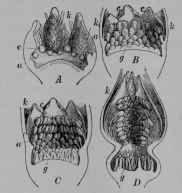
Fig. 298.-Flower of Rose (Rosa alpina, Rose Family, Rosacea) in early stages, cut vertically and enlarged. A, the sepals (k) are well developed, but the petals (c) and the stamens (a) are just appearing as minute knobs. B, sepals, petals, and stamens further advanced; and the pistils (g) just appearing as knobs on the dome of the stem-tip. C, later stage. D, still later stage in which the parts are still developing in the bud. (Payer.)
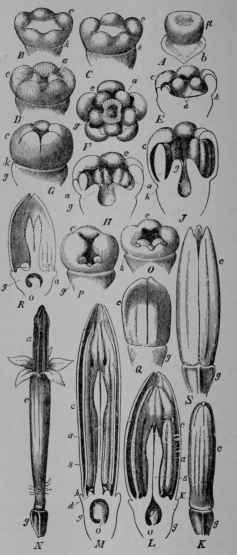
Fig. 299, I.-Flower of Oxeye (Heliopsis scabra, Sunflower Family, Compositoe). A-N, stages in the development of a tubular floret, enlarged. A, very young stage in which the flower ( ft) is as yet without petals but is plainly distinguishable from its bract (b). B, shows the ringlike swelling (k) which represents the calyx, and five knobs (c) which are the beginnings of petals. C, a somewhat more advanced stage, just before the appearance of stamens. D, showing the stamens (a) just appearing. E, same stage as D, cut vertically. E, later stage in which the beginnings of two carpels (g) appear. G, same stage, viewed from the side, showing that the petals or corolla lobes have curved inward protectively and are united below by a ring of tissue which by upward growth becomes the corolla-tube bearing the five lobes above. H. same stage, cut vertically; showing the upward growth of the carpels (g) leaving a hollow in the stem-tip (torus). J, later stage, cut vertically through the middle of the carpels (g) showing a deepening of the hollow in the torus. K, bud of middle age, showing the corolla-tube (c) with its five lobes well developed, and lower part of the pistil (g), enveloped by the torus, becoming plainly distinct as an "inferior ovary." L, a somewhat later stage, cut vertically, showing the appearance of two styles (s), still distinct, and a young ovule (o) with its outer coat half-grown. M, bud almost ready to open; the two styles having grown into one (s); the anthers (a) joined into a tube; the sepals (k) distinct prominences on the top of the torus, a nectar-gland (d); and the ovule (o) completely formed. N, Tubular floret, open, showing anther-tube (a), corolla-tube (c), and inferior ovary (g). O-S, stages in the growth of a ray-floret. O, very early stage in which five petal-lobes appear, three of which, however, are distinctly larger than the other two. P, later stage in which the three larger lobes (c) have become much larger, while the two smaller ones have remained undeveloped. Q, ray-floret about half-grown, showing two of the three petal-lobes separate to the base. R, same, cut vertically between the two separate petals, showing the union of the middle one (at the left) with one of the other two which together with the middle one are to form the strap-shaped corolla. S, somewhat later stage showing the three lobes of the strap-shaped corolla (c) and the inferior ovary (g). (Payer.)-A perennial herb about 1 m. or more tall; resembling a sunflower. Native home, Eastern United States; familiar in gardens.
Flowers which as they develop retain the original distinctness of their petals, or which develop none at all, are termed archichlamydeous.l Such flowers, we have seen, characterize the crowfoot series which includes all the orders we have studied and a number of others resembling them in the peculiarity noted.
1 Ar"chi-chla-myd'e-ous - Gr. archi, first; chlamys, mantle; implying that the corolla, likened to a mantle, retains its original condition,
Continue to:


My Books

