


Part 57. Non-Alcoholic Beverages
Description
This section is from the book "Plants And Their Uses - An Introduction To Botany", by Frederick Leroy Sargent. Also available from Amazon: Plants And Their Uses; An Introduction To Botany
Part 57. Non-Alcoholic Beverages
Part 57. Non-alcoholic beverages include those made from unfermented fruit juices, as, for example, lemonade; those made with syrups flavored with various essences, such as soda water mixtures; and those made by steeping the dried leaves of the tea-plant (Fig. 149), or boiling the prepared seeds of coffee (Fig. 150) or cacao (Fig. 115). The plants yielding fruit juices or flavoring matters used for beverages, have already been sufficiently described for our present purpose.
Tea, coffee, and cacao agree in each containing a crystalline constituent which belongs to the class of substances known as alkaloids. That of tea has been called theine, of coffee caffeine, and of cacao theobromine. Theine and caffeine have been found by chemists to be identical, and to differ but slightly from theobromine.
Alkaloids differ chemically from oils and carbohydrates in containing nitrogen, and are distinguished from other nitrogenous substances by the fact that alkaloids form combinations with various acids in much the same way that ammonia and other alkalis will do. Among alkaloids are included some of the most powerful poisons known and some of the most valuable medicines. Caffeine acts as a poison when taken in more than small amounts. Even in minute quantity it often has upon the nervous system a marked effect, which may be injurious or beneficial according to circumstances. The coffee "bean" contains about 0.5-2% of caffeine, dried tea leaves about 1-3%. Theobromine, of which there is about 1.5% in the cacao seed, is found to be scarcely soluble in the fluids of the body, and thus exerts little if any effect.
The most active constituent of each of the three beverage plants we are considering is the aromatic substance to which its peculiar flavor is due. In black tea there is about .5%, and in green tea about 1% of a volatile oil which is mainly developed during the curing or preparation of the leaves for market. The commercial value of a tea depends mainly upon the flavor imparted by its volatile oil. This flavor is carefully tested by experts who are known as "tea-tasters," although curiously enough they smell rather than taste the samples submitted to them. Even so, the effect of the volatile oil upon the nervous system is so powerful as to cause giddiness and headache if the "tasting" be continued more than a few hours a day; and it is said that the most vigorous cannot pursue the work for many years without suffering serious consequences. The peculiar aroma of coffee is not found in the raw "bean" but is developed during the process of roasting; that of cacao arises during the process of fermentation which the seeds undergo before they are ready for market. In coffee the aromatic constituent is hardly as powerful as in tea, while in cacao it is so mild that vanilla and various spices are added as flavoring to make chocolate.
Finally, mention must be made of an astringent constituent belonging to the class of substances known as tannins. This forms about 10% of dry tea leaves. It is similar to the substance extracted from bark for tanning leather. Black ink is commonly made by combining tannin with a substance containing iron, When taken with food in considerable quantities this astringent interferes with digestion. Prolonged boiling extracts it in large amount from tea leaves; consequently tea so prepared is most injurious. Steeping for a short time, on the contrary, removes but little of the tannin, while it extracts practically all of the exhilarating and aromatic constituents. A small amount of a tannin-like substance is found also in coffee, and in cacao. Cacao, although used as a beverage, is so nutritious that it should be regarded rather as a food than as a food-adjunct.
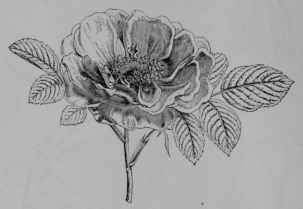
Fig. 148, II.-French Rose (Rosa gallica, Rose Family, Rosacece). (BailIon.)-Shrub about 1.5 m. tall; leaves hairy beneath; flowers pink to crimson; fruit brick-red. Native home, Middle and Southern Europe, and Western Asia. This species crossed more or less with others is the principal source of "attar of roses."
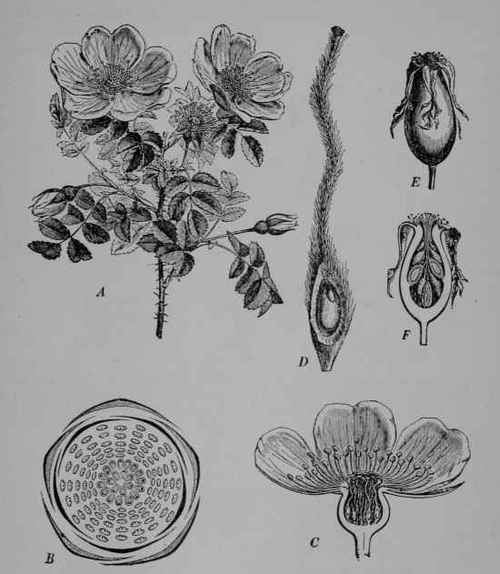
Fig. 148, III.-Scotch Rose (Rosa spinosissima, Rose Family, Rosaceoe). A, flowering branch. B, floral diagram. C, flower, cut vertically. D, pistil, with ovary cut open to show the single ovule within. E, fruit entire. F, same, cut vertically, to show the nutlets enclosed by the fleshy urn-like expansion of the flower-stalk which bears the other floral parts around its rim. (Baillon.)-Shrub about 1 m. tall, very prickly; flowers pink, white, or yellowish; fruit black. Native home, Eurasia. Although this species is not used for making attar it is here included as showing the floral structure more clearly than the more highly cultivated French rose.
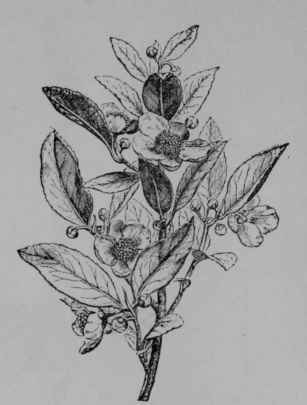
Fig. 149, I.-Tea (Thea sinensis, Tea Family, Theaceoe). Flowering branch (Baillon.)-A shrub or tree growing 10 m. tall; leaves evergreen; flowers white, fragrant; fruit dry. Native home, China and India.

Fig. 149, II.-Tea. A, flower, entire. B, flower, cut vertically. C, floral diagram. D, fruit. E, seed, entire. F, same, cut vertically. (Baillon.)

Fig. 150.-Coffee (Coffea arabica, Madder Family, Rubiaceoe). Plant, showing general form. Flower entire, and cut vertically. Fruiting branch. (Baillon.) A small tree growing about 6-8 m. tall; leaves evergreen, glossy; flowers creamy white, delicately fragrant; fruit a crimson berry. Native home, Abyssinia, Mozambique, and Angola.
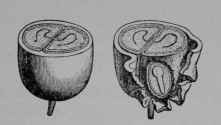
Fig. 150, I.-Coffee. Fruit, cut across to show the two seeds (the "coffee beans" of commerce). Same, with lower part removed to show position of the embryo. (Baillon.)
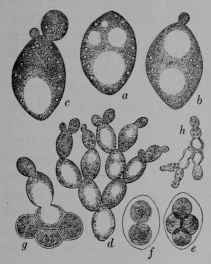
Fig. 151.-Yeast (Saccharomyces cerevisice, Yeast Family, Saccharomycetaceoe). a, a single beer-yeast plant; greatly magnified; b, same sending forth a bud-like protrusion; c, same with bud more developed and a second one appearing; d, a colony produced by such budding without separation; e, a yeast plant divided into four within the enveloping wall; f, a plant dividing into two, each with a wall of its own, and thus able to resist adverse conditions for a long while; g, a cluster of four such resistant plants, one of which upon the return of favorable conditions is producing a budding colony; h, such a colony farther advanced. (Luerssen, Reese.)-Beer yeast, the form here shown- used not only for beer but for bread-is not found wild; but the closely similar wine yeast occurs regularly upon the surface of grapes and (in its resistant form in the soil of vineyards) so does not have to be added to the grape "must" in making wine. The plant is very pale brown or colorless.
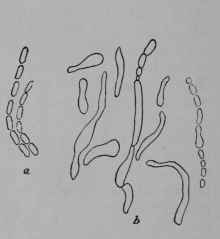
Fig. 152.-Vinegar Ferment (Bacterium aceti, Rod-germ Family, Bacteriaceoe). a, ordinary form of plant, grouped into chain-like colonies, b, an irregular form occurring under very adverse conditions. (Migula.) -The plants are colorless, and form about themselves a mass of jelly which constitutes the "mother" of vinegar.
Continue to:


My Books

