


119. Eucalyptus Woollsiana
Description
This section is from the book "A Research On The Eucalypts Especially In Regard To Their Essential Oils", by Richard T. Baker, Henry G. Smith. Also available from Amazon: A Research On The Eucalypts And Their Essential Oils.
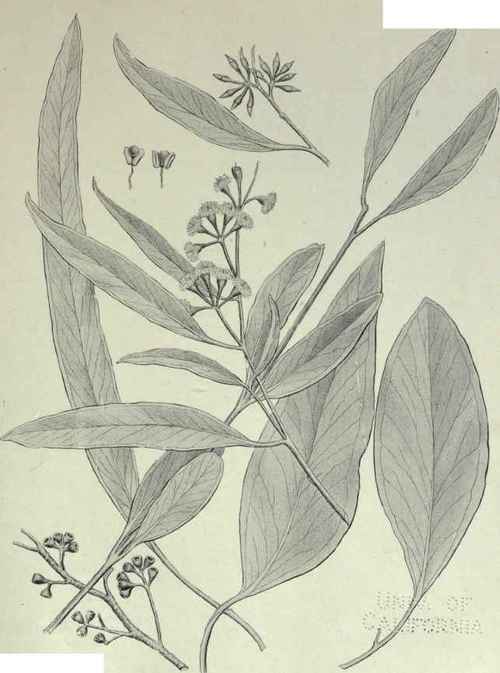
119. Eucalyptus Woollsiana
(R.T.B., Proc. Linn. Soc, N.S.W., 1900, p. 684, t. XLIII.) Mallee Box.
Systematic. - A large tree, up to 80 feet high, and more than 3 feet in diameter. Bark persistent half-way or more up the trunk, smooth, chiefly of a rich brown colour. Abnormal leaves lanceolate, alternate, 2 to 3 inches long, 6 to 9 lines broad. Normal leaves under 6 inches long, on a petiole less than 6 lines long, narrow-lanceolate, tapering to a fine recurved point, mostly of a thin texture, of a light-yellowish green, generally shining; venation slightly obscured, impressed on the upper surface, lateral veins few, intramarginal vein removed from the edge. Peduncles axillary, from 2 to 12 lines long. Flowers few. Calyx tube about 1 line in diameter, tapering into a short stalk; operculum hemispherical, acuminate, and often more obtuse than shown in the plate.
Fruit. - Mostly pear-shaped, only occasionally hemispherical; rim thin, slightly contracted; valves not exserted; about 3 lines in diameter.
The fruits greatly resemble: those of E. polybractca, but differ in shape from most of those of other "Boxes" such as E. hemiphloia and E. odorata.
Habitat. - Girilambone, Cobar, Trangie, Nyngan, Murga, New South Wales; also interior of Victoria.

REMARKS. - The tree is a half-barked "Box," and allied in bark, timber and oil to other cognate "Box" trees. The leaves have not a shining surface as obtains in E. populilolia, F.v.M., and E. Behriana, F.v.M. It differs from E. microtheca in the valves of the fruits not being exserted, in the colour of the wood, and in the bark, and chemical constituents. From E. hemiphloia it differs in the nature of its timber, buds and leaves; from E. bicolor, A. Cunn., in the venation and shape of the leaves, the shape of the fruits and constituents of the oil, and particularly in its timber. It also has a more erect habit than E. bicolor, E. populifolia has much wider leaves and a different venation, but the barks of the species are similar. It is usually associated with E. populifolia, with the green "Mallee" E. viridis, R.T.B., and with the "Grey Mallee" E. Morrisii, R.T.B., on which account it is called Mallee Box." It is never seen as a "Mallee," and as a result of inquiries it appears that it does not grow in that form The fruits at once differentiate it from E. albens, Miq., E. odorata, and several other species with which, it has been synonymised in recent years.
ESSENTIAL OIL. - Leaves and terminal branchlets were obtained for distillation from several localities in the neighbourhood of Girilambone, N.S.W. The oil obtained from leaves from this locality in January, 1900, gave the following results. Yield of oil was 0.5 per cent. The colour of the crude oil was orange-brown, and in odour and constituents resembled that from the typical "Boxes." Pinene was detected, but phellandrene was absent, and this is usually the case with the oils of all the species included in the group of "Boxes." Aromadendral was present in some quantity, and it was to this constituent that the lævo-rotation was chiefly due. Cineol was present, but only about 10 or 12 per cent. in the crude oil. Cymene was detected, this hydrocarbon being evidently a constant constituent in the oils of this group.
Plate LXll.
R.T.B., del.
Eucalyptus Woollsiana. r.t.b. Mallee Box
On redistilling the crude oil, the results below were obtained. These show it to be in agreement with those of the "Boxes" such as E. hemiphloia, etc. The oils of this group have no commercial value at present.
The crude oil had specific gravity at 150 C. - 0.889; rotation aB - 12.2°; refractive index at 200 = 1.4838, and was soluble in 1 volume 80 per cent. alcohol. The saponification number for the esters and free acid was 9.1.
On rectification 2 per cent, distilled below 1670 C. (corr.). Between 167-1830, 77 per cent, distilled; between 183-2240, 11 per cent, came over, and between 224-2650, 3 per cent, distilled. These fractions gave the following results: -
First fraction, sp. gr. at 150 C. | = | 0.8773; | rotation aD | - | 8.3°. | |||
Second | " | " | " | = | 0.9138; | " | not taken. | |
Third | " | " | " | = | 0.9282; | " | not taken. | |
The presence 0f aromadendral is well demonstrated by the rotation of the crude oil to the left being higher than that of the first fraction. Although light did not pass well with the second fraction, yet it was highly lævo-rotatory.
In order to test the constancy of the oil products from this species, three other consignments were received from various localities in the Girilambone district, and one from Condobolin, also in N.S.W. The oils were all in agreement, as can be seen from the tabulated results. They all formed clear solutions with 1 volume 80 per cent, alcohol.
E. Woottsuma. Crude Oils | Specific Gravity at 150 C. | Optical Rotation | Yield of Oil per cent. |
25th January, 1900 ................................ | 0.8890 | - 12.2° | 0.50 |
13th March, 1900 ... ......... | 0.8917 | - 9.5° | 0.45 |
16th March, 1900 ............ | 0.8947 | - 15.8° | 0.52 |
26th March, 1900 ... ... ...... | 0.8977 | - 12.9o | 0.52 |
Condobolin, 25th March, 1901 ...... | 0.9051 | - 11.9° | 0.52 |
Continue to:


My Books

