


126. Eucalyptus Gunnii
Description
This section is from the book "A Research On The Eucalypts Especially In Regard To Their Essential Oils", by Richard T. Baker, Henry G. Smith. Also available from Amazon: A Research On The Eucalypts And Their Essential Oils.
126. Eucalyptus Gunnii
(Hook., f., in Lond. Journ. Bot., iii, 499, 1844). Cider Gum.
Systematic. - A small tree with a smooth bark, foliage glaucous when young. Abnormal leaves cordate-ovate or ovate sessile or with petioles varying much in length, usually opposite, sometimes emarginate or mucronate. Normal leaves lanceolate, under 3 inches long, acuminate or mucronate, sometimes falcate, older leaves shining; venation not prominent, intramarginal vein well removed from the edge, lateral veins few, spreading, fairly oblique. Peduncles usually axillary, 1 to 3 lines long, each with three flowers. Calyx tube turbinate, 2 to 3 lines long, almost sessile; operculum hemispherical, umbonate, much shorter than the tube.
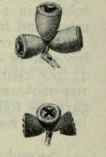
Fruit. - Cylindrical-turbinate (Kosciusko), or turbinate (Tasmania), almost sessile, more or less glaucous; rim convex or somewhat countersunk; valves slightly exserted in Tasmanian specimen; 3 to 4 lines long, 3 lines in diameter.
The Tasmanian form is perhaps nearest in shape to E. acervula, E. paludosa and E. camphora, but larger. The Kosciusko form has its nearest counter-part in E. Irbyi.
Habitat. - High elevations in New South Wales; Victoria; Tasmania,
REMARKS. - Hookers description of this species in his "Flora Tasmaniæ," under the common name of "Cider Gum," and his original in the London Journal of Botany, 1844, iii, p. 499, seems to express definitely what species of Eucalyptus he had discovered in that Island. However, very much has been written about it in the last few years, especially by Deane and Maiden, and later by Maiden alone in various scientific publications. Maiden gives in Proc. Linn. Soc, N.S.W., 1902, vol. 26. a long synonymy. Later he describes it in Crit. Rev., vol, iii, p 106. We deal fully with the history of the species in our paper on the Eucalypts and their Essential Oils, Roy. Soc, Tag., 1912, from which the following short remarks are taken. The name of E. Gunnii was bestowed by Sir J. D. Hooker on what is known as the "Cider Tree" of Tasmania, as shown by his own writings and repeated by Bentham, Mueller, Rod way, and others; and this point should be borne in mind when writing on the species,
Whatever tree is now placed under the name it must be a sine qua nan that it is identieal with the " Cider Tree" of Tasmania, for that was the original intention of Hooker. His description accords with that particular tree, and Bentham's reproduction in "Flora Australicnsis" (Hi. p. 246), equally so, for it accurately describes the material in this Museum obtained from the Tasmanian "Cider Tree" by L. G. Irby, Conservator of Forests, Tasmana. acting under Mr. L. Rodway's direction.
Mr. Irby states in this connection . -"This tree gets its local name from a sweet exudation which flows-from it at certain times of the year. This exudation appears to be just the sap of the tree, for by cutting the bark the sweet flavour may be tasted at any time. Where wounded the sap exudes, and crystallises as it flows down the side of the tree. At this time of the year (May) the 'cider' will only flow in small quantities, and cannot be collected. I was informed by local residents that to obtain it in any quantity it is necessary to tap the trees during the spring or summer months. Like manna, this exudation is of a very pleasing flavour, and is rather Bought alter in consequence. Opossums are extremely fond of it. as also are many birds. I am also informed that at certain times of the year the wattle birds appeal to almost live on it."
ESSENTIAL OIL. Material for distillation was collected at Interlaken, Tasmania, in May, 1912. The yield of oil from the leaves and terminal branchlets was 0.39 per cent. The crude oil was dark-coloured, and had a terpene odour, together with that of cineol. The chief constituents in the oil of this species were dextro-rotatory pinene, lævo-rotatory phellandrene, cineol, a sesquiterpene, and a small amount of ester. The dextro-rotation of the higher-boiling portion suggests the presence of the liquid form of eudesmol.
The crude oil had specific gravity at 15° C. = 0.9014; rotation aD + 1.5°; refractive index at 200 = 1.4743, and was soluble in 4 volumes 80 per cent. alcohol.
On rectification, a small amount of acid water and volatile aldehydes came over below 165° C. (corr.). Between 165-1730, 30 per cent, distilled; between 173-1980, 52 per cent.; the thermometer then rose to 2540, and between 254-2700 14 per cent. distilled. These fractions gave the following results: -
First traction, sp. gr. at 15o C. | = | 0.8813; rotation aD + 5.4; refractive index at 200 = 1.4671. | |||
Second | " | " | " | = | 0.8930; rotation aD - 4.2°; refractive index at 20° = 1.4677. |
Third | " | " | " | = | 0.9377; rotation aD + 8.9°; refractive index at 200 = 1.5004. |
The cineol was determined by the resorcinol method in the oil distilling below 198°, and calculated for the crude oil; the result was 41 per cent. By the rapid phosphoric acid method it was 26 per cent. when calculated for the crude oil.
The saponification number for the esters and free acid was 6.7. The results of this investigation show the oil of this species to be distinct from that of E. camphora of New South Wales. E. Gunnii has no value as an oil-producing tree; the yield is small, and the main constituents have no special value in the amounts present.
In March and April, 1913, material for distillation was sent by Mr. L. G. Irby from Mount Kosciusko, N.S.W. Two consignments were forwarded, one consisting of mature lanceolate leaves and terminal branchlets only, the other of abnormal leaves only. The idea was to see what differences, if any, were observable in the oils obtained from the two forms of growth.
The results indicate that the oil from the abnormal leaves contains rather more dextro-rotatory pinene than does that from the mature leaves, thus following apparently the general rule in this direction; otherwise the oils were in marked agreement, and the results also in conformity with those of the oil distilled from material of this species from Tasmania, as recorded above. The dextro-rotation of the higher boiling fractions is evidently due to the presence of the liquid form of eudesmol, as no crystals could be detected with either sample. The cineol was more abundant in the Tasmanian oil than in the others, and in slightly larger amount in the mature leaves of the New South Wales material. The phellandrene was also present in less amount in the abnormal leaves than in the mature. By tabulating the results obtained with the two oils from New South Wales, the differences and agreements are readily shown.
E. Gunnii. New South Wales. Mature leaves only. | E. Gunnii. New South Wales. Abnormal leaves only. | |
Yield of oil ................................. | 0.82 per cent. | 0.79 per cent. |
Cineol, crude oil .................................... | 24 per cent. | 20 per cent. |
Specific gravity, crude oil, at 15° C. ................. | 0.8994 | 0.8984 |
Optical rotation aD crude oil................................. | -4.3° | + 47° |
Refractive index at 20°, crude oil........................... | 1.4790 | 1.4799 |
Saponification number ester and free acid, crude oil. | 4.5 | 4.4 |
Solubility in alcohol, crude oil .................................. | 7 vols. 80 per cent. | 8 vols. 80 per cent. |
Fraction 167-1720 C. (corr.)................................. | 19 per cent. | 26 per cent. |
„ 172-1930 „ ............ | 49 per cent. | 38 per cent |
„ 264-2720 „ ............ | 27 per cent. | 32 per cent |
First fraction - | ||
Specific gravity at 150 C............. | 0.8751 | 0.8754 |
Rotation aD .................................... | - 7.8° | + 2.2° |
Ref. index at 20° C. ............ | 1.4669 | 1.4661 |
Second fraction - | ||
Specific gravity at 15° C............. | 0.8816 | 0.8839 |
Rotation aD .................................... | - 15.1° | - 8.9° |
Ref. index at 20° C.................................. | 1.4689 | 1.4676 |
Third fraction - | ||
Specific gravity at 150 C............. | 0.9324 | 0.9257 |
Rotation aD .................................... | + 2.2o | + 0.9° |
Ref. index at 200 C. ............ | 1.5008 | 1.4969 |
Continue to:


My Books

