


154. Eucalyptus Luehmanniana
Description
This section is from the book "A Research On The Eucalypts Especially In Regard To Their Essential Oils", by Richard T. Baker, Henry G. Smith. Also available from Amazon: A Research On The Eucalypts And Their Essential Oils.
154. Eucalyptus Luehmanniana
(F.v.M., in Frag., xi, 38.)
Systematic. - A small tree, or 'Mallee, ' with a flaky bark towards the butt of the trunk, upper- limbs smooth, branchlets distinctly quadrangular, or flattened and glaucous, as well as the buds and peduncles. Leaves.coriaceous, variable in size, those in the early growth of timber broadly lanceolate, 3 inches wide to 7 inches long, ordinary ones lanceolate, about 6 inches long and 1 inch wide, green on both sides, slightly shining, petiole flattened, over 1 inch long; venation very pronounced, lateral veins oblique, spreading, intramarginal ones removed from the edge. Peduncles axillary, much flattened, sometimes 6 lines broad at the top, bearing about six flowers, which in the early stage of growth are enclosed in a calyptra or bracts. Calyx and pedicel continuous, almost quadrangular wrinkles much in drying, about 2 to 3 lines in diameter when in flower; operculum acuminate under 3 lines long.
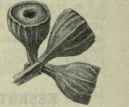
Fruit. - Hemispherical, shining, ribbed, on a very stout flat peduncle about 1 inch long and 3 lines broad; rim broad, outer edge raised in a thin circle; valves inserted, 6 lines in diameter.
This fruit stands alone, being quite distinct from any described Eucalypt.
Habitat. - National Park, Bulli Mountain, Spit, Port Jackson, Balgowlah, New South Wales.
REMARKS. - This tree is very rare in New South Wales, being only recorded from a few localities in the neighbourhood of Sydney. Mueller was the original author of this species, but he afterwards synonymised it under E. stricta, with which species it does not appear to us to have any morphological affinity, as the two seem quite distinct. We think that this Eucalyptus from the above quoted localities is distinct from any other New South Wales Eucalyptus tree, and so have retained Mueller's original name for it, as it should, in our opinion, and in the light of our researches, now stand as a species. We do not see how it can be E. virgata, Sieb., as all the previous writings on that particular species go to show that in herbarium material E. virgata, of Sieber, so much resembled E. Sieberiana of Mueller, that the two were thought to be almost, if not quite, identical, and so were placed under one name by Bentham, B. Fl., vol. iii, p. 202. The herbarium material of E. Luehmanniana cannot be confounded with any known species as far as we know, as it is so characteristic. (Vide also remarks under E. virgata, Sieb., and E. Sieberiana, F.v.M., in this work)
ESSENTIAL OIL. - Leaves and terminal branchlcts for distillation were obtained from National Park N.S.W., in September. 1900. The yield of oil was 0.3 per cent. The crude oil was light amber in colour, and had a peppermint odour due to the presence of a small quantity of piperitone. It contained a large quantity of phellandrene, but only a small amount of pinene. Cineol was present, but not more than about 10 per cent, in the first fraction. A lemon odour was detected in the portion distilling at about 2300 C, so that probably citral occurs in the oil, especially as the presence of a high-boiling aldehyde was shown. Esters were only present in very small amount Fudesmol was detected, as it crystallised after the more volatile constituents had evaporated.
The crude oil had specific gravity at 150 C. = 0.879; rotation aD - 27.5°; refractive index at 20° = 1.4880, and was insoluble in 10 volumes 80 per cent, alcohol. The saponification number for the esters and free acid was 2.3.
On rectification, 2 per cent, distilled below 1720 C. (corr.). Between 172-1830 75 per cent, distilled; between 183-2240, 13 per cent. came over, and between 224-2780, 6 per cent. distilled. These fractions gave the following results: -
First fraction, sp. gr. at 150 C. | = | 0.8719; | rotation aD | - | 30.2°. | |||
Second | " | " | " | = | 0.8885; | " aD | - | 22.7°. |
Third | " | " | " | = | 0.9237; | " | not taken. | |
Continue to:


My Books

