


177. Eucalyptus Baileyana
Description
This section is from the book "A Research On The Eucalypts Especially In Regard To Their Essential Oils", by Richard T. Baker, Henry G. Smith. Also available from Amazon: A Research On The Eucalypts And Their Essential Oils.
177. Eucalyptus Baileyana
[F.v.M., Fragm. xl, p. 37 (1878).] Rough Stringybark.
Systematic. - A large tree, reaching a height of 150 feet, and a diameter of 4 feet. Bark fibrous, persistent on the branches as well as the trunk. Branchlets angular. Abnormal leaves ovate to ovate-lanceolate, sometimes cordate at the base, mucronate, often inclined to be acuminate or even rounded, petiolate, up to 6 inches long and 2 1/2 inches broad, margin undulate, recurved, under surface much paler in colour, branchlets and under surface of leaves covered with rusty-coloured, stellate hairs. Normal leaves lanceolate, often falcate, strongly acuminate, uncinate, under side decidedly paler in colour than the upper surface, which is somewhat shining, about 5 inches long and 1 inch broad; venation distinct, lateral veins fine, numerous, more or less parallel, forming an angle of 450 or more with the mid-rib, intramarginal vein close to the edge. Peduncles lateral or axillary, flattened, about 1 inch in length, bearing umbels of five to seven flowers. Buds pyriform, on flattened or angular pedicels 2 to 4 lines long; operculum hemispherical, umbonate.
Fruit. - Globular, jar-shaped; contracted at the rim, rim thin, grooved; valves coarse, blunt, deltoid, slightly ex-serted; up to 7 lines long and 7 lines in diameter.
Habitat. - Coomer Plains, 8 to 10 miles south of Brisbane (F. M. Bailey), and as far south as Copmanhurst and Grafton District, N.S.W.
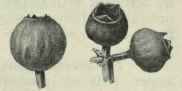
REMARKS. - This species was founded on mixed material, as shown by the original now in the National Herbarium, Melbourne. The description of the leaves and buds in Mueller's Eucalyptographia and also his Fragmenta, do not apply to the above description of these organs, but rather to those from the trees having fruits similar to those figured by Mueller (loc. cit.).
ESSENTIAL OIL. - Leaves and terminal branchlets for distillation were obtained from Copmanhurst, New South Wales, in April, 1920. The crude oil was of a dark amber colour, and had a turpentine-like odour. The yield of oil was 0.82 per cent. It was quite mobile, and consisted principally of dextrorotatory pinene and lævo-rotatory aromadendrene. It also contained a very little cineol, some alcoholic bodies, together with a small amount of volatile aldehydes. Neither phellandrene nor crystallised eudesmol was detected.
We were the more anxious to obtain the oil of this species in order to determine its constituents, because those previously stated to occur appeared contrary to what might be expected from a species belonging to the group in which E. Baileyana is placed botanically. We failed to find either citral or phellandrene, so that evidently the previous statements refer to the oil of a species other than this.
The crude oil had specific gravity at 150 C. = 0.8928; optical rotation aD + 14°; refractive index at 200 = 1.4767, and was only just soluble in 10 volumes 80 per cent. alcohol. The saponification number for the esters and free acid was 2.5 both by the hot and cold method. After acetylation it was 31.7 by boiling, and 11.2 in the cold with two hours' contact.
On rectification less than 1 per cent. distilled below 1570 C. (corr.). Between 157-161°, 5 per cent. distilled; between 161-166°, 30 per cent.; 166-174°, 16 per cent.; 174-193°, 16 per cent.; 193-254°, 5 per cent., and 254-268 , 26 per cent. These fractions gave the following results: -
First fraction, sp. gr. at 150 C. | = | 0.8631; rotation aD + 27.1°; refractive index at 200 = 1.4651. | ||
Second | " | " | = | 0.8682; rotation aD + 25.3; refractive index at 200 = 1.4660. |
Third | " | " | = | 0.8719; rotation aD + 21.6°; refractive index at 200 = 1.4672. |
Fourth | " | " | = | 0.8780; rotation aD + 16.3°; refractive index at 200 = 1.4686. |
Fifth | " | " | = | 0.8855; rotation aD + 3.5°; refractive index at 200 = 1.4715. |
Sixth | " | " | = | 0.9316; rotation aD - 1.2°; refractive index at 200 = 1.4988. |
The sixth fraction contained a small quantity of a sesquiterpene alcohol, as the saponification number after acetylation was 45.
The cineol was determined by the resorcinol method in the portion distilling below 190° C.; when calculated for the crude oil the result was 7 per cent.
The pinene was prepared in a pure condition, the cineol being first removed by agitating with 50 per cent. resorcinol. The terpene boiled at 155-156° C.; had optical rotation aD + 30.1°; specific gravity at 15° = 0.8633, and refractive index at 20° = 1.4661. The nitrosochloride was prepared, and this melted at 104° C.
The sesquiterpene was also prepared as pure as possible by refractionation under reduced pressure over sodium. This boiled at 123.125° at 10 millimetres pressure; had specific gravity at 15° = 0.924; optical rotation aD - 3.7°; refractive index at 20° = 1.4964, and gave the colour reactions characteristic for this sesquiterpene. This species falls in our Group I.
Plate LXXXIV.
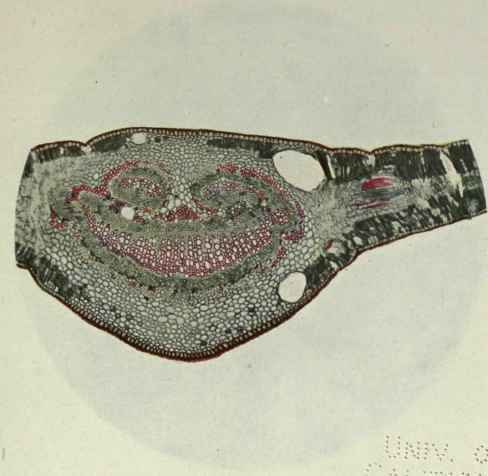
A cross section through the exceptionally stout mid-rib characteristic of this species, and portions of the blade on either side of it. On the right of the bundle top and bottom are two larger oil glands. The palisade parenchyma is more developed towards the upper surface and the spongy mesophyll occupies about a third of the area of the section. The supporting tissue is particularly well developed around the bundle, which is bicollateral, backed by a rather broken ring of thick walled woody fibres (red). The compact rings of the phloem (green) are seen to contrast with the larger cells of the supporting tissue. x 75.
Eucalyptus Baileyana. F.v.M
Continue to:


My Books

