


176. Eucalyptus apiculata
Description
This section is from the book "A Research On The Eucalypts Especially In Regard To Their Essential Oils", by Richard T. Baker, Henry G. Smith. Also available from Amazon: A Research On The Eucalypts And Their Essential Oils.
176. Eucalyptus apiculata
(R.T.B. & H.G.S., in Euc. and their Ess. Oils, 1st Edit., 1902.)
Systematic. - A shrub 6 to 8 feet high. Leaves narrow, lanceolate, with a pronounced recurved point, erect, thinly coriaceous, shining, 4 to 5 inches long, petiole about 2 lines long; venation quite hidden beneath the cuticle, which, when removed, shows the lateral veins to be oblique and spreading, and identical in disposition with those of E. dives, Schau., and others of the " Peppermint "
group of Eucalypts. Peduncles axillary, about 5 lines long, terete or slightly flattened, with five to seven flowers in the umbel. Calyx hemispherical; operculum hemispherical, shortly acuminate, 3 lines in diameter.
Fruit. -Might be described as hemispherical or pilular, but contracted at the rim, which is either countersunk or flat; 3 to 4 lines in diameter.
These are very close in form to E, stricta. Habitat. - Berrima, Mittagong, New South Wales.
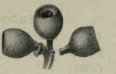
REMARKS. This tree, both in the field and herbarium material, has so much the facies of E. stricta, Sieb., that it was considered by us at first, and without any hesitation, as identical with that species. The differences, - however, in the constituents of their respective oils - differences.such as could not be due to soil or climate - caused us to make a further search for morphological characters, such as the oil constituents seemed to indicate. The presence of the peppermint constituent in this species also led us to look for a venation similar to that of E. dives, Schau., and others containing this particular property, and such was found when the cuticle of the leaf was removed. By a similar treatment, the leaf of E. Stride was found to have a venation corresponding to E. Bridgesiana, R.T.B., and others of the richer cineol-yielding Eucalypts. It is, therefore, upon the presence of these characters and oil constituents that the two species, E. stricta, Sieb., and E. apiculata, are separated.
ESSENTIAL OIL. - Leaves and terminal branchlets for distillation were obtained from Berrima, N.S.W., in May, 1899. The yield of oil was 0.7 per cent. The crude oil was of a light orange-brown colour, and had a strong peppermint-like odour. Only a small amount of cineol could be detected. Pinene was present, but phellandrene was absent. The peppermint constituent was present in some quantity, and 18 per cent. came over between 228-2400 C.
The crude oil had specific gravity at 150 C. = 0.9112; rotation aD - 7.8°; refractive index at 200 = 1.4877; and was soluble in 1 volume 80 per cent. alcohol. The saponification number for the esters and free acid was 8.7.
On rectification, 2 per cent. distilled below 1700 C. (corr.). Between 170-1850, 38 per cent. distilled; between 185-2280, 37 per cent. came over, and between 228-2400, 18 per cent. distilled. These fractions gave the following results: -
First fraction, sp. gr. at 150 C. | = | 0.8861; | rotation aD | + | 4.3°. | |||
Second | " | " | " | = | 0.9045; | " | + | 1.5°. |
Third | " | " | " | = | 0.9420; | " | + | 4.4°. |
It will be noticed that the three fractions were all dextro-rotatory, but that the crude oil was lævo-rotatory. The reason for this peculiarity was the alteration which takes place in the optical activity of the piperitone when submitted to direct distillation.
Material of this species for distillation was also obtained from Berrima, N.S.W., in September, 1899, in order to test the constancy of constituents. The oil was found to be practically identical with that of the previous consignment, the constituents were similar, and present in about the same amounts. The specific gravity of the crude oil was 0.9056, and the optical rotation aD - 8.4°. The crude oil formed a clear solution with 1 volume 80 per cent. alcohol.
Material of this species was also obtained for distillation from Mittagong, N.S.W., in July, 1901. The oil was in agreement with those of the material from Berrima. A portion of this oil was acetylated in order to determine if alcohols were present; the saponification number of the acetylated oil was 39.74, whilst that for the original oil was 10.05; the increase was thus 29.69, due to the free alcohols present. This result represents about 5 per cent. of free alcohol, considered as C10Hl8O.
The above samples were mixed together, stored in the dark, and in December, 1919, the oil was again analysed. It had specific gravity at 15° C. = 0.9138; rotation aD - 10.8°; refractive index at 200 = 14864; ketone estimation 38 per cent.
On rectification, under reduced pressure, the following results were obtained: -
Below 100° C. at 10 millimetres pressure | = | per cent. | ||||
Between | 100-1080 | " | " | = | 23 | " |
Between | 108-1280 | " | " | = | 5 | " |
Between | 128-152° | " | " | = | 11 | " |
The first fraction had specific gravity at 15 C.=0.8818; rotation aD - 1.8°; refractive index at 20° = 1.4818; it contained both cineol and piperitone.
On repeated fractionation, a substance was obtained having specific gravity at 15° C. = 0.864; rotation aD + 11.6°; refractive index at 20° = 1.4752; it was mostly pinene and gave a nitrosochloride, melting at 1040.
The second fraction (100-108°) had specific gravity at 15° C. = 0.940; rotation aD - 31.4°; refractive index at 20° = 1.4854; ketone absorption 91 per cent. On reduction with sodium-amalgam it gave the crystalline body melting at 142°. This fraction thus consisted almost entirely of piperitone. The third fraction (108-128°) differed but slightly from the second fraction, and contained 90 per cent. piperitone.
The fourth fraction consisted of piperitone, the sesquiterpene, and some alcoholic bodies.
To determine the approximate amount of the alcohols, the piperitone was removed by treatment with a neutral sodium sulphite solution; the remainder had specific gravity at 15° = 0.8971; rotation aD + 1.6°; refractive index at 20° = 1.4876; saponification number 12.4; after acetylation it was 36.7, equal to 10 per cent, of a C15H25OH alcohol. This sesquiterpene alcohol was probably the liquid form of eudesmol.
A portion of the original oil was rectified under atmospheric pressure, when 42 per cent. distilled below 190° C. This portion had specific gravity at 15° C. = 0.8800; rotation aD 4+0°; and refractive index at 20° = 1.4811.
The cineol was determined in this fraction by the resorcinol method; when calculated for the crude oil, the result was 8 per cent.
Continue to:


My Books

