


41. Eucalyptus viminalis, var. a
Description
This section is from the book "A Research On The Eucalypts Especially In Regard To Their Essential Oils", by Richard T. Baker, Henry G. Smith. Also available from Amazon: A Research On The Eucalypts And Their Essential Oils.
41. Eucalyptus viminalis, var. a
(R.T.B. & H.G.S., in Euc. and their Ess. Oils, 1st. Edit., 1902, p. 91.)
Systematic. - A tree apparently similar in most morphological characters to the type.
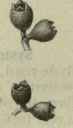
Fruit.- The fruits, however, are less pedicellate, often sessile, and not quite hemispherical, nor are the valves quite so exserted, nor the mouth of the capsule so expanded as in the type. The fruits in dried specimens are almost invariably affected with a fungoid growth on the inner surface of the valves.
Habitat. - Crookwell District, New South Wales.
ESSENTIAL OIL. - Leaves and terminal branchlets for distillation were obtained from Laggan, near Crookwell, New South Wales, in May, 1901. The yield of oil was 07 per cent. The crude oil was amber-coloured, and had an almond-like odour, indicating the probable presence of benzaldehyde. This odour appears to be characteristic of the oil of this species, and has not, so far, been detected in any other Eucalyptus oil. It was first noticed in a sample of oil presented by Mr. J. J. Hook to the Goulburn Museum.
In April, 1901, a commercial sample of freshly-distilled oil from this species was submitted to us for determination. It was found to be identical in composition with the specimen in the Goulburn Museum.
The oil of this species was rich in cineol; it contained pinene, but phellan-drene was absent. On agitating a portion of the oil with acid sodium sulphite a small amount of a crystalline compound was obtained; this was separated, purified, decomposed, and the aldehyde removed by ether. The product had a marked odour of benzaldehyde, but an attempt to oxidise it to benzoic acid was not successful, so that its identity yet remains to be proved.
The crude oil from the Laggan material had specific gravity at 15o C. = 0.9122; rotation aD + 6.7°; refractive index at 20o = 1.4654, and was soluble in 1 1/2 volumes 70 per cent. alcohol. The saponification number for the esters and free acid was 4.6.
On rectification, 2 per cent. distilled below 162o C. (corr.). Between 162-180o, 83 per cent, distilled; between 180-188o, 6 per cent. came over, and between 188-250o, 4 per cent. distilled. These fractions gave the following results: -
First fraction, sp. gr. at 15o C. | = | 0.9083; | rotation aD | + | 8.2°. | ||||
Second | " | " | " | = | 0.9216; | " | not taken. | ||
Third | " | " | " | = | 0.028l; | "' | " | ||
The cineol, determined by the phosphoric acid method in the first traction was 55 per cent. (O.M.), indicating about 48 per cent. in the crude oil. The third fraction consisted largely of the sesquiterpene.
The above sample was stored in the dark, and in November, 1919, again analysed. Not much alteration had taken place during the time it had been kept, with the exception that the specific gravity had increased a little. The rotation had also altered, and showed a slightly higher dextro-rotation, evidently due to the diminution in rotation of a lævo-rotatory constituent. The odour of benzaldehyde was very pronounced in the rectified oil, particularly after the cineol had been fixed by phosphoric acid. 87 per cent. distilled below 190° C. The crude oil and the rectified portion gave the following results: -
Crude oil, sp gr. at 15o C. | = | 0.9192; rotation aD + 7.8°; refractive index at 20o = 1.4664. | ||
Rectified portion | " | " | = | 0.9113; rotation aD + 9.4°; refractive index at 20o = 1.4607. |
The cineol was determined by the resorcinol method in the rectified portion; the result was 63 per cent. when calculated for the crude oil. By the rapid phosphoric acid method it was 58 per cent.
In the year 1908, Mr. W. T. Farrell, of the Australian Eucalyptus Oil Co., submitted a sample of Eucalyptus oil he was distilling for commercial purposes from a tree known in the South Coast district of New South Wales as "Ribbon Gum." This oil indicated the presence of benzaldehyde, and in other respects, particularly the botanical material, agreed with the species we had previously received from Laggan, near Crookwell, New South Wales. It was thought desirable, therefore, to obtain material for distillation.
Through the kindness of Mr. Farrell leaves and terminal branchlets for distillation were received from Monga, New South Wales, in June, 1910.
The yield of oil was 0.9 per cent. The crude oil was of a dark orange-brown colour, due to the action of the phenols on the iron removed from the still in the process of distillation. It contained much cineol, and dextro-rotatory pinene was also present in some quantity; but phellandrene was absent. The aldehydes were pronounced, benzaldehyde being detected by the odour.
A portion of the oil was agitated with dilute soda solution until the phenols were absorbed; the alkaline solution was separated, washed with ether, acidified, and the phenols prepared in the ordinary way. The amount of phenols in the crude oil was thus shown to be 0.46 per cent.; tasmanol was readily detected by the characteristic reaction with ferric chloride, although the principal phenol was australol.
The crude oil from which the phenols had been removed had specific gravity at 15o C. = 0.9141; rotation aD + 6.2°; refractive index at 20o = 1.4655, and was soluble in 1.6 volumes 70 per cent. alcohol. The saponification number for the esters was 3.4.
On rectification, 1 per cent. distilled below 168o C. (corr.). Between 168-172o, 20 per cent. distilled; between 172-193°, 62 per cent. came over, and between 193-204o, 6 per cent, distilled, leaving 11 per cent. as residue. These fractions gave the following results: -
First fraction, sp. gr. at 15° C. | = | 0.9044; rotation aD + 10°; refractive index at 20o = 1.4612. | |||
Second | " | " | " | = | 0.9094; rotation aD + 7.1°; refractive index at 20o = 1.4614. |
Third | " | " | " | = | 0.9208; rotation aD + 2.2°; refractive index at 20o = 1.4601. |
The saponification number for the first fraction was only 1.8, while that in the residue was 7.6 by boiling, and 7.1 in the cold with two hours' contact. The indication was that the principal ester was geranyl-acetate.
The cineol was determined by the resorcinol method in the portion distilling below 193o. When calculated for the crude oil the result was 60 per cent.
Plate XXII.

Section through the mid-rib of the leaf and dependent tissue. Three oil glands are sectioned, two on the right and all are well below the thickened cuticle. The supporting tissue to all the bundles sectioned is a feature of the plate; the palisade tissue extends from the two surfaces of the leaf, but is apparently more developed towards the upper side.
Eucalyptus Paniculata. Sm
Plate XXIII.
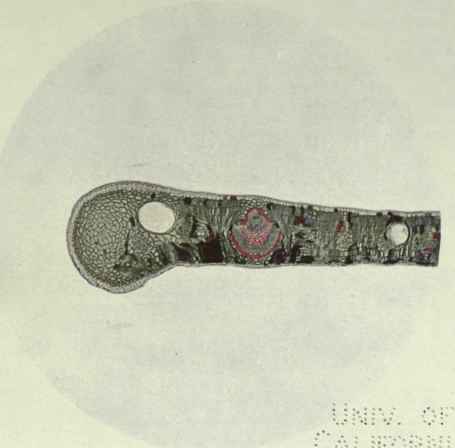
Cross section showing the thickened edge of a leaf blade with an oil gland in the vicinity, and another at the right of the section. The cuticle in this case is strongly developed on the upper surface and around the edge, where it la backed by a mass of supporting tissue. The palisade parenchyma is strongly developed on the upper surface, The dark-coloured patches probably indicate tannin in the tissue. X 55.
Continue to:


My Books

