


51. Eucalyptus longifolia
Description
This section is from the book "A Research On The Eucalypts Especially In Regard To Their Essential Oils", by Richard T. Baker, Henry G. Smith. Also available from Amazon: A Research On The Eucalypts And Their Essential Oils.
51. Eucalyptus longifolia
(Link & Otto, Ic. Pl. Scl., 97, t. 45.) (Syn. E. Woollsii, F.v.M.) Woollybutt.
Systematic. - Often a tall tree, with a persistent grey, fibrous bark. Leaves lanceolate, often measuring 12 inches in length (some Eucalypts have longer leaves than this species), not shining; venation well marked, intramarginal vein rather close to the edge. Peduncles axillary, 1 1/2 inch long, mostly bearing three comparatively large flowers. Calyx 5 to 6 lines long, turbinate, often angular.
Fruit. - Large, occasionally angular; valves scarcely exserted, very distinct and erect, edge sharp; rim broad, sloping outwards, or bevelled; 3/4 inch in diameter. These large fruits, which occur in threes, make the species easy of determination both in the field and herbarium.
One of the most distinctive capsules of the genus and readily identified.
Habitat. - Port Jackson, New South Wales, to Victoria.
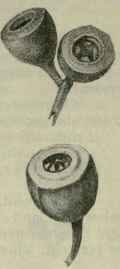
REMARKS. - "Woollybutt" appears to be the general vernacular name for this tree, though in the south-east corner of the Continent it is sometimes known as "Peppermint." but it is difficult to understand why it is so called, as the oil contains no peppermint constituent. It is a beautiful foliaceous tree, individual leaves sometimes measuring over a foot long, but the leaves of several other species far exceed this measurement, so that the species name is not happily chosen. The bark is similar to that of some "Box" trees, the upper branches being smooth. The timber is reddish in colour, hard, and very durable.
ESSENTIAL OIL. - Leaves and terminal branchlets for distillation were obtained from Canterbury, N.S.W., in August, 1897. The yield of oil was 0.54 per cent. The crude oil was of a light orange-brown colour, and had an odour resembling those of the cineol-pinene Eucalyptus oils generally. It was rich in cineol, contained a little pinene, but phellandrene was absent. The third fraction consisted largely of the sesquiterpene, and as this fraction was rather large, the specific gravity of the crude oil was somewhat high.
The crude oil had specific gravity at 150 C. = 0.9226; rotation aD + 2.86°; refractive index at 200 = 1.4681, and was soluble in 1 1/4 volumes 70 per cent, alcohol. The saponification number for the esters and free acid was 3.6.
On rectification, 2 per cent. distilled below 1720 C. (corr.). Between 172-1830, 69 per cent. distilled; between 183-2500, 14 per cent. came over, and between 250-2730, 10 per cent, distilled. These fractions gave the following results: -
First fraction, sp. gr. at 150 C. | = | 0.9158; | rotation aD | + | 3.9° | ||||
Second | " | " | " | = | 0.9240; | " | not taken. | ||
Third | " | " | " | = | 0.0460; | " | not taken. | ||
The cineol, determined by the phosphoric acid method in the first fraction, was 63 per cent. (O.M.), indicating about 45 per cent, in the crude oil.
The above sample had been stored in the dark, and in August, 1919, was again analysed. Not much alteration had taken place during the twenty-two years it had been kept, although the cineol had increased somewhat. 82 per cent, distilled below 190° C. The crude oil and the rectified portion gave the following results: -
Crude on, sp. gr. at 15o C. | = | 0.9258; rotation aD + 1.2°; refractive index at 20° = 1.4675. | |
Redistilled portion | " | = | 0.9180; rotation aD + 3.6°; refractive index at 20° = 1.4612. |
The cineol was determined by the resorcmol method in the rectified portion, and calculated for the crude oil; the result was 71 per cent. By the rapid phosphoric acid method, it was 61 per cent, when calculated for the crude oil.
Continue to:


My Books

