


52. Eucalyptus Behriana
Description
This section is from the book "A Research On The Eucalypts Especially In Regard To Their Essential Oils", by Richard T. Baker, Henry G. Smith. Also available from Amazon: A Research On The Eucalypts And Their Essential Oils.
52. Eucalyptus Behriana
(F.v.M., in Trans. Vict. Inst., i, .34. 1854.)
Systematic. - A small tree of the "Mallee" country. Branchlets terete. Bark thin, smooth, greenish, hard. Leaves ovate, ovate-lanceolate, oval, acuminate, or shortly acuminate, smooth, coriaceous, more or less shining, 2 to 3 inches long; venation fairly prominent, lateral veins very oblique, distant, spreading, intramarginal vein removed from the edge. Flowers in rather lengthened, terminal panicles. Peduncles short, 3 to 4 lines long, angled; seven or fewer flowers on the umbel. Flowers sessile, calyx angular, almost cylindrical, under 2 lines long; inner operculum hemispherical, shortly acuminate, outer one very small, membraneous and persistent.
Fruit. Small, shining, top-shaped, slightly hemispherical, truncate; rim comparatively thick, sunk; valves enclosed; under 2 lines in diameter.
In shape they resemble E. odorata, but arc much smaller and shining.
Habitat. - Interior of New South Wales; South Australia; Victoria.
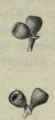
REMARKS. - This species is easy of determination, both in the field and the herbarium. The bark is very characteristic, being smooth, firm, and very hard, and difficult to remove, even after the timber is cut. The leaves have somewhat the resemblance of "Mallee Box," E. Woollsiana, R.T.B., from which species it differs in having a smooth bark, its inflorescence, timber, and chemical constituents. It is a strong species and Mueller's figure of it in the "Eucalyptographia" is very good.
ESSENTIAL OIL. - Leaves and terminal branchlets for distillation were obtained from Wyalong, N.S.W., in December, 1900. The yield of oil was 0.62 per cent. The crude oil was of a reddish-brown colour, and had an odour resembling those of the cineol-pinene class of Eucalyptus oils. It was fairly rich in cineol; pinene was present, but phellandrene could not be detected. It is doubtful if the aldehyde aromadendral occurs, as the rotation of the crude oil and of the higher boiling portion was more highly dextro-rotatory than was that of the first fraction. It is probable that a constituent exists in this oil, similar to that in E. Rossii and other species. The specific gravity of the oil was high, but it was less rich in cineol than those from such "Mallees" as E. polybractea and E. oleosa. The third fraction contained the sesquiterpene.
The crude oil had specific gravity at 15° C. = 0.0237; rotation aD + 3.7°; refractive index at 20° = 1.4708, and was soluble in 1 1/2volumes 70 per cent, alcohol. The saponification number for the esters and free acid was 11.1 After acetylation, the saponification number was 58.4, showing the presence of a considerable amount of free alcohols.
On rectification, the usual amount of acid water and volatile aldehydes came over below 1640 C. (corr.). Between 164-1830, 81 per cent, distilled; between 183-194°, 12 per cent, came over, and between 194-265°, 5 per cent, distilled. These fractions gave the following results: -
hirst traction, sp. gr. at 15o C. | = | 0.9159; | rotation aD | + | 1.05o. | ||||
Second | " | " | " | = | 0.9308; | " aD | + | 4.80°. | |
Third | " | " | " | = | 0.9475; | " | not taken. | ||
A high-boiling dextro-rotatory alcohol was evidently present m the third fraction. The cineol determined by the phosphoric acid method in the large fraction was 52 per cent. (O.M.), indicating about 45 per cent. in the original oil.
The above sample of oil had been preserved in the dark, and in September, 1919, was again analysed. No great change was observable in the character of the oil after nineteen years, except perhaps, that it was a little richer in cineol.
On rectification, 84 per cent. distilled below 190° C. The results with the crude and rectified oils were as follow: -
Crude oil, sp. gr. at 15o C. | = | 0.9297; rotation aD + 3; refractive index at 200 = 1.4709. | ||
Fraction | " | " | = | 0.9168; rotation aD + 2.0°; refractive index at 200 = 1.4637. |
The cineol was determined by the resorcinol method in the portion distilling below 190°. When calculated for the crude oil, the result was 65 per cent. By the phosphoric acid method it was 53 per cent.
Continue to:


My Books

