


65. Eucalyptus urnigera
Description
This section is from the book "A Research On The Eucalypts Especially In Regard To Their Essential Oils", by Richard T. Baker, Henry G. Smith. Also available from Amazon: A Research On The Eucalypts And Their Essential Oils.
65. Eucalyptus urnigera
(Hook., f. in Lond. Jour. Bot, VI, 477, 1847.) Urn Gum.
Systematic. - A tree varying greatly in size, usually found at an altitude between 2,000 or 3,000 feet. Bark smooth, usually blotched with red or brown (Rodway). Abnormal leaves opposite or alternate, rounded, oval to ovate, crenulate, petiolate. or sessile, often cordate, branchlets and foliage often glaucous. Normal leaves oval or ovate-lanceolate to lanceolate, older leaves often thick and shining; venation very indistinct. Flowers pedicellate, the common peduncle axillary, about .5 lines in length. Buds glaucous, about 5 lines long. Calyx tube expanded from the pedicel, then contracted and enlarged again at the rim; operculum about 1 line long, somewhat acuminate.
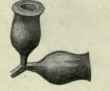
Fruit. - Urn-shaped, contracted below the orifice; rim truncate, broad; valves deeply inserted; about ,7 lines long and up to 5 lines broad.
These are uncommonly like those of the "Bloodnoods," . the nearest being E. corymbosa.
Habitat. - Confined to Tasmania.
ESSENTIAL OIL. - Material for distillation was obtained at Mount Wellington, Tasmania, at an altitude of about 2,500 feet. It was collected in July, 1908; and this being the depth of winter, the yield was probably less than if collected in the summer, as this species most likely follows the general rule in. this respect. The principal constituents in the oil were dextro-rotatory pinene and cineol, over 50 per cent. of the latter constituent being present. Phellandrene does not occur, nor were either eudesmol, piperitone, or aromaden-dral detected. The ester was probably geranyl-acetate largely, as the greater portion was saponified in the cold with two hours' contact. The small amount of high-boiling constituents in the oil of this species caused it to have a specific gravity below 0.91 at 150 C, while the presence of the pinene in rather large excess gave a somewhat high dextro-rotation. The rectified oil, however, was practically colourless - almost water-white - and it had, for an ordinary Eucalyptus oil, a very agreeable odour, and nothing objectionable. The yield of oil from leaves with terminal branchlets was 1.13 per cent. The crude oil was reddish in colour, usual with oils of this class when the leaves are distilled from iron digesters. The specific gravity at 150 C. = 0.9088; rotation aD + 11.8°; refractive index at 200 C. = 1.4652, and was soluble in 5 volumes 70 per cent, alcohol.
On rectification, a small amount of acid water and volatile aldehydes, for oils of this class, came over below 1650 C. (corr.). Between 165-1740, 54 per cent, distilled; between 174-1930. 36 per cent.; the thermometer then quickly rose to 2300, and between that temperature and 2460, 5 per cent, distilled. These fractions gave the following results: -
First fraction, sp. gr. at 150 C. | = | 0.9001; rotation aD + 15.7; refractive index at 200 = 1.4613. | |||
Second | " | " | " | = | 0.9165; rotation aD + 6-4°; refractive index at 200 = 1.4616. |
Third | " | " | " | = | 0.9258; rotation not taken; refractive index at 200 = 1.4850. |
The cineol was determined by the resorcinol method in the oil distilling below 1930; the result was 63 per cent, when calculated lor the crude oil. By the rapid phosphoric acid method it was 53 per cent, when calculated for the crude oil.
The saponification number for the esters and free acid was 18.3. In the cold with two hours' contact, it was 10.7, equal to 3.7 per cent, of geranyl-acetate when calculated for that ester.
A portion of the crude oil was rectified by steam. The product was almost colourless, and the odour good, whilst but little residue remained. The oil thus rectified had specific gravity at 150 C. = 0.9071; rotation aD + 12-1°; refractive index at 200 = 1.4621.
The results of this investigation were published by us in the Proc. Roy, Soc, Tasmania, October, 1912.
Continue to:


My Books

