


66. Eucalyptus unialata
Description
This section is from the book "A Research On The Eucalypts Especially In Regard To Their Essential Oils", by Richard T. Baker, Henry G. Smith. Also available from Amazon: A Research On The Eucalypts And Their Essential Oils.
66. Eucalyptus unialata
(R.T.B. & H.G.S., in Roy. Soc. Tas., 1912, p. 176, t. I.)
Systematic. - A tree reaching 30 to 40 feet in height, with a bark flaky at the butt and smooth above. Abnormal leaves sessile, the lower pairs oval, then cordate, acuminate, up to 3 inches long and 1 1/2 inch wide to narrow lanceolate. Normal leaves lanceolate, falcate, up to 9 inches long and 1 inch wide, sub-coriaceous, occasionally shining on the upper surface; intramarginal yein slightly removed from the edge, venation distinct, lateral veins fairly oblique.
Plate XXX
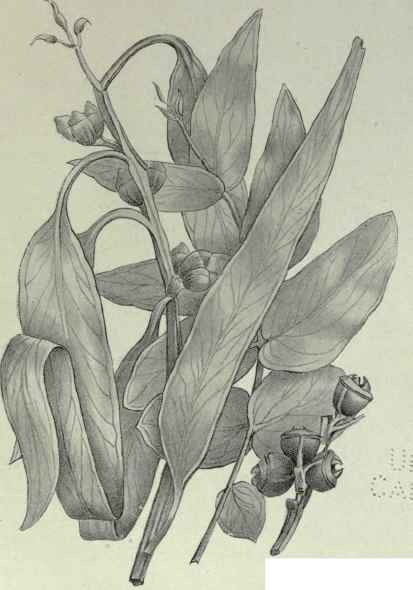
R T. Baker, del.
Eucalyptus Unialata
R.T.B. a H.G.S.
Branchlets in seedling growth terete, but normally angular at first. Penduncles axillary, flattened, short, thick, 3 lines long, with three sessile flowers. Calyx tube compressed, angular, under 6 lines long; operculum conical.
Fruit. - Hemispherical, sometimes slightly flanged, shining generally with one rib; rim thickened, convex with a narrow groove below it; valves exserted; 5 lines long and 6 lines in diameter.
These come somewhat closely in form to those of E. Muelleri or E. Baeuerleni.
Habitat. - Mount Nelson, Tasmania.

REMARKS.- - A particularly rare tree that has been classed with several others by systematists - by Mueller, as a form of E. globulus; Maiden, a form of E. Maideni, F.v.M. (Rodway, Fl. Tas., p. 87). To us the facts point to its being worthy of distinctive rank.
ESSENTIAL OIL. - Material for distillation was collected near Hobart Tasmania, in August, 1912, and was quite fresh and green when received at the Museum. The yield of oil from the leaves and terminal branchlets was 0.89 per cent. The crude oil was light-amber in colour, and had an odour resembling that of the crude oil of E. globulus. It was fairly rich in cineol, and contained dextro-rotatory pinene; phellandrene was absent. The saponification number was somewhat high, and the oil contained rather a large amount of high-boiling constituents. The rectified oil had a distinctly yellow tinge.
The crude oil had specific gravity at 150 C. = 0.9179; rotation aD + 3.1°; refractive index at 200 = 1.4681, and was soluble in 1 3/4 volumes 70 per cent, alcohol. On the addition of about 10 volumes of this alcohol the oil became again turbid, indicating the presence of traces of the solid paraffin, a constituent which occurs in greater quantity in the oil of E. acervula. The saponification number for the esters and free acid was 11.1.
On rectification, a small amount of acid water and volatile aldehydes, having an objectionable odour, came over below 1700 C. (corr.). Between 170-193° 83 Per cent, distilled, and between 193-2680, 11 per cent, distilled, mostly above 2600. These fractions gave the following results: -
First fraction, sp. gr. at 15o C. | = | 0.9104; rotation aD + 4.3o ; relractive index at 200 = 1.4623. | ||
Second | " | " | = | 0.9294; rotation not taken; refractive . index at 200 = 1.4900. |
The cineol was determined in the first fraction by the resorcinol method; the result was 62 per cent, when calculated for the crude oil. By the rapid phosphoric acid method it was 54 per cent, in the crude oil. After acetylation the saponification number was 20, thus showing the presence of alcoholic bodies in the rectified portion.
The results of this investigation were published by us in the Proc. Roy. Soc, Tasmania, October, 1912.
Continue to:


My Books

