


67. Eucalyptus Gullicki, sp. nov
Description
This section is from the book "A Research On The Eucalypts Especially In Regard To Their Essential Oils", by Richard T. Baker, Henry G. Smith. Also available from Amazon: A Research On The Eucalypts And Their Essential Oils.
67. Eucalyptus Gullicki, sp. nov
Systematic. - A medium sized tree with a smoothish bark. Abnormal leaves lanceolate, rarely ovate, usually under 3 inches long, almost sessile, mucronate or acute, seldom obtuse, venation netted, oil glands prominent. Normal leaves lanceolate, falcate, under 5 inches long, strongly acuminate, more or less shining, coriaceous, margin thickened; venation not prominent in the older leaves, intramarginal vein not far removed from the edge, lateral veins numerous, nearly parallel, inclined at an angle of 30-400 to the mid-rib. Peduncles axillary or lateral, angular, 2 to 4 lines long, each with an umbel of about five flowers. Buds almost sessile, somewhat shining, reddish. Calyx tube turbinate, 2 lines in length, and twice as long as the usually broad conical operculum, which sometimes shows a tendency to become acuminate.
Fruit.-Turbinate to hemispherical, contracted to a short pedicel; rim moderately broad, slightly domed or raised, depressed in the hemispherical shape, and concave when pyriform - the most common form; valves exserted; 2 lines long and 3 lines in diameter.
The hemispherical fruits are uncommonly like those of E. hæmastoma and the pyriform ones with the concave raised rim (not sufficiently emphasised in the illustrations) and exserted valves, are most difficult to separate from those of E. Smithii, etc.
Habitat. - This tree is fairly well distributed over the Blue Mountains, N .S.W.
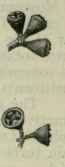
REMARKS. - -In the past it has probably been confounded with such species as E. Smithii, R.T.B., and when the fruits are immature with E. maculosa, R.T.B., or E. hæmastoma, Sm. var. micrantha, Benth., the two latter of which it much resembles in field characters, and even somewhat in fruits. From E. maculosa, R.T.B., it differs in the shape of the abnormal leaves and fruits, as well as chemical, properties of the oil. From E. hæmastoma, Sm. var. micrantha, in the texture and venation of the leaves, the rim, shape of fruits, and disposition of the valves, and also in the absence of insect markings on the bark. From E. Smithii, R.T.B., in the nature of the bark, which is smooth like all other "Gums," whilst E. Smithii has a bark of an "Ironbark" character, and a timber much harder and pale than this species, whilst its botanical affinities are with most of the above enumerated species, yet chemically it differs from them all in its oil constituents.
Dedication
This Eucalyptus is named in honour of Mr. William Applegate Gullick. the Government Printer, Sydney, in acknowledgment of the valuable assistance rendered to us during the last twenty-five years, in the furtherance of our technical research work, towards the accomplishment of which he has always given us material help, both by advice and application of his technical knowledge. His assistance in the passage of our books through the press, and the aid thus given we most gratefully acknowledge.
ESSENTIAL OIL. - Leaves and terminal branchlets for distillation were obtained from Lawson, New South Wales, in August, 1919. The yield of oil was 0.38 per cent. The crude oil was dark coloured, and had a rank terpene-like odour. A small quantity of pinene was detected, but phellandrene was absent. Cineol was present in some quantity, as was also eudesmol. Esters were not pronounced, but phenols were present in fair amount.
The crude oil had specific gravity at 150 C. = 0.9285; rotation aD + 6.7°; refractive index at 200 = 1.4717, and was soluble in 1.1 volume 70 per cent, alcohol. The saponification number for the esters and free acid was 4.6, and in the cold with two hours' contact 3.6.
On rectification 2 per cent, distilled below 1720 C. (corr.). Between 172-1930, 64 per cent, distilled; between 193-2750, 9.5 per cent, came over, and between 275-2940, 21 per cent, distilled. These fractions gave the following results: -
First fraction, sp. gr. at 15o C. | = | 0.9169; rotation aD + 3750; refractive index at 200 = 1.4619. | ||
Second | " | " | = | 0.9251; rotation aD + 3.8°; refractive index at 200 = 1.4700. |
Third | "' | " | = | 0.9582; rotation not taken; refractive index at 200 = 1.5030. |
The cineol was determined by the resorcinol method in the first fraction; the result was 56 per cent, when calculated for the crude oil. By the rapid phosphoric acid method it was 46 per cent, when calculated for the crude oil.
A portion of the oil was acetylated in the usual way; the saponification number had then risen to 67.2, and in the cold with two hours' contact it was 19.7. This result indicated that 19 per cent, of eudesmol and 4.4 per cent, of geraniol were present in the free condition. The eudesmol was purified, when it melted at 8o° C, and in chloroform at 240 C, had specific rotation
[a]D + 33.65°.
Continue to:


My Books

