


68. Eucalyptus platypus
Description
This section is from the book "A Research On The Eucalypts Especially In Regard To Their Essential Oils", by Richard T. Baker, Henry G. Smith. Also available from Amazon: A Research On The Eucalypts And Their Essential Oils.
68. Eucalyptus platypus
(Hook., Ic. Pl. t. 849, 1852.)
Systematic. - A small tree with a smooth bark. Abnormal leaves ovate or obcordate. Normal leaves broadly ovate or orbicular, often crenate, mostly under 2 inches long, thick, smooth and shining; venation not prominent. Peduncles axillary, thick, woody, flat, up to 6 lines broad and 2 inches long; bearing about five to twelve flowers. Calyx tube 3 to 4 lines long, narrow turbinate, sometimes ridged, sessile; operculum conical, obtuse, much longer and narrower than the calyx tube.
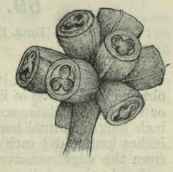
Fruit. - Crowded in heads, semi-ovoid or turbinate, slightly contracted at the orifice, ribbed; rim thick and slightly convex; valves often acuminate, exserted; 6 to 9 lines long, 4 to 7 lines in diameter.
This clustering of fruits occurs also in E. Lehmanni and E. cornuta, but these litter are easily distinguished from this Eucalypt by their elongated valves.
Habitat. - Western Australia.
ESSENTIAL OIL. - The oil of this species was distilled by Mr. P. R. H. St. John, at Melbourne, September, 1919, from cultivated trees in the Botanic Gardens of that city, and forwarded to us for investigation. The yield of oil was 0.82 per cent. The crude oil was but little coloured, and had an odour similar to those of the cineol-pinene oils generally, although the volatile aldehydes were rather pronounced. The constituents present were dextrorotatory pinene, cineol, esters, alcoholic bodies, and a little sesquiterpene. Phellandrene was not present, nor was it expected to occur in oils of this group.
The crude oil had specific gravity at 150 C. = 0.9103; rotation aD + 10.2°, refractive index at 200 = 1.4639; and was soluble in 1 3/4 volumes 70 per cent. alcohol. The saponification number for the esters and free acid was 15.2, and in the cold with 2 hours' contact 2.8. After acetylation it was 49.5, and in the cold 37.6. This result represents 9.6 per cent. free alcohols, having the C10Hl8O molecule.
On rectification, 2 per cent. distilled below 1560 C. (corr.). Between 156-1720, 31 per cent, distilled; between 172-1930, 59 per cent, came over; between 193-2170, 5 per cent, distilled, and between 217-235°, 2 per cent. The fractions gave the following results: -
First fraction, sp. gr. at 15°C. | = | 0.8950; rotation aD+ 16.2°; refractive index at 200 = 1.4601. | ||
Second | " | " | = | 0.9123; rotation aD + 8.7°; refractive index at 200 = 1.4629. |
Third | " | " | = | 0.9350; rotation aD - 1.2°; refractive index at 200 = 1.4731. |
Fourth | " | " | = | 0.9385; rotation too dark; refractive index at 200 = 1.4811. |
The cineol was determined by the resorcinol method in the portion distilling between 156-193°; when calculated for the original oil the result was 63 per cent. By the phosphoric acid method, determined in the crude oil, it was 48 per cent. It is thus apparent that constituents other than cineol were absorbed by the resorcinol.
A similar alcohol to that in the oil of E. longicornis was present, and altogether the results with the oils of the two species were in close agreement.
A later distillation with material of this species was made by Mr. St. John, with the result that this oil was quite similar in character with the above, and did not contain phellandrene.
(For a determination of the oil of this species see Proc. Roy. Soc, Victoria, Vol. 28, 1915, by Mr. J. C. Earl.)
Continue to:


My Books

