


7. Eucalyptus Intermedia,
Description
This section is from the book "A Research On The Eucalypts Especially In Regard To Their Essential Oils", by Richard T. Baker, Henry G. Smith. Also available from Amazon: A Research On The Eucalypts And Their Essential Oils.
7. Eucalyptus Intermedia,
(R.T.B., Proc. Linn. Soc, N.S.W., 1900, p. 674.) A Blood-wood.
Systematic. - A medium-sized tree, with a light-brown flaky bark. Leaves lanceolate, acuminate, about 6 inches long, and 1 to 1 1/2 inch wide or more, pale on the underside; lateral veins oblique, fine, numerous, parallel; intra-marginal vein quite close to the edge. Flowers mostly in large terminal corymbs; calyx turbinate, 4 lines in diameter, 3 lines long, on a pedicel of about 4 lines.
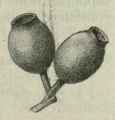
Fruit. - Urceolate, mottled, contracted at the orifice to sometimes 2 lines; rim countersunk, with a ringed edge; about 10 lines long, 5 to 7 lines in diameter.
The fruits are not unlike those of E. corymbosa without the expanding neck.
Habitat. - Richmond and Clarence Rivers to South Coast districts of New South Wales.
Timber.- A pale pink-coloured timber, hard, straight-grained, and easy to work. It is much closer in texture than the Sydney "Bloodwood" (E. corymbosa, Sm.). The figure is occasionally not unlike that of E. macniata, Hook.
Gum veins are often present. It is considered a good, durable timber, and superior to that of E. corymbosa, Sm. It has quite a metallic ring when the fractured edges of two pieces are rubbed together.
REMARKS. - A tree closely allied to both E. corymbosa, Sm., and E. eximia Schau. It has, however, always been considered as the northern form of the former species, but in botanical characters it more nearly resembles the latter, and especially E. maculata. Hook. The chemical constituents and optical features place it midway between the two former. It differs from E. corymbosa in the nature of the timber, bark, oil, and fruit--, which have not the marked recurved rim of that species. From E. eximia it differs in pedicellate fruits, a stringy, flaky bark, and its pinkish timber. Dr. Woolls was cognisant of the differences existing between these species, for in his " Flora of Australia " (p. 238) he states :--" At the Clarence and Richmond Ravers the 'Bloodwood' prevails to a great extent, and the workmen reckon two kinds-one with smooth, and the other with rough bark. It seems probable that the Mountain ' Bloodwood ' (E. eximia), which overhangs the valley of the Grose, is different from the 'Bloodwood' of the north." Most botanists have regarded the northern "Bloodwood " as identical with the Sydney and southern " Bloodwood," but Dr. Woolls is the only one who connected it (the northern one) with E. eximia, Schau., and our recent observations also show it to have affinities with that specie. Its physical characters however, are so evenly balanced between the two (E. eximia and E. corymbosa) that it was decided to give it specific rank.
ESSENTIAL OIL. Leaves and terminal branchlets for distillation were obtained from Lismore, N.S.W., in October, 1900. The yield of oil was 0.13 per cent. The crude oil was amber coloured, and had a slight aromatic odour. It consisted largely of pinene; phellandrene was not present, and but a trace of cineol could be detected.
The crude oil had a specific gravity at 150 C. - 0.8829; optical rotation aD + 9.9°; refractive index at 200 - 1.4821, and was insoluble in 10 volumes 80 per cent. alcohol. The rotation of the higher boiling portion of the oil being to the left, indicated the presence of aromadendral, particularly as an aldehvde was shown to occur in this fraction. The saponification number for the esters and free acid was 2.5.
On rectification a few drops of acid water and volatile aldehydes came over below 157° C. (corr.). Between 157-172°, 58 per cent. distilled; between 172-245°, 16 per cent. came over; and between 245-266°, 16 per cent. distilled. These fractions gave the following: -
First fraction, sp. gr. at 150 C. | = | 0.8606; | rotation aD | + | 13.9. | |||
Second | ,, | ,, | ,, | = | 0.8647; | ,, | + | 2.8°. |
Third | ,, | ,, | ,, | = | 0.9302; | ,, | - | 1.3. |
The oil of this species thus differs from that of the Bloodwood of the Sydney District, in that the oil of the latter tree is laevo-rotatory. For comparative results between the oils of the three "Bloodwoods" see table under E. corymbosa.
Material from this species was also obtained from Tumbulgum, N.S.W., in November, 1897. The oil was practically identical with the above. The specific gravity at 15° C. = o.8881; and the optical rotation aD + 12.2°. The saponification number for the ester was 3.8. The lower boiling terpenes consisted almost entirely of pinene.
Continue to:


My Books

