


86. Eucalyptus maculosa
Description
This section is from the book "A Research On The Eucalypts Especially In Regard To Their Essential Oils", by Richard T. Baker, Henry G. Smith. Also available from Amazon: A Research On The Eucalypts And Their Essential Oils.
86. Eucalyptus maculosa
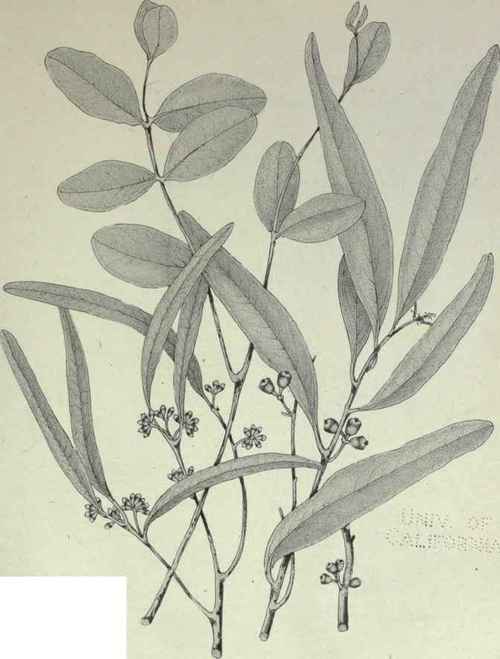
(R.T.B., Proc. Linn. Soc, N.S.W., 1899, p. 598, t. XL IV.) Spotted Gum or Brittle Gum.
Systematic. - A tree rarely exceeding 60 feet in height, usually from 20 to 40 feet. Bark smooth to the ground. Abnormal leaves thin, lanceolate, or oval lanceolate, 2 or 3 inches long, mostly alternate; intramarginal vein removed from the edge. Normal leaves lanceolate, or narrow lanceolate, falcate, not shining, same colour on both sides; venation faintly marked, or rather obscure, intramarginal vein close to or slightly removed from the edge, lateral veins oblique. Some trees have the leaves quite rigid and erect. Peduncles axillary, slender, under 6 lines long, bearing from four to" sixteen, occasionally twenty sessile or shortly pedicellate flowers. Calyx turbinate, about 1 line long; operculum of equal length to the calyx, obtuse.
Fruit.- Hemispherical mostly, occasionally slightly turbinate, shortly pedicellate; rim shortly domed; valves slightly exserted; about 2 lines in diameter.
In form they range from a small to a medium sized E. viminalis fruit, and in the latter case somewhat resemble those of E. Smithii.
Habitat. - Coast District of New South Wales-and Victoria.

REMARKS. - It grows in poor, open, forest country up to 50 or 60 feet in height, and from 1 to 3 feet in diameter, with a rather dense head. The bark is of different shades of grey, or bluish or yellow, with spots of about the same size and shape as those of E. maculata. Hook., the true "Spotted Gum." It has affinity with E. Smithii, R.T.B., in the fruits (in some instances) and particularly in the chemical composition of its oil. With the original "Spotted Gum." E. maculata. Hook, it has little or no affinity. On account of the markings on the bark it can with equal justice be called "Spotted Gum," as well as E. maculata, but to distinguish it from that species and to record its field character, the name of E. maculosa was given to it. The two species have so far not been found together in the same locality. It has in the past probably been confused in herbaria with E. hæmastoma, Sm. var. micrantha, D.C. or E. Rossii. Its chemical constituents connect it with E. Smithii, R.T.B., as also do the shape of the fruits, and occasionally the rough bark at the base of the trunk.
ESSENTIAL OIL. - Leaves and branchlets for oil distillation were obtained from Bungendore, N.S.W., in July, 1898. The yield of oil was 11 per cent. The crude oil was of a light amber colour, and had an odour resembling those of the cineol-pinene class. The presence of pinene in the oil was determined, but it is evident that the dextro-rotatory form does not predominate to any great extent; phellandrene was absent. The sesquiterpene was present in small amount. One peculiarity of the oil of this species is, that the right rotation of the crude oil is greater than that of the first fraction, thus indicating the presence of a constituent in the higher boiling portion which has right rotation. This peculiarity of rotation is of rare occurrence in Eucalyptus oils, because, generally, it is the pinenes or the phellandrene that determine the optical rotation of the oil, and, of course, these low-boiling terpenes come over first on distillation, so that, in most cases, the rotation of the first fraction of dextro-rotatory Eucalyptus oils is higher than that of the crude oil. This constituent is present in several of the oils at this end of the group (E. Rossii and others), and is eudesmol in the liquid form. (See the article dealing with this substance.)
The crude oil had specific gravity at 150 C. = 0.9158; rotation aD + 3.35°; refractive index at 200 = 1.4684, and was soluble in 1 3/4 volumes 70 per cent. alcohol. The saponification number for the esters and free acid was 21.3.
On rectification 2 per cent. distilled below 170° C. (corr.). Between 170-1880, 87 per cent. distilled; between 188-235°, 5 per cent. distilled. These fractions gave the following results: -
First fraction, sp. gr. at 15° C. | = | 0.9075; | rotation aD | + | 3.0°. | ||||
Second | " | " | " | = | 0.0176; | " | not taken. | ||
The cineol, determined in the crude oil by the phosphoric acid method, was 46 per cent. (O.M.).
Material of this species was also obtained at Towrang, N.S.W., in October, 1900. The oil was similar in character to that from Bungendore, although at this time of the year it had a higher specific gravity, a less amount of ester, and contained a greater proportion of cineol. It showed the same peculiarity in optical rotation and had the same solubility in alcohol.
The specific gravity at 150 = 0.92.29; rotation aD + 2.3°; saponification number 8.7, and was soluble in 1 3/4 volumes 70 per cent. alcohol.
The cineol, determined in the crude oil by the phosphoric acid method, was 58 per cent. (O.M.).
The above samples were mixed together, stored in the dark, and in November, 1919, the oil was again analysed. Very little alteration had taken place during the nineteen years it had been kept, except that the specific gravity had increased somewhat, and apparently the cineol a little also, although this alteration was not so pronounced as with the crude oils of some species. 82 per cent. distilled below 1900 C. The crude oil and the rectified portion gave the following result: -
Crude oil, sp. gr. at 150 C. | = | 0.9433; rotation aD + 3.7°; refractive index at 200 = 1.4688. | ||
Large fraction | " | " | = | 0.918.2; rotation aD + 2.4°; refractive index at 200 = 1.4624. |
The cineol was determined by the resorcinol method in the rectified portion, and calculated for the crude oil; the result was 65 per cent. By the rapid phosphoric acid method it was 55 per cent. when calculated for the crude oil.
Plate XLIII.
W. Maishall, del.
Eucalyptus Maculosa. R.T.B. A Spotted Gum
Continue to:


My Books

