


87. Eucalyptus goniocalyx
Description
This section is from the book "A Research On The Eucalypts Especially In Regard To Their Essential Oils", by Richard T. Baker, Henry G. Smith. Also available from Amazon: A Research On The Eucalypts And Their Essential Oils.
87. Eucalyptus goniocalyx
(F.v.M., in Fragm., vol. ii, 48, 1860.) A Mountain Gum.
Systematic- A very tall tree with a smooth bark, except for a few feet at the base, found mostly on basalt and granite ridges. Abnormal leaves cordate, sessile, acuminate, 6 inches long and 2 inches broad, dark-coloured above, lightish underneath; branchlets square. Normal leaves lanceolate, falcate,' sometimes as much as 2 feet long and 3 inches broad; venation fairly distinct, intramarginal vein removed from the edge. Peduncles axillary, few, under 1 inch long, flattened. Buds angular, sessile or shortly pedicellate, 7 to 8 lines long; operculum shortly acuminate, obtuse.
Fruit. - Ovate-truncate, oblong or hemispherical, pedicellate, only occasionally sessile; rim countersunk; valves inserted or, when hemispherical, the valves are slightly exserted; about 6 lines long and 4 lines in diameter.
The pyriform fruits closely resemble those of E. obliqua and E. Delegatensis and somswhat E. regnans. The hemispherical form is very much like those of Tristania conferta, a non-Eucalypt.
Habitat. - Coast range from the Blue Mountains, New South Wales, well into Victoria and South Australia.
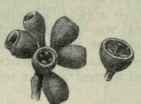
REMARKS. - The specific name in this case is not a good one, in that it applies much better to quite half-a-dozen other Eucalypts, and it is owing to this fact, that several good species have, in the past, been confounded with it. It is another instance where morphology fails in the classification of Eucalypts. "Mountain Gum" is one of the finest of our forest trees, but, unfortunately, is sometimes found in inaccessible gullies. The timber is hard, close-grained, interlocked, pale-coloured, and very durable. The timber alone differentiates this species from all others that have from time to time been confounded with it. Mueller's plate of this species in his Eucalvptographia appears to include species other than E. goniocalyx.
ESSENTIAL OIL.- Leaves and terminal branchlets for distillation were obtained from Monga, N.S.W., in August, 1898. The yield of oil was 0.96 per cent. The crude oil was lemon-yellow in colour, and had an odour resembling those of the richer cineol-pinene Eucalyptus oils. The presence of volatile aldehydes was pronounced. The oil of this species was rich in cineol, contained dextro-rotatorv pinene, but phellandrene was absent. Eudesmol was present in the crystallised form, and the fourth fraction consisted largely of that constituent, together with the sesquiterpene. On standing some time the crude oil became turbid, eventually depositing a whitish powdery substance. Many of the oils of this class of Eucalyptus form this deposit on keeping, although quite clear when freshly distilled. (See the article dealing with this substance in this work,)
The crude oil bad specific gravity at 150 C. = 0.9125; rotation aD + 7.2°; refractive index at 200 = 1.4689, and was soluble in 1 1/4 volumes 70 per cent. alcohol. The saponification number for the esters and free acid was 13.3.
On rectification 2 per cent. distilled below 1690 C. (corr."). Between 169-1710, 25 per cent. distilled; between 171-183 °, 60 per cent. distilled; between 183-2600, 5 per cent. came over, and between 260-275°, 4 per cent. distilled. These fractions gave the following results: -
First traction, sp. gr. at 15o C. | = | 0.9045; | rotation aD | + | 9.58o. | ||||
Second | " | " | " | = | 0.9110; | " | + | 5.6°. | |
Third | " | " | " | = | 0.9220; | " | not taken. | ||
Fourth | " | " | " | = | 0.9459; | " | " | ||
The cineol, determined by the phosphoric acid method in the crude oil, was 56 per cent. (O.M.). The pinene, when separated, readily formed the nitrosochloride, which melted at the correct temperature.
Material of this species was also obtained from Katoomba, N.S.W., in May, 1900. The oil was practically identical with the above. The yield of oil was 1 per cent. The specific gravity of the crude oil = 0.9117; optical rotation aD + 4.35°. The cineol, determined by the phosphoric acid method in the crude oil, was 55 per cent. (O.M.). Crystallised eudesmol was present, also pinene, but not phellandrene. The esters were valeric acid ester and an acetic acid ester, as the presence of both these acids was chemically determined. The crude oil formed a clear solution with 1 1/2 volumes 70 per cent, alcohol.
The above samples were mixed together and stored in the dark, and in August, 1919, the oil was again analysed. Not much alteration had taken place during the twenty-one years the oil had been kept; and no increase in cineol was observed. 90 per cent. distilled below 190° C. The crude oil and the fraction gave the following results: -
Crude oil, sp. gr. at 150 C. | = | 0.9127; rotation aD + 4.3°; refractive index at 200 = 1.4694. | ||
Fraction | " | " | = | 0.9078; rotation aD + 4.0°; refractive index at 200 = 1.4663. |
The cineol was determined by the resorcinol method in the fractionated portion and calculated for the crude oil; the result was 65 per cent. By the phosphoric acid method it was 56 per cent, when calculated for the crude oil.
In Wittstein's work (trans. F.v.M.), page 148, the oil of E. goniocalyx is stated to be pale yellow, of pungent, penetrating, rather disagreeable odour; taste, exceedingly unpleasant; specific gravity, 0.918; boils at 152-1750. These results agree closely with our own, thus indicating that the material had been distilled from the species stated. The presence of a fair amount of dextro-rotatory pinene is also indicated by Wittstein's figures of boiling-point, whilst the unpleasant odour mentioned is due to the predominance of the volatile aldehydes, and also perhaps to the esters. The yield of oil from this species, prepared for the Exhibition of 1862, was 1 per cent., which also agrees with our results. The relative constancy of constituents in the oil of the same species of Eucalyptus is thus again illustrated.
Plate XLIV.
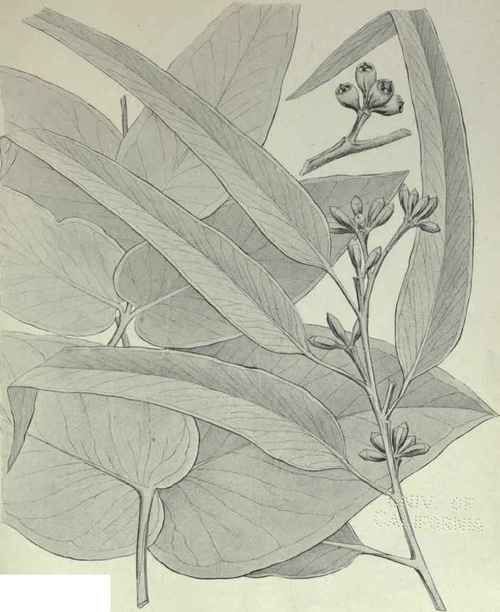
R.T.B., del. ad not eucalyptus goniocalyx. f.v.m. Mountain Gum.
Continue to:


My Books

