


Section III. Pelvic Girdle And Lower Limb
Description
This section is from the book "Handbook Of Anatomy For Students Of Massage", by Margaret E. Bjorkegren. Also available from Amazon: Handbook Of Anatomy For Students Of Massage.
Section III. Pelvic Girdle And Lower Limb

Fig. 19. Muscles and Cutaneous Nerves of Leg (Posterior View).
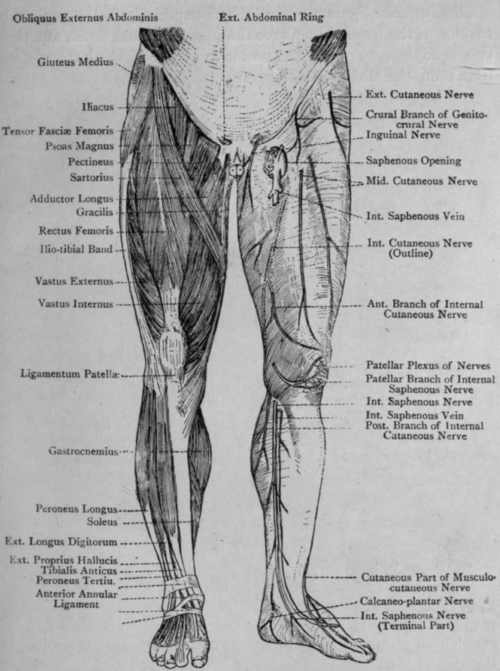
Fig. 20. - Muscles and Cutaneous Nerves of Leg (Anterior View).

Fig. 23. - Muscles of Leg.
Pelvic Girdle
The pelvic girdle consists of three bones firmly joined together, with two of which the two femurs articulate by means of ball-and-socket joints; the pelvic girdle and lower limb are analogous to the shoulder girdle and upper limbs (see comparison in Section I.).
The bones forming the pelvis are the two innominate bones, joined together in front at the symphysis pubis and articulating with the sacrum behind.
Innominate Bone
The Innominate Bone is a large, flat irregular-shaped bone consisting of three parts, which at birth are distinct, but in adult life become fused together in the same way that epiphyses fuse with the shafts in long bones. The three parts are respectively the ilium, ischium, and pubis, which join together to form the acetabulum, a deep socket which receives the head of the femur.

Fig. 11. - Innominate Bone.
Ilium
The Ilium forms a fan-shaped expansion, the top edge of which, the crest of the ilium, is thickened to give attachment to muscles. About two inches from the anterior end is a rough tubercle, which is the highest point of the crest, and can easily be felt in the living subject. The crest forms an S-shaped curve, the anterior half being convex outwards. The ends are termed respectively the anterior and posterior superior spines. The anterior margin of the ilium extends from the anterior superior spine to the margin of the acetabulum, of which the ilium forms the upper two-fifths. Halfway down the anterior margin is a rough tubercle called the anterior inferior spine.
The posterior margin extends from the posterior superior spine to the posterior margin of the acetabulum. A little way below the spine is another tubercle, called the posterior inferior spine; from this the edge of the bone curves sharply forwards, forming the great sciatic notch.
The ilium has two surfaces-internal and external. The external one is sometimes termed the gluteal; as it has three well-marked ridges-superior, middle, and inferior-which limit the origins of the gluteal muscles. The internal surface of the bone is divided into two parts-the posterior part, which takes up nearly half, is a rough auricular-shaped surface for articulation with the sacrum; while the anterior part, which is smooth, has a sharp well-defined oblique ridge, the ilio-pectineal line, from the auricular surface to the front of the bone. This marks the line of fusion with the pubis, and also divides the true pelvis from the false pelvis. Above the ilio-pectineal line the bone forms the shallow iliac fossa.
Continue to:


My Books

