


The Knee Joint
Description
This section is from the book "Handbook Of Anatomy For Students Of Massage", by Margaret E. Bjorkegren. Also available from Amazon: Handbook Of Anatomy For Students Of Massage.
The Knee Joint
The Knee-Joint is formed between the condyles of the femur and the superior surface of the head of the tibia. The posterior surface of the patella also enters into the joint.
A hinge-joint capable of movement round one axis only :
Transverse - flexion and extension.
A capsule surrounds the joint. It is, however, incomplete in front where the tendon of the quadriceps extensor takes its place. It has, as usual, distinct bands of fibres forming strengthening fibres; but they are not sufficient, so that expansions from the tendons of adjacent muscles are also found.
The Anterior Ligament (ligamentum patellae) is a strong flat band, the tendon of the quadriceps extensor, attached to the apex and margins of the patella, and continued on to be inserted into the anterior tubercle of the tibia. Expansions of the vasti tendons, called lateral patellar ligaments, augment this.
The Posterior ligament is attached superiorly to the popliteal surface of the femur just above the intercondyloid notch and the two condyles; below to the posterior border of the head of the tibia; on the fibular side, is an opening for the tendon of popliteus. The tendon of semimembranosus forms an expansion to strengthen the ligament, called the oblique popliteal ligament.
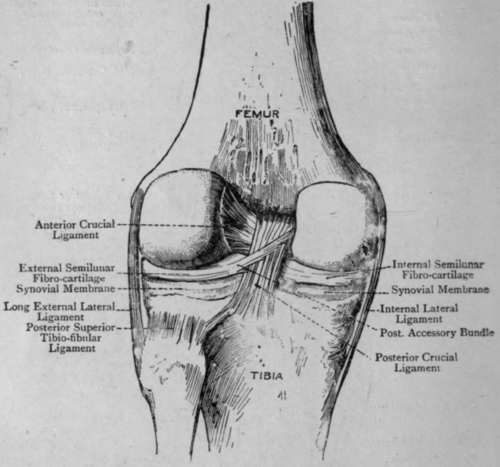
Fig. 21. - Knee-Joint (Posterior View).
The Internal Lateral ligament is a strong, flat band, rather wider in the middle. It is attached above to the inner surface of the internal condyle just below the adductor tubercle, and below to the inner surface of the internal tuberosity of the tibia, reaching round to the part above the groove for semimembranosus.
The External Lateral ligament is a rounded ligament attached above to a tubercle on the outer surface of the external condyle and below to the head of the fibula in front of the styloid process; at its attachment it splits the tendon of biceps. This ligament is inside the capsule and not part of it.
Continue to:


My Books

