


Effleurage
Description
This section is from the book "Lessons on Massage", by Margaret D. Palmer. Also available from Amazon: The Book Of Massage: The Complete Stepbystep Guide To Eastern And Western Technique.
Effleurage
This movement may be done with the lightest touch of the tips of the fingers, or with the whole palmar surface of the hand held in different ways, and with various degrees of pressure till it borders on pétrissage. Whatever pressure is made should be in the direction of the venous blood and lymph flow ; therefore in the limbs it is upwards and from the head downwards. The hand is not lifted at the end of a stroke, but glides back to where it started, without pressure and without losing contact with the patient. The various ways of doing this movement are :
1. The fingers are held straight and close together, but not stiffly. The tips, or cushions, are placed on the part to be worked—for example, the wrist ; a straight upward stroke is made with little pressure, the fingers glide back with no pressure, say twenty times. This form of effleurage is useful in the beginning treatment of sprains, in synovitis of the knee or any joint, and in neuritis. It may be done firmly at other times in the course of nerves.
1 'Fat and Blood.'
2. The cushions of the fingers to be placed in the same way and moved in overlapping circles, lightly and slowly moving on gradually without pressure. This is useful in insomnia, done on the spinal column or on the forehead. It allays irritability in a nerve after more vigorous treatment.
3. A straight stroke with the whole palmar surface of the hand held flat, the return stroke as before, twenty times.
4. The thumb is separated from the fingers and placed across the top of a limb ; the fingers are underneath, the limb being, as it were, held in the hand ; the strokes are made as before. This is a good way to effleurage the limb of a child ;
the hand embraces the small limb, and every aspect of it is done at the same time. It is also used on the inner and outer aspects of large limbs.
5. The hands are placed one on each side of a limb, fairly firm pressure is made upwards, both hands acting at the same time ; this borders on pétrissage, and is useful in cases of obesity.
6. The thumbs are placed parallel on the top of a limb, the fingers underneath, a sweeping upward movement with each hand alternately is made, gliding back almost to the starting-point, again sweeping upwards and back till the required space is covered.
This is a pleasant and soothing finish after other movements. Except the first two, all these movements are done rapidly. Dr. Douglas Graham gives the number of strokes as 100 to 160 per minute below the knee, and from 60 to 100 above. No. 1 is done slowly because it is used mostly over swollen and tender parts, No. 2 because slow movements are more soothing and more likely to quiet nerves and induce sleep.
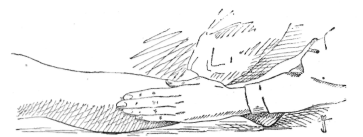
Fig. 1.—Effleurage with Straight Hand.
Effleurage acts on the skin, superficial fascia, and on the cutaneous vessels and nerves ; through the latter impulses are sent to the more deeply seated nerves. It quickens the circulation in the superficial veins, capillaries, and lymphatics, and the arterial circulation is also accelerated by venous pressure being lessened.
Continue to:


My Books

