


Petrissage
Description
This section is from the book "Lessons on Massage", by Margaret D. Palmer. Also available from Amazon: The Book Of Massage: The Complete Stepbystep Guide To Eastern And Western Technique.
Petrissage
This is a deep movement, and done on the muscles, which are grasped p>between the thumbs and fingers, or in the palms of the hands, and p>kneaded, rolled, and squeezed in the following manner :
1. With one thumb and index-finger any single muscle, or the muscles of the cheek or palm of the hand are grasped, the finger is kept steady, and the muscle is rolled back on it with the thumb, or the thumb is kept steady and the muscle is rolled back with the finger ; this is repeated several times—say five—then a very slight onward movement is made, and the kneading is repeated, and so on.
2. A group of muscles is grasped between the fingers and thumbs of both hands, the fingers being on one side and the thumbs on the other ; the thumbs are kept steady, and the muscle is worked back against them with the fingers, or vice versa ; repeat on the same spot five times, move slightly onward, and repeat. In this way the movements are continually overlapping, and no portion can be left undone.
3. The muscles to be grasped in the hand between the fingers and heel of hand or ball of thumb, and kneaded by the heel of hand against the fingers.
4. The arms or leg, where there are masses of muscles, is grasped between the hands one on,each side, the fingers (Fig. 2) are kept steady, while the thumbs and palms work against them with an upward, outward, and spiral movement, by which the tissues are rolled, squeezed, and kneaded. Every bit of the hand must be kept in close contact with the flesh, and the progress upward gradual. This movement is the most difficult to describe and to acquire ; it is also the deepest and the best.

FIG. 2.—Pétrissage with Palms.
5. The limb is grasped in both hands, one in advance of the other, very much as a cloth is held when being wrung ; the hands are twisted round the limb backwards and forwards, carrying the muscles with them ; the movement is called ' wringing,' and is very useful for the limbs of children suffering from infantile paralysis. It is a favourite movement with the little ones.
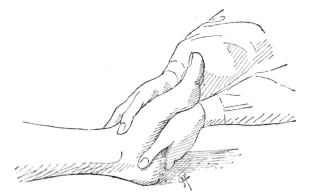
FIG. 3. — Pétrissage Of Sole Of Foot.
6. This movement, which is called pincement, differs from the others of this class in that the muscles are not worked on, but only the skin and immediately underlying tissue ; these tissues are taken up between the fingers and thumbs, the fingers on one side, the thumbs on the other, held end to end ; the thumbs work alternately in rotatory manner and press and squeeze the tissues against the fingers. It is a useful movement in obesity and œdema. The muscles may also be worked on in this way, especially when wasted ; they sometimes seem little more than connective tissue, and in such cases pincement is suitable. Pétrissage is the most important movement in massage. In it the muscles and other tissues are : (a) stretched and lifted from the bone ; (b) the nerves, bloodvessels and lymph vessels,. glands, and all tissues, are stimulated ; (c) by alternate compression and relaxation lymph is forced out of the spaces and into the lymphatics. By the same compression and relaxation veins are alternately emptied and filled, so that effete matter is sent onward, and a supply of fresh blood favoured. All this cannot be accomplished if the work is not deep. The muscles must be thoroughly gripped and well kneaded ; this does not mean that force should be used ; it is never necessary. The delicacy of the tissues worked on must be borne in mind, also that these tissues are bathed in lymph and surrounded by vessels prepared to carry away all that is not wanted by the tissues ; intermittent compression without undue force is all that is required to increase the activities of these vessels.
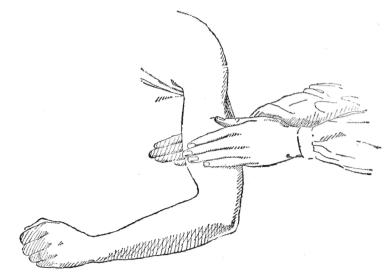
Fig. 4.—Fulling.
Fulling is a movement which may be classed with effleurage or pétrissage, according to the amount of pressure used ; by some it is called ' light friction rolling ' (Fig. 4), which places it under effleurage. By others it is described as ' kneading with both hands,' which places it under pétrissage. Its value is certainly enhanced if it is done firmly, the hands carrying the muscles with them. It was named by Ling from the way fullers scour cloth. One hand is placed under a limb, palm upwards ; the other over it, palm downwards, and exactly above the first hand. A rapid to and fro movement is made on the limb with both hands, as one does in warming the hands by rubbing the palms against each other. Several movements are made in one place before advancing. The advance is slight and the movement is repeated, thus overlapping the movements as before.
A kneading movement, which has some of the characteristics of both pétrissage and friction, is done in the following manner : The tissues are moved about in large circles by the tips of the fingers of the right hand, which are kept straight by the tips of the fingers of the left hand being placed on the second phalanges. It is called finger kneading.
Continue to:


My Books

