


Massage Of The Hand
Description
This section is from the book "Lessons on Massage", by Margaret D. Palmer. Also available from Amazon: The Book Of Massage: The Complete Stepbystep Guide To Eastern And Western Technique.
Massage Of The Hand
Hand.—The operator should stand or sit facing the patient, whose arm must be supported, if sitting, with the elbow on a table ; if in bed, with the elbow resting on the bed. The arm must not be raised nor pulled out from the shoulder, as it would be fatiguing to the patient.
1. To effleurage the fingers, each one is taken separately between the thumb and index-finger, held transversely to it and stroked from the nail upwards several times on the front and back and on the sides.
2. A pressure movement is then made by clasping the finger in the hand several times, or with the thumb and index-finger several small pressures may be given along the length of the finger.
3. To get at the very ends, each tip may be stroked firmly and rapidly towards the nail ; or held on a plane, they may be rubbed quickly with the palm of the hand.
4. In cases of rheumatism or stiff joints from any cause, special movements for the joints must be added to the above. They are, friction of each joint separately with the thumb; under, over, at the sides, every part well manipulated, also every joint gone over with an upward pushing movement with the thumb, the whole finger to be stroked at the finish.
5. Each joint is to be flexed and extended ; circumduction to be added to the first joint.
6. Back of Hand.—Friction with the thumb between each two metacarpal bones from the fingers to the wrist, several circles to be made each time before proceeding onward ; followed by effleurage with the thumb over some spaces.

Fig. 43.—Friction of Wrist.
7. Palm.—With the palm turned upwards, the balls of the little finger and thumb are kneaded with the thumb and index-finger, then an upward pushing movement with both thumbs in the hollow between. In matting of tissues or scars after palmar abscess or accidents, friction with the thumb is added, and the tissues are well stretched by being drawn from the middle line with both hands. Another way of doing the palm is to interlock the thumb with the patient's thumb, palm against palm, the fingers fixed at the back of the hand ; the palm is kneaded by a firm backward and forward movement of the operator's hand. The right hand is used for the right hand, and the left for the left. Support must be given at the back of the patient's hand.
8. The hand is taken between the two hands lengthwise, and rapid to-and-fro movements made alternately on the back and the palm (fulling) from the tips of the fingers to the wrist.
9. Wrist.—Friction with the thumb in all depressions between the carpal bones, followed by effleurage with the tips of the fingers and a circular movement with the balls of the thumbs.
Later on joints will be more fully treated of in regard to sprains, etc.
10. Passive movements.
The arm is grasped above the wrist ; the hand is grasped at the palm. Care must be taken not to hinder circulation by too firm a grasp, and to avoid making pressure on the edges of the bones.
Flexion, the hand is bent toward the forearm. Extension, the hand is straightened. If bent backwards, it is over-extension ; abduction, it is carried to the thumb side ; adduction, it is carried to the little-finger side. Circumduction is a combination of all these movements.
Active movements are done in the same way, but by the patient alone.
Resistive movements are done in the same way, but resistance is given. Thus, the wrist is supported by one hand of the operator, while the other hand, placed on the back of the patient's hand, resists the extension of the hand by the patient.
Flexion is resisted by the operator's hand being placed on the palmar surface of the patient's hand.
The amount of resistance is suited to the strength of the limb ; it should at first be slight and gradually increased.
In healthy joints the passive movement is continued till resistance is felt—that is, to the limit of the natural movement of the joint. In stiff joints resistance may be met at the outset ; then patience, gentleness and tact are needed, so as not to unnecessarily hurt or frighten the patient, especially if a child, as some force must be used. Where the muscles are wasted, they should be improved and strengthened by massage for some days before movements are tried. Massage should always precede the movements, and also be resorted to in between.
In joints with lax ligaments care must be taken not to exceed the natural limit of movement.

Fig. 44.—Effleurage with Flat Hand.
When the movement of a joint causes pain, patients frequently make conscious or unconscious resistance, thereby increasing the difficulty of movement and the pain. It is well in such cases to desist for the moment, and to engage the patient in conversation before a second attempt, so as to distract attention from the joint. Even when sincerely wishing to relax their muscles, patients have frequently much difficulty in not contracting them. The limb should be held so that only one joint is between the operator's hands.
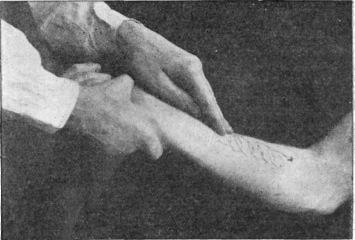
Fig. 45.—Circular Effleurage.
Continue to:


My Books

