


Massage Of The Forearm
Description
This section is from the book "Lessons on Massage", by Margaret D. Palmer. Also available from Amazon: The Book Of Massage: The Complete Stepbystep Guide To Eastern And Western Technique.
Massage Of The Forearm
The Forearm.— 1. Effleurage.—The forearm, somewhat flexed to relax the muscles, rests on and is supported by one hand, while the other makes straight, even, rapid strokes with the whole palmar surface from wrist to elbow ; without losing contact it glides back after each stroke. Twenty or more strokes may be made on the front of the arm, the same on the side next the hand that is working, the same on the other side and the back, the other hand being used. Thus the forearm is stroked in four divisions ; the hands must be fitted into the shape of the parts worked on. No break is made in the work in passing from one division to the other.
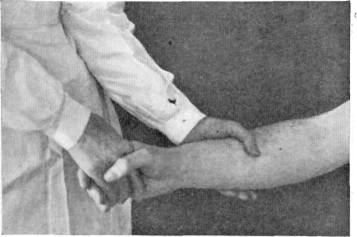
Fig. 46.—Effleurage with Thumb and Fingers.
2. Pétrissage.—With the heel of the hand work from the wrist to the elbow, first on one side and then on the other.
3. With both hands grasping, one at each side, deep kneading with palms (No. 4, p. 12) from wrist to elbow. Between each deep movement stroking should be done.
4. Fulling from wrist to elbow.
5. Squeezing from wrist to elbow.
Elbow.—1. Effleurage all over the joint.
2. Friction into all depressions.
3. Pétrissage with the heel of the hand.
4. Effleurage.
Passive Movements.—To flex, the arm is grasped above the elbow, the forearm above the wrists, and the forearm is brought up to the arm ; the hand should be carried out, the ulnar border to the outer border of the shoulder, so as to stretch the muscles of the chest. To extend, the arm is straightened.
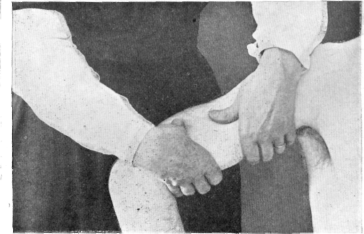
Fig. 47.—Pétrissage with Fingers and Thumbs.
To supinate and pronate, the elbow is grasped with the thumb in front, that the joint may be controlled. The hand is taken as in shaking hands ; the palm is turned upwards and then downwards. Care must be taken to really move the radioulnar joint, and not to merely twist the hand to and fro.
Resistive Movements.—The limb is grasped in the same way as in passive movements, resistance is given on the front of the wrist in flexion, and on the back of the wrist in extension.
Continue to:


My Books

