


The Leg
Description
This section is from the book "Lessons on Massage", by Margaret D. Palmer. Also available from Amazon: The Book Of Massage: The Complete Stepbystep Guide To Eastern And Western Technique.
The Leg
The bones of the leg are the tibia and fibula ; the tibia is the inner and larger bone, and articulates at its upper extremity by two tuberosities with the condyles of the femur to form the knee-joint. There is a facet on the external tuberosity for articulation with the head of the fibula. In front, below the head, there is a prominence called the anterior tubercle, to which the ligamentum patella is attached. Down the front of the shaft is a sharp edge called the crest of the tibia. The thick process at the lower extremity is the inner malleolus, which articulates with the astragalus and forms the inner ankle. The fibula is parallel with the tibia on its outer side, and articulates with it at both extremities. It does not enter into the formation of the knee-joint ; at its upper end there is a projection called the styloid process.

Fig. 50.—Tibia (Left).
1, Spine; 2, internal tuberosity ; 3, external tuberosity ; 4, internal malleolus.
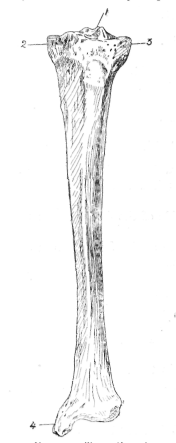
Fig. 51.—Fibula (Left).
1, Styloid process ; 2, external malleolus.
The shaft is very slender ; the lower end is the external malleolus, which articulates with the astragalus and forms the outer ankle. An interosseous membrane stretches between the tibia and fibula, and gives attachment to muscles. The patella is the third bone of the knee-joint ; it is a sesamoid bone developed in the tendons of the extensor quadriceps muscles.
Continue to:


My Books

