


The Lower Limb Bones
Description
This section is from the book "Lessons on Massage", by Margaret D. Palmer. Also available from Amazon: The Book Of Massage: The Complete Stepbystep Guide To Eastern And Western Technique.
The Lower Limb Bones
Innominate, or Hip-bone.
Femur, „ Thigh-bone,
Patella, „ Kneecap.
Tibia, „ Shin-bone.
Fibula, „ Splint-bone.
Tarsal, „ Bones of foot.
Metatarsal, „ Bones of foot.
Phalanges, „ Bones of toes.
The innominate bone forms part of the pelvis. In early life it consists of three parts :
(1) Ilium,
(2) Ischium,
(3) Pubis.
The junction of these three bones forms a cup-like cavity called the cotyloid cavity, or acetabulum, which receives the superior head of the femur and forms the hip-joint. The cavity is deeper than that of the shoulder, and is further deepened by a rim of fibro-cartilage, called the cotyloid ligament. The round head of the femur is more prominent than that of the humerus ; for these reasons the hip-joint is not so freely movable as the shoulder-joint.
The femur is a long, cylindrical bone, the longest and strongest in the skeleton. It consists of a superior and inferior head and shaft. The neck connects the superior head with the shaft ; below the neck are two protuberances, the greater and lesser trochanters, which give attachment to muscles.
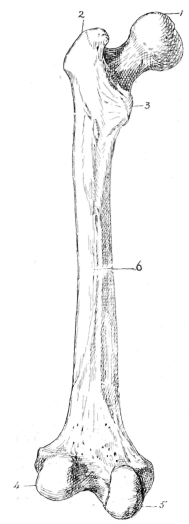
Fig. 49.—Back of Femur (Left).
1, Head ; 2, great trochanter ; 3, less trochanter; 4, external condyle ; 5, internal condyle ; 6, linea aspera.
Down the back of the shaft there is a rough line running down called the linea aspera, to which muscles are also attached. The inferior head is flattened ; it has two tuberosities and two projections, called condyles, internal and external. There is a deep notch between called the intercondyloid notch. Several muscles of the leg are attached to the condyles of the femur.
Continue to:


My Books

