


(A) Superficial Stroking Massage
Description
This section is from the book "Massage Its Principles And Practice", by James B. Mennell. Also available from Amazon: Massage It's Principles and Practice.
(A) Superficial Stroking Massage
Though it is possible to trace a reflex response to most of the movements of massage, this is the only movement which aims at securing no other effect.
The essentials to remember in using this treatment are that our movements must be slow, gentle, and rhythmical.
The slowness is important, as without it the other two essentials are impossible. If the stroke is to pass from hand to shoulder, some fifteen movements a minute will suffice. Moreover, the movement of the masseur's hand must throughout be continuous and even, not only while the hand is in contact with the part, but also during its return through the air, when there must be no contact. Occasionally we hear it stated that loss of contact between the hand and the part is conducive to a chilling of the patient. This can only be due to inefficient performance, when the movement may convey a "creepy" sensation. This is usually the outcome of timidity, or of lack of training and practice.
The call for gentleness is obvious, as we are avowedly attempting to secure no mechanical effect. The firmness of the pressure should be sufficient only to ensure that the patient is actually conscious of the passage of the hand throughout the entire movement. Thus there should be no question of the patient being able to detect the passage of the hand over a certain point during one movement while being unable to note it during subsequent movements. Otherwise the sensation conveyed by one movement cannot be identical with that conveyed by each subsequent movement. Firmness is essential, but only the lightest possible pressure.
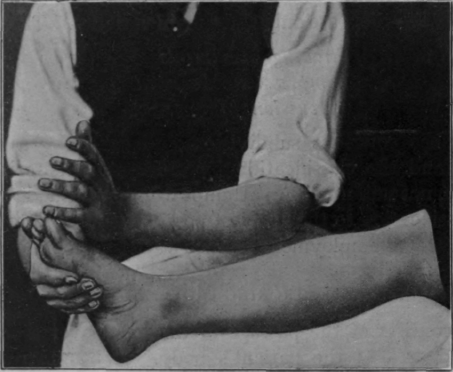
Fig. 5. - Showing upward surface stroking of the lower extremity. In practice, in order to secure the fullest effect, the stroke should be continued up the thigh. Note that the "stroke" commences before the hand comes in contact with the limb, and also the slight flexion of the knee.
The need for rhythm can be readily understood, as without it the nature of the stimulus will be uneven, and the reaction also will thereby be rendered uneven.
There should be no sensation of jarring at the beginning or end of the stroke, and the time that elapses between the end of one stroke and the commencement of the next must be identical throughout the whole of the treatment. To attain all these requisites it is essential to develop a "swing," and the portion of the "swing" which takes place with the hand out of contact with the limb is as important as that during which hand and skin are in contact. Throughout the treatment the masseur's hand must remain supple, with all muscles relaxed, so that it may mould itself naturally to the contour of the limb, thus ensuring greater perfection of contact, and bringing as wide an area as possible under treatment (see Figs. 5, 6, 7).
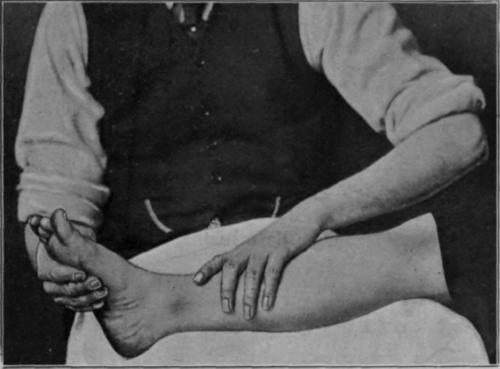
Fig. 6. - Showing upward surface stroking of the lower extremity, the middle of the "stroke." Note how the hand is adapting itself to the contour of the limb. There is no fear of the patient noticing any "scratching" or tickling sensation.
The last point to consider is the direction of the stroke, when we are applying this form of massage to the limbs. Provided that the three essentials are carried out, this is a matter of minor importance. In his book on the treatment of fractures Lucas-Championniere inveighs heavily against the use of any stroking in a direction opposed to that of the venous flow. But the context proves that he had in mind the so-called massage which is meted out after a Turkish bath, and surely it is impossible to imagine anything more devoid of scientific excuse than any form of heavy stroking against the venous return. But we are speaking now of the massage of skilled workers employed in the treatment of injury or disease, and of a movement which the French master referred to as "little more than a caress." If we wish to secure nothing but a reflex response to our movement, it may safely be left to the patient to decide the direction. If movement in one direction is more pleasing than another, there can be no objection to using it, even though the movement be centrifugal. Surface stroking "against the grain" of a hairy limb may be devoid of comfort, and, if so, it cannot be expected to call forth a beneficent reflex. It can only annoy. Shaving the part might be expected to help: it does not, and the process is not recommended save in the rarest of cases. But whatever may be the direction chosen, one rule must be strictly adhered to, namely, that the stroking is performed in the one direction only. Thus, if we are stroking the back of a patient suffering from insomnia, our stroke should be from cervical or thoracic region downwards, or to the cervical or thoracic region upwards, never from sacrum to thoracic region and then out over the shoulder with a downward tendency at the end. In the same way, if a leg is being stroked upwards, the utmost care must be taken not to allow the hand to come into contact with any part of the limb during the return; otherwise the stimulus will be broken and the reaction thereby rendered imperfect.
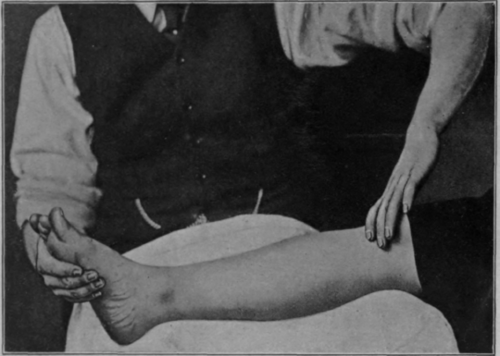
Fig. 7. - Showing upward surface stroking of the lower extremity, the finish of the "stroke" just before contact between hand and skin ceases. Although reference is made to the "commencement" and the "finish" of the "stroke," it must be clearly understood that the "finish" represents equally well the "commencement" of the return of the hand through the air. As the movement is continuous, there can be no "beginning" or "end."
Some people seem to be totally unable to learn the art of surface stroking. It is the simplest, but apparently the most difficult, of all the movements of massage. The discomfort to the patient of inefficient stroking must be experienced to be believed. The most common mistake is to scratch the patient with the pads of the fingers towards the end of each stroke. A second common error is to ignore the necessity for controlling the return of the hand through the air, and so to make this part of the movement less rhythmical than the stroking itself. A third main fault in technique is to ignore the necessity of selecting one definite direction for the movement, and, once having made the selection, of abiding thereby. One point is often overlooked. Not only the hand, but every joint in the limb must be perfectly relaxed and perfectly supple.
It is often possible to secure reflex action in deep-seated structures as the result of superficial stroking, such as contraction of the stomach due to stimulating the left lower intercostal nerves, and stimulation of the rectum by stroking over the gluteal area. These will be dealt with subsequently, each in its separate place.
Continue to:


My Books

