


(B) Deep Stroking Massage
Description
This section is from the book "Massage Its Principles And Practice", by James B. Mennell. Also available from Amazon: Massage It's Principles and Practice.
(B) Deep Stroking Massage
This is usually referred to as effleurage. Unfortunately some writers regard effleurage as essentially a superficial movement. If the movement is performed over muscles which are held contracted, doubtless this is the case. But if the musculature is relaxed throughout the treatment, as here advocated, even a light pressure must influence every structure throughout the part treated (cf. p. 14). Effleurage should always be performed centripetally, as is the case with all "deep" movements. Although the movement is here described as "deep," it must be emphasised, even ad nauseam, that the depth of the movement depends solely on the presence of relaxation of the musculature throughout the part. Thus the movement may be "deep" without in any sense of the word being "forcible"; and, as applied to the manipulations of massage, the terms are not synonymous, though the practice of many masseurs would lead one to suppose that they were so. The movement is intended to assist the restoration or maintenance of the tone of the vasomotor system, to assist the venous flow and the circulation of the lymph, and, incidentally, thereby to improve the vascularity of the part and to hasten the elimination of waste products. It may be used to quicken mechanically the movements of the contents of some hollow viscus, or to secure some reflex response, such as an increase in peristaltic movement.
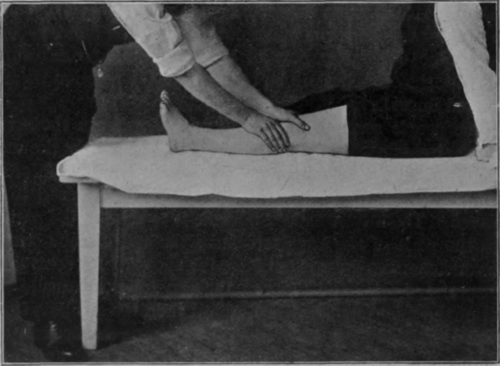
Fig. 8. - Upward stroking of the lower extremity to illustrate some common faults in position.
(A) Of the patient.
(i.) General discomfort, head unsupported, abdominal muscles contracted. (ii.) Knee fully extended, thigh muscles tense. (iii.) Foot uusupported.
(B) Of the masseur.
(i.) General discomfort, great strain on back muscles, and on knees. (ii.) Inability to reach whole of limb. (iii.) Inability to render support to limb. (iv.) Regularity of movement or pressure quite uncontrolled.
The resistance offered by muscular contraction to deep stroking is so great as to render it practically useless. As the first essential is to ensure that the whole part under treatment is in a state of perfect relaxation, careful attention must be given to the posture not only of the part under treatment but of the patient's whole body. If necessary, relaxation must be procured by preliminary superficial stroking. If the muscles are relaxed, they offer no more resistance to the movement than so much fluid, and therefore it is obvious that any pressure, exerted on the surface, will be transmitted freely to all the structures under the hand. To attain any of the objects in view in using the movement, except perhaps the mechanical emptying of a dilated stomach, a pressure of 10 mm. of mercury will suffice. A little practice, combined with a skill that is born only of a sensitive sense of touch, will show how delicate may be the pressure which will suffice to compress any structure to its full extent, and therefore, incidentally, to empty the veins and lymphatic spaces. Also there is no call for great rapidity of movement. The flow of blood in the veins is slow, and of the lymph in its channels still slower. There is no object in performing a movement to empty a vein if sufficient time has not elapsed for blood to flow into it since the last movement ceased. Moreover, a heavy pressure, a very rapid movement, or even a jarring contact may convey to the patient the fear of a possible chance of injury, be the fear conscious or subconscious. A protective reflex may then be established, the muscles may contract, and the one condition under which we can perform our work to the greatest advantage thereby be demolished. If we are fortunate enough to escape this sequel, we shall run the danger of forcing the arterial blood against the stream, unless we keep the pressure we exert within moderate bounds.
Unless contra-indications exist, we may take it for granted that deep stroking should commence over the proximal segment of a limb before we attack the distal, so as to ensure the "removal of the cork from the bottle."
In performing all stroking movements the points that require most attention are the position of the patient and of the masseur and the relative position of one to the other. Especially is this the case in the treatment of the limbs. An attempt has been made in Fig. 8 to illustrate common faults in position of the patient and masseur. It will be noted in illustrations 5, 6, and 7 that, contrary to the teaching of some schools, the masseur works from the side of the patient instead of from the end of the outstretched limb. This enables him to ensure an evenness in his work which is well-nigh impossible in the "faulty position." The other point which will be noted, as being at variance with the procedure sometimes advocated, is that the ulnar border of the hand is allowed to lead the movement as freely as the radial border. By this means it is often possible to secure a greater amount of regularity both of pressure and movement.
Deep-stroking massage is frequently applied to the abdomen. It stimulates peristalsis by the reflex response of the unstriped muscle to mechanical stimulation, and may help to move the contents of one piece of bowel into that next adjacent. In treating the caecum and the ascending and descending colons, this movement may be used with great benefit; but we must remember that, to attain the greatest benefit, the same rule must be observed which we saw was essential in the treatment of oedema, namely, to ensure that the exit is free before we try to empty it. Thus if we wish to empty the caecum the place to commence our stroking is over the descending colon, then over the transverse colon (if we know where to find it), and finally over the ascending colon before the area of the caecum is attacked. Let us remember, however, how great is the difficulty experienced when we try to empty a piece of bowel of its fluid contents by mechanical means.
It is possible also - the claim is usually definitely made but without explanation to justify it - that by our massage we are able to promote glandular activity in the bowel (cf. p. 8). The increased peristalsis will undoubtedly assist us directly, and will also aid indirectly by demanding an increased blood supply. At the same time our massage is assisting the abdominal circulation and aids the onward passage of lymph and chyle. Doubtless the improvement in circulation will materially assist the glandular activity. It is, however, a secondary and not a primary effect.
Continue to:


My Books

