


Chapter V. The Movements Of Massage. 2. - Compression Movements
Description
This section is from the book "Massage Its Principles And Practice", by James B. Mennell. Also available from Amazon: Massage It's Principles and Practice.
Chapter V. The Movements Of Massage. 2. - Compression Movements
This is used if we wish to exert local pressure at any definite point, and is usually applied to a series of points. The movements fall under three heads: -
(a) Kneading.
(b) Friction.
(c) Petrissage.
A considerable amount of confusion exists as to the definition of the exact movements which should be comprised under each head. The fact is that the movements so closely resemble one another that it may be almost impossible to differentiate between kneading and the picking-up movements of petrissage. From the clinical point of view the line of demarcation appears to be purely arbitrary, as there can be little or no difference in therapeutic effect (provided the part is relaxed) between, say, pressing the superficial flexors of the forearm upon the deep flexors (usually called kneading) and picking up the whole muscle group in the hand as far as possible and gently squeezing it (petrissage). The first is a vertical compression of the tissues as compared with the lateral compression of the second. Then, again, friction is a term often wrongly applied to the administration of a purely local pressure given with, say, the tips of the fingers, while kneading is the term applied if the pressure is to be exerted with the whole surface of the hand. "Kneading" is a term which should be confined solely to movements which aim at securing circulatory effect, while "friction" should be held to indicate that the movement is of small amplitude and aims at dispersing the products of pathological change, whether due to past trauma or to chronic disease. Occasionally it is used with other objectives, as will be explained later. There are, however, definite points in the mechanical performance of the movements which serve to differentiate them, even though the division between them is arbitrary and the difference of therapeutic effect more imaginary than real.
To be effective, absolute relaxation is essential throughout the performance of the movements. As in the case of effleurage, the attainment of this essential desideratum can be rendered impossible if the movements are carried out with sufficient vigour to call forth a protective reflex contraction of the muscles. Thus care and gentleness are the key to success: vigour, excessive rapidity, and undue pressure are all inimical. Repetition may serve to emphasise the fact that in relaxation the tissues of the body respond to pressure as would fluid in a bag, and that very slight pressure suffices to empty veins and lymphatics, while any heavier pressure may force the arterial blood against the stream.
(a) Kneading may be applied to the limbs, the back, and the abdomen. It is usually described as a deep movement, but some authors prefer to describe it as "superficial" to distinguish it from the "deep" movement of friction. If perfect relaxation is present, the pressure in either instance must, by all the laws of hydrostatics, be transmitted throughout the segment of the part under treatment, and the movement hardly less so. Thus the distinction between "superficial" and "deep" is unimportant.
(i.) Kneading of the limbs is performed with the two hands placed on opposite sides of the limb, the whole of the palmar surfaces being in contact with the part. Gentle pressure is then exerted and a circular movement performed, the hands usually working in opposite directions. Firmer kneading is performed in a similar manner for chronic cases with infiltration of the tissues. The pressure is so regulated that it is not even throughout the movement, but should be greatest while the hand is engaged with the lowest part of the circumference of the circle, and least when at the opposite pole. This is effected by imparting a slight rotation to the wrist, the hand being more supinated below than above (see Figs. 9 and 10). In this way we can imagine that a sort of pumping action is exerted on the fluid contents of the limb. The movement commences over the proximal portion of the limb; the pressure is then re-applied at the next most distal part and the movement repeated. The two portions are then stroked firmly, or perhaps the first is again kneaded before a third more distal part is treated. It is sometimes said that the idea of the movement is to roll the superficial structures on the deep - in fact the movement is sometimes referred to as "rolling." In perfect relaxation the soft tissues might be "rolled" on the bone; but, as this is usually undesirable and to be avoided with care, the action produced should be rather that of a wavelike motion throughout the limb. The point (or rather pair of points) from which the wave is transmitted is fixed, as distinct from the movable point when the wave is set in motion by deep stroking.
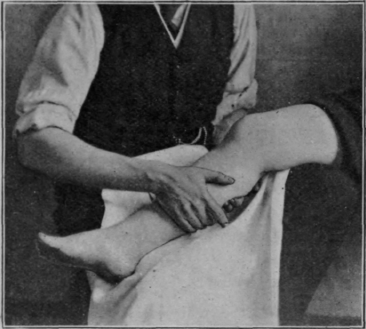
Fig. 9. - Kneading. First position.
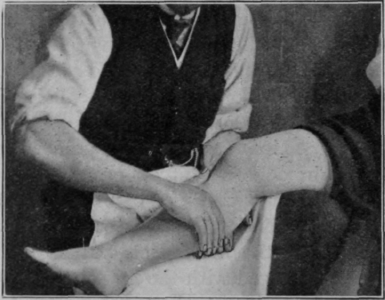
Fig. 10. - Kneading. Second position. Note the relative pronation. The rotation is exaggerated for purposes of reproduction.
The objectives in view when kneading a muscle mass may be many, and amongst them are the following: - To assist nutrition by reflex via the vaso-motor system and by mechanical effect on the unstriped muscle of the arterioles, and so to influence every structure in the limb; to assist the flow of lymph and hasten the removal of oedema; to bring a sense of comfort and well-being to the muscles and thus render them the more ready to perform exercise; and, after exercise, to prepare the way for greater or more prolonged effort by hastening the removal of waste products. There is a common delusion that kneading a muscle - "working a muscle up" is a common phrase - will of itself build up muscular strength. Until this delusion is eradicated massage treatment will never be free of an element of charlatanism. By one means alone can muscular strength be developed, and that is by muscular contraction, and no form of massage can do more than aid this means indirectly. Nevertheless, by excessive kneading it is possible to produce in a wasted muscle all the symptoms of acute fatigue. At the same time massage can beyond all doubt counteract all the effects of muscular fatigue more rapidly than even rest; and is able, by reviving the power of spontaneous action, materially to assist the patient to build up his own muscular strength. None the less it is not the massage which accomplishes the restoration, it is only a means to an end, the end being muscular contraction and relaxation. Kneading can also be used to aid in the stretching of pathological shortening of soft tissues and of adhesions, and is of great service in resolving any general matting together of the former.
(ii.) On the back kneading is performed in a similar manner, working from below upwards, so as to impart to each portion of the muscle-mass an alternating wave of compression and relaxation. A lateralisation movement is also accomplished. Unless it is desired to loosen anything in the form of adhesions or to disperse pathological deposits, the kneading movement so often applied to the erector spinae has no scientific excuse. It aims, apparently, at forcing the blood in one direction with one hand and in the opposite direction with the other. It is quite easy to obtain the lateralisation effect with deep stroking, and, by using this instead, the flow of fluid in the tissues is maintained in one direction.
(iii.) Kneading of the abdomen will be dealt with in a subsequent chapter. Here it suffices to say that a common type of description of this movement is somewhat as follows. Kneading consists (a) of making alternate pressure first with the heel of the hand and then with the fingers - a sort of see-saw movement; (b) of circular kneading by pressure with the radial border of the hand, tips of the fingers, and ulnar border in turn; or (c) of kneading the colon with the palmar surface of the fingers on the ascending colon, rolling the hand over so that the ulnar border presses on the supposed position of the transverse colon, while the ball of the thumb finishes up the movement along the descending colon. A description of this type simply ignores the fact that abdominal massage treatment should be performed not solely to hasten the passage of the abdominal contents, but also with many other objectives. Moreover, the raison d'etre of the first two movements is not very plain. The see-saw movement might be performed over a piece of small bowel so as to exert pressure in the opposite direction to the flow of its contents, while the second is almost certain to do so at some points. The last movement would probably be better performed by plain stroking and intermittent pressure over one spot. If the idea of performing the movement as described is that any of the contents of the caecum are thereby pushed into the ascending colon and thence via the two flexures and transverse colon into the descending, the sooner it is abandoned as hopeless the better. Yet this is another common delusion which it will take years to eradicate. Were we actually to perform such a feat, the chances are we should be able to produce an involuntary evacuation of the bowels by a mere movement of the hand 1
Any of the movements mentioned will, however, have the effect that the part of the bowel pressed upon will respond by the contraction of the unstriped muscle to the mechanical stimulus. Care must be taken, however, to ensure that the pressure is not sufficient to tend to paralyse the part pressed upon, in the same way that paralytic vaso-dilatation can be inflicted by the too vigorous massage of a limb. It should be noted that not more than three peristaltic waves pass along any given portion of the bowel in a minute.
Continue to:


My Books

