


Massage And Splintage In Orthopaedic Surgery. Part 6
Description
This section is from the book "Massage Its Principles And Practice", by James B. Mennell. Also available from Amazon: Massage It's Principles and Practice.
Massage And Splintage In Orthopaedic Surgery. Part 6
When, however, deformity is present, and we wish by splintage to exert a constant tension, which shall stretch the offending structures responsible for the deformity or for any impediment in movement, the principles involved vary only in one detail. This is that all movement in the opposite direction to that which we are trying to enforce shall be absolutely cut off. But, on the other hand, it is of immense importance, whenever possible, to ensure freedom of action for the muscles that control the movement which is lacking.
Thus the cuff-and-collar principle is nearly ideal (see Fig. 76, p. 150). It would be quite so were the tension exerted not so entirely dependent on the position of the shoulder which remains mobile. Adduction across the front of the trunk loosens the tension, abduction tightens it. Tension on the fingers by means of tapes is another good example of this method of treatment, but the disadvantage of the pattern shown in Fig. 96 (p. 208) is that it is unduly painful owing to pressure on the back of the joints involved. As a preliminary to securing flexion in rigid fingers by means of splintage and tapes, tension in the longitudinal direction is most desirable. This tends to overcome adaptive shortening in the lateral ligaments of the joints, which is one of the main causes of impediment to movement. Sometimes the hand is placed in a plaster cock-up splint and adhesive strapping applied to the fingers. In this case the strapping should be confined to the distal phalanges. The disadvantage is that it may slip, and the tension on the tapes tends to pull the splint forward into the palm of the hand. To be successful the palm piece must never pass the middle cross-line of the palm. For these reasons I devised the use of a posterior plaster splint (see Figs. 163 and 164). This is ideal in principle, but is dependent for its action solely on the activities of the flexor muscles. Both splints illustrated satisfactorily impede the action of the extensors, but fail when anything but a very small degree of pressure is required, as the position of the palm of the hand is so difficult to control.

Fig. 163. - A posterior plaster splint which inhibits over-action of all the extensors while allowing perfect freedom of action to the flexors of the fingers.

Fig. 164. - A posterior plaster splint which only inhibits over-action of the extensors of the metacarpo-phalangeal joints. There is a tendency for this splint to "rest" the interossei as well. In practice, when these muscles are paralysed, the interphalangeal joints remain extended when the proximal joints are flexed and the long flexors are also at rest. The latter are, of course, free to act; but, on relaxing, the fingers tend to straighten when this splint is applied. If, on the other hand, the interossei are paralysed and the metacarpo-phalangeal joints are free to extend, flexion deformity at the interphalangeal joints is inevitable.
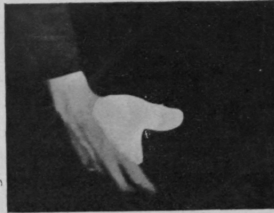
Back view.
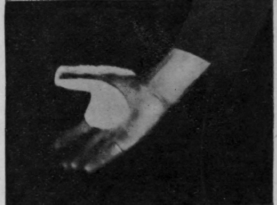
Front view. Fig. 165. To show the application of a thumb abduction splint. Note that the splint is applied with the first metarcarpal in opposition. The distal phalanx of the thumb is usually left free.

Fig. 166. - Capt. Verrall's supinating (or pronating) plaster of Paris splint.
A splint of similar construction was devised by, I believe, Capt. Teece at Shepherd's Bush. In cases of fixed adduction of the thumb he inserted a plaster splint over the web between the thumb and the index finger (see Fig. 165). Abduction was in no way restricted. The splint was replaced as the shortened structures stretched.
A splint which satisfies the main principles is that for rotation of the forearm devised by Capt. Verrall (see Fig. 166), while the "drop-heel-plaster" splint - a walking plaster in which the heel is supported only on a pad, while the fore part of the foot rests upon the splint - illustrates another type of "tension" splint, the tension now being one that is very constantly repeated, and intermittent - but not constant.
It might be thought that in using splints of this type recovery could be anticipated regardless of the good-will and co-operation of the patient. To a certain extent this is so. But two things are sure: first, that the patient who diligently does all in his power to assist his treatment by constant voluntary contraction of the muscles, which control the movement that is lacking, will improve vastly more rapidly than he who merely relies on his splint; and second, without the co-operation of the patient, relapse is almost certain.
Continue to:


My Books

