


The Treatment Of Neuralgia And Neuritis. Part 3
Description
This section is from the book "Massage Its Principles And Practice", by James B. Mennell. Also available from Amazon: Massage It's Principles and Practice.
The Treatment Of Neuralgia And Neuritis. Part 3
Little or nothing can be done by massage to relieve neuritis due to organic disease, such as malignant tumours, aneurism, or caries. When paralysis follows pressure on the cord due to caries, massage can aid the nutrition of the paralysed limbs and contractures can be prevented. Surface stroking is occasionally of service and may be given a trial. It is unwise to persevere with any form of treatment by physical methods, unless benefit is definite and immediate. Relief, however trifling, should encourage perseverance; failure to secure it indicates that treatment tends to aggravate the evil. One form of pressure neuritis can be greatly alleviated by massage, that is, when pain in the leg, or spasm of the calf muscles, is due to intra-abdominal pressure during the later stages of pregnancy. Firm stroking and gentle kneading of the whole limb will often secure complete relief.
Neuritis caused by the involvement of a nerve in scar tissue is invariably troublesome. The only hope of cure is to shake the nerve free. Vibration is the chief remedial agent at our disposal. In its application the utmost tact must be displayed. One example of this troublesome condition must suffice, so let us take, for instance, the neuritis that follows amputation of the fingers. A most disabling condition arises from the pain experienced at the site of the wound, when one of the digital nerves happens to have been caught in the stitches and has thus become firmly embedded in the scar. Baths and stroking may relieve the pain for the moment; they will not cure. Ionisation may do the same, but the great hope of permanent relief lies in vibration. Local treatment will aggravate the pain, and it is essential to avoid the stumps altogether during the early stages. The vibrator should be applied to the hand near the wrist, if, indeed, this can be borne in comfort; if not, treatment must begin on the forearm. The fingers are gradually approached until the patient complains of discomfort. Then a slight withdrawal must be made. The whole palm and back of the hand must gradually be included, and finally the adjacent fingers, before the injured digit itself is treated. As soon as the vibrator can be tolerated close to the site of the scar, the flesh of the finger can be submitted to a rolling movement, which is best imparted by using the two forefingers (see Fig. 144). One of the most troublesome elements in the treatment of this condition is the fact that pain not infrequently persists only in the patient's memory. This is known as "memory pain." It may, of course, be present in any condition where pain has been a prominent symptom. Diagnosis is difficult in the extreme, and physical treatment, of course, tends to confirm it. Sooner or later the attentive masseur will notice that the painful spots can be touched with impunity when the patient's attention is distracted. Psychical treatment is then indicated.
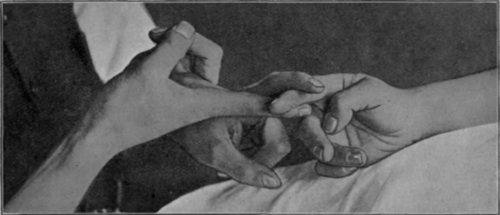
Fig. 144. - To show the grip for rolling the flesh of a digit to loosen the tissues when a nerve has been caught in the scar.
Massage treatment for metatarsalgia (Morton's disease) is useless by itself; as an adjunct to remedial exercise it is invaluable. The pain may be due to a pressure neuritis, the digital nerves being pressed upon by the heads of the metatarsal bones, the fourth being the chief offender. A tight boot may compress the nerves between the heads of the fourth and fifth metatarsals. The pressure is made possible by the dropping of the anterior metatarsal arch. More commonly pain in this region is due to bruising of the heads of the metatarsals or to traumatic arthritis. While there is no weight upon the foot there is no pain, so treatment must aim at correcting the deformity. Sometimes great relief can be secured by strapping the arch with adhesive plaster or with a broad band of elastic; this alleviates but does not cure. The foot should be encircled obliquely just behind the heads of the first and fifth metatarsals. Beneath the elastic or strapping a pad of felt should be applied to fit accurately the concavity formed by the heads of the bones. Further details of treatment will be given in the chapter dealing with deformities (see Chapter XXXI (The Treatment Of Deformities).).
Occasionally neuritis may affect other portions of the foot. Sometimes the whole sole of the foot may become intensely sensitive after any prolonged illness; in other cases the heel only may suffer (pododynia). These complaints are probably a true neuritis. In treatment the whirlpool bath should invariably be given a trial as a preliminary to massage, and the latter should take the form of surface stroking, the sensitive areas being gradually approached via leg and dorsum of foot.
As tolerance is acquired, deep stroking, vibration, and kneading follow in this sequence, and treatment should progress till all forms of percussion massage can be given freely.
Non-traumatic neuritis of sensory nerves is due to toxicity or joint disease. The latter type will be referred to later when considering the treatment of osteo-arthritis. Sciatica may be taken as typical of the former.
There has been, probably, more dispute as to the efficacy of massage in cases of sciatica than in any other form of illness for which massage is commonly prescribed. Physicians as a rule are very chary in prescribing it at all, and very few indeed will do so during the earlier stages. The truth is that, in the early stages, neuritis affords excellent opportunity for the abuse of massage treatment; and, later on, transitory increase in the symptoms may be inseparable from recovery. This may appear to be an injudicious statement, but few physicians would expect complete and instant cure of pain to follow exploration of the nerve and violent stretching, or even simple stretching, under an anaesthetic. Massage or manipulation likewise cannot afford immediate relief, as if adhesions have formed they must be broken or stretched, and this cannot be done altogether painlessly. The whole art is to accomplish the feat with the minimum of discomfort. This can only be done by starting treatment with the utmost care and gentleness, gradually increasing its severity as the patient's condition indicates the possibility. Cupping, as described on p. 370, will often pave the way for other forms of treatment, particularly when applied to the gluteal region.
Continue to:


My Books

