


2. Cylinder-Celled Epithelioma
Description
This section is from the book "A Manual Of Pathology", by Joseph Coats, Lewis K. Sutherland. Also available from Amazon: A Manual Of Pathology.
2. Cylinder-Celled Epithelioma
This is a tumour of parts where cylindrical epithelium normally covers the surface, hence it is found chiefly in the stomach and intestines, and more rarely in the uterus. As cancer of the stomach and intestine is of very frequent occurrence, this tumour, which is the most common form in these parts, is very often met with.
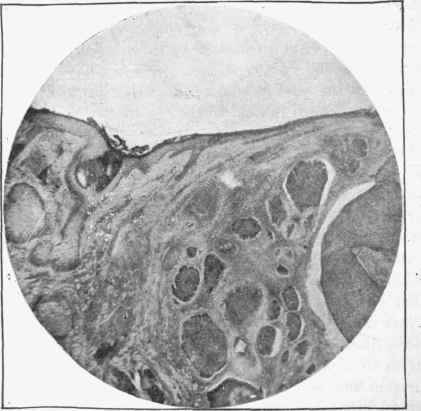
Fig. 111. - Rodent ulcer. To the left the normal skin structures, including part of a hair-follicle and sebaceous gland. To the right masses of cells, which undermine the epidermis and cause it to become thin, x 25.
The tumour usually takes origin in the mucous membrane or its glands, the chief exception to this being the case of certain rare tumours of the brain, where it seems to arise from the epithelial lining of the ventricles. The tissue has a glandular appearance, forming a congeries of tubes and cavities lined with cylindrical epithelium (see Figs. 112 and 113). Sometimes the glandular appearance is strictly preserved, but frequently the spaces enlarge, and as the epithelial cells accumulate they lose their cylindrical form, although the outer layer of cells next the stroma may still preserve the shape (see Figure).
The glandular elements are contained in a well-formed stroma, which is new-formed as well as the epithelial elements.
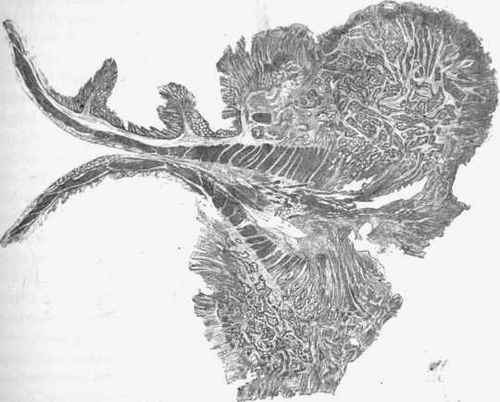
Fig. 112. - Cylinder-celled epithelioma of large intestine. The submucous tissue is infiltrated with variously shaped cancerous spaces. The muscular coat is also invaded at parts.
In growing, the tumour infiltrates neighbouring parts, very often insinuating itself among the muscular trabeculee, and extending further. It may form a considerable tumour, projecting from the surface, and is frequently ulcerated, as it occurs mostly in situations where it is exposed to friction.
From the strikingly glandular character of these tumours, they are included by some writers among the adenomas. They are called by these writers Malignant adenoma or Adenocarcinoma. As they are so distinctly atypical in their mode of growth, there seems no reason to separate them from the cancers.
Continue to:


My Books

