


3. Soft Cancers Or Medullary Cancers
Description
This section is from the book "A Manual Of Pathology", by Joseph Coats, Lewis K. Sutherland. Also available from Amazon: A Manual Of Pathology.
3. Soft Cancers Or Medullary Cancers
Soft Cancers Or Medullary Cancers are characterized by the existence of a very delicate stroma in which are abundant cells, usually of small size, and loosely packed in the alveoli with a good deal of fluid. They occur chiefly on mucous membranes, in the ovaries, testicles, kidneys, less commonly in the mamma. Being soft, they tend to bleed, and if originating on a surface or coming to it in their growth, they may undergo ulceration. Sometimes the softened, ulcerating, bleeding tissue projects in a very striking manner from a surface, forming the Fungus nematodes, this condition also occurring, however, in soft sarcomas (p. 244). The cut surface of such tumours is grey in colour, and a somewhat fluid juice can be scraped from it. In this juice will be found cells and free nuclei, the latter large and mainly oval in shape. Many of the cells contain fat granules, and there may be some in an advanced state of fatty degeneration.
Cancers of this kind sometimes grow to a considerable size, and they are often of very rapid growth. They are, as a rule, very malignant; the young cells, being loosely attached, readily pass away and lead to metastasis. 4. Hard cancer or Scirrhus occurs most commonly in the mamma, but also in the stomach, the testicles, ovary, pleura, and peritoneum.
It is characterized by the preponderance of connective tissue as compared with the epithelial structures. The cells in this form of cancer are mostly in narrow elongated processes divided by connective tissue which does not form a characteristic stroma (see Fig. 112).
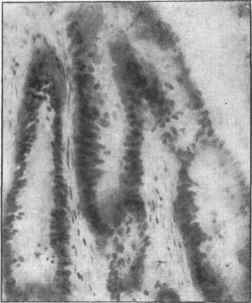
Fig. 113. - Cylinder-celled cancer from same specimen as No. 112. Several elongated passages are shown. The nuclei of the cylindrical epithelium lining the spaces are prominent.

Fig. 114. - From a scirrhus of the mamma. The cell-masses of the cancer are in narrow elongated processes. To the right is some mammary gland tissue.
The cancers of this kind have usually a very infiltrating character, the epithelial processes penetrating among the surrounding structures, and it looks as if these processes, by their irritation, produced an excessive amount of connective tissue. This view is borne out by the fact that the connective tissue is not usually in the form of a well-developed stroma as if planned to support the epithelial structures, but is irregular and even impinges on and destroys the cells. The cells readily undergo fatty degeneration, and they sometimes to a large extent entirely disintegrate, the stroma assuming the upper hand. It therefore happens that different parts of such tumours have often very different structures. The more recent parts will show well-marked epithelial masses with stroma, while in the older parts the cells have almost disappeared, and there is nothing but dense connective tissue.
A scirrhus occurs more as an infiltration than a distinct tumour, the hardening and contraction of the connective tissue causes the organ in which it grows to be sometimes contracted rather than enlarged. It is frequently so in scirrhus of the mamma and of the stomach, its two most frequent seats. On cutting into the organ the tissue is felt to be dense and elastic. The cut surface is greyish and transparent, with opaque yellow markings indicating the existence of fatty degeneration in the cells. The juice to be obtained from the cut surface is scarce, and under the microscope it is seen to contain cells, often of large size, and free nuclei (see Fig. 115). The cells vary greatly in size and shape, and they often contain two nuclei, or even a fully formed cell inside (mother and daughter cells). These cells inside cells are, however, frequently interpreted nowadays as the parasitic organisms of cancer.
These cancers are less malignant than the soft cancers, but they produce somewhat readily secondary tumours in lymphatic glands.
Between the hard and soft cancers there are cases presenting all shades of gradation; so that it might be possible to form a group of simple or normal cancers. These have mostly a well-developed stroma with moderately-sized cells which lie in the stroma in considerable spaces. The mamma presents these varieties, and they will be again referred to in the section devoted to the diseases of that organ.

Fig. 115. - Cells from a cancer of the mamma. Most of them contain several nuclei, and some daughter cells, x 200.
Continue to:


My Books

