


5. Melanaemia
Description
This section is from the book "A Manual Of Pathology", by Joseph Coats, Lewis K. Sutherland. Also available from Amazon: A Manual Of Pathology.
5. Melanaemia
By this name is meant, literally, black blood. It is used to designate a condition in which pigment occurs abnormally in the blood and is deposited in the tissues. The pigment is in the form of solid granules, and, although black in colour, it is derived from the blood pigment, and contains iron. It is met with in cases of malarial fever, but not in every case, as a rule only in the more severe forms. The origin of this pigment has been determined by Laveran to be the colouring matter of the blood altered and set free by the parasite, which is the cause of malarial fevers.
When the pigment gets into the blood it is rapidly taken up by the white blood corpuscles, so that these appear in the blood as pigmented cells. These pigmented cells are often larger than normal white corpuscles, being enlarged by their abnormal contents. It will thus be seen that very little free pigment will be present in the blood except immediately after the acute paroxysm, the white corpuscles picking up the solid granules just as they do when a solid pigment, such as vermilion, is artificially introduced into the blood of an animal (see Fig. 120). The white corpuscles containing the pigment accumulate in certain organs, especially the spleen, liver, and bone-marrow. In the spleen and bone-marrow the pigmented cells appear to leave the capillaries readily, and pass into the tissues, producing an actual pigmentation of them, but in the liver they linger longer in the capillaries, which may be seen with many such corpuscles in them, although here also the latter may pass out into the surrounding tissue. In very severe cases, other organs and tissues may be pigmented in this way. The brain is very often pigmented, especially in cases where there has been much cerebral excitement. The kidneys are sometimes the seat of it as well as other tissues, such as pancreas, intestine, etc.
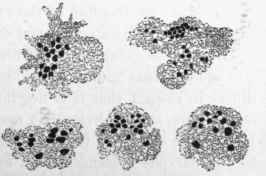
Fig. 120. - White blood-corpuscles of the frog, containing granules of vermilion, and showing amteboid movement. (After Klein).
This abnormal pigmentation of course produces changes in the colour of the organs affected. The spleen is slaty-grey or almost black, the liver is steel-grey or blackish, the grey substance of the brain is of a dark chocolate or graphite colour, and the kidneys present greyish spots.
Literature
Arnstein, Virch. Arch., vol. lxi., p. 494; Mosler, Virch. Arch., vol. lxix., p. 369; Laveran, Paludism, New Syd. Soc. trans., 1893.
Continue to:


My Books

