


9. Bacteria In The Mouth
Description
This section is from the book "A Manual Of Pathology", by Joseph Coats, Lewis K. Sutherland. Also available from Amazon: A Manual Of Pathology.
9. Bacteria In The Mouth
A number of varieties have been described, having the three forms of cocci, bacilli, and spirilla. The most constant and readily distinguished is the Leptothrix buccalis, which consists of long threads which lie frequently in tufts (see Fig. 156). These stain with the ordinary aniline dyes, and some give a yellow, others a blue colour with solution of iodine in iodide of potassium. The bacteria in the mouth are supposed by some to extract lime from the food and form the so-called tartar. They are also supposed to have to do with caries, extracting lime and breaking down the tissue of the tooth. It is to be noted further that the pathogenic form, the diplococcus pneumonias has been found in the mouths of healthy persons.
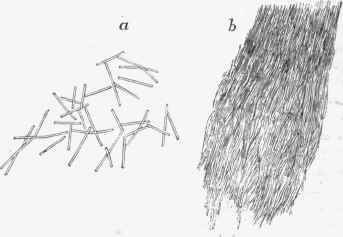
Fig. 156. - Leptothrix buccalis from the gums at edges of teeth, a, the filaments separated; b, masses of filaments, x 350.
Literature
Sarcina - Lostorfer, Wien. med. Jahrb., 1871; Ferrier, Brit. Med. Jour., i., 1872; Falkenheim, Arch. f. experiment. Path. u. Pharmac, xix., 1885. Month - David, Die Mikro-organismen der Mundhohle.
Addendum. Parasitic Fungi
The fungi proper consist of cells devoid of chlorophyll and occurring in the form of threads (Hyphoe) and round or oval spores (Conidia). The fungi are divisible into two classes, the moulds or filamentous fungi and the yeasts or sprouting fungi. In the filamentous fungi the threads or hyphai form an interwoven network which constitutes the root part of the fungus and is called the Mycelium. • From this root part upright stems arise, under favourable circumstances, which bear the fructification. The moulds are called, from the presence of this root part composed of hyphae, Hypho-mycetae. The sprouting fungi consist merely of cells, which multiply by budding, and are not known to produce a mycelium, although some of them are supposed to bear spores. It should be added that this distinction only expresses a mode of growth, and that some of the filamentous fungi, under certain circumstances, grow like yeasts, while the sprouting fungi are believed by some to be only a particular phase of fungi which may have in other phases the characters of the filamentous forms. In Fig. 157, for example, we have a portion of an ordinary filamentous fungus (penicillium) which has been growing submerged in a nutrient material. It shows a mode of growth approaching to that of the sprouting fungi.
Continue to:


My Books

