


Bacillus Anthracis
Description
This section is from the book "A Manual Of Pathology", by Guthrie McConnell. Also available from Amazon: A Manual Of Pathology.
Bacillus Anthracis
Bacillus Anthracis is a non-motile, sporogenous, liquefying, aerobic bacillus, from 1 u to 1.5 u in breadth by 5 to 20 u in length. Has square ends and is found either singly or in long threads. The organism is found in the blood of the infected animal as well as in the local lesions.
Stains by usual methods and by Gram's.
Culture
Grows readily on all media. On gelatin surface colonies appear as small, round, grayish-white dots, accompanied by liquefaction. In gelatin stabs there is a characteristic tree-like growth.
Grows at temperatures from 120 to 45° C. Toward the higher point there is marked formation of spores which appear as oval, transparent bodies situated at the middle of the bacillus and not causing any alteration in its shape.
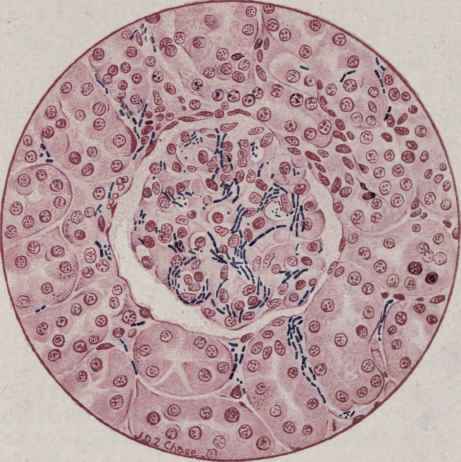
Fig. 92. - Anthrax Bacilli in Glomeruli of Kidney (McFarland).
Pathogenesis
Is the cause of anthrax, wool-sorter's disease, or malignant pustule. It gains entrance by means of wounds, through the respiratory or through the alimentary tract. The viscera show marked congestion. Under the microscope numerous bacilli are seen in the capillaries.
Continue to:


My Books

