


Bacillus Tetani
Description
This section is from the book "A Manual Of Pathology", by Guthrie McConnell. Also available from Amazon: A Manual Of Pathology.
Bacillus Tetani
Bacillus Tetani is a motile, flagellated, spcrogenous, liquefying, obligatory anaerobic bacillus. Is found in earth, particularly that which has been manured, and in the discharges from wounds after infection. It is about 0.3 u X 2 to 4 u in size, usually straight, but frequently club-shaped, due to the presence of a large round spore.
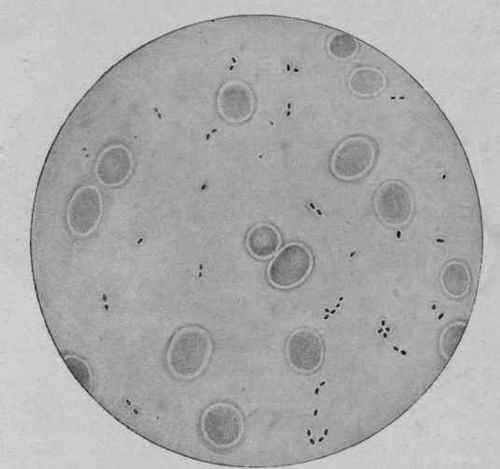
Fig. 84. - Capsulated Pneumococci in Blood from the Heart of a Rabbit. X 1000 (McFarland).
Stains
Usual ones and Gram's.
Culture
Will grow only when there is no free oxygen present. Grows best in alkaline gelatin that contains 2 per cent, dextrose. In stab cultures in gelatin and in agar-agar colonies form at right angles to the puncture. In gelatin liquefaction begins in the second week.
This organism is the cause of tetanus in man.
Bacillus Pneumoniae
Bacillus Pneumoniae is an encapsulated, non-motile, non-sporo-genous, aerobic bacillus, so short that it may resemble a coccus. Varies, however, in length and sometimes occurs in chains of four or more individuals. Is found in the sputum and in the lung of croupous pneumonia.
Stains
Ordinary methods, but not by Gram's.
Continue to:


My Books

