


Protozoa
Description
This section is from the book "A Manual Of Pathology", by Guthrie McConnell. Also available from Amazon: A Manual Of Pathology.
Protozoa
Definition
The protozoa are with few exceptions, unicellular organisms of a primitive type, reproducing by division, by budding, and by spore formation. They consist of protoplasm which is differentiated into cytoplasm and nucleus, both of which may show many variations throughout the more or less complicated life cycle that each individual undergoes. Some protozoa maintain an independent existence, others are parasitic for men and lower animals.
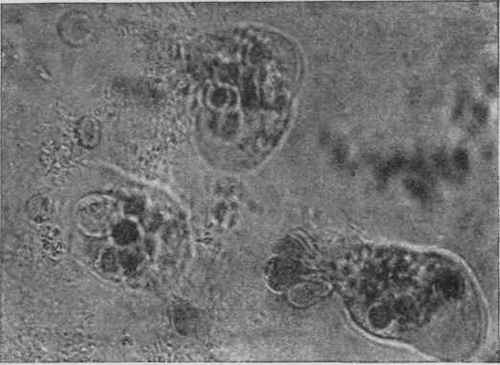
Fig. 100. - Entamceba Histolytica. Living Organisms. Note absence of Nucleus. All three of the Parasites Contain Red Blood Corpuscles. X 750. (Bulletin No. 1, Medical Department, U. S. Army).
Transmission may occur by contact, by ingestion with food or drink, or it may be by means of intermediate hosts. This is the case in malaria, yellow fever and with some of the trypano-somes. The more common carriers are mosquitoes, flies, ticks, bed-bugs and leeches.
The following are the more important members.
Continue to:


My Books

