


Gastrodiaphany, Or Transillumination Of The Stomach
Description
This section is from the book "Diseases Of The Stomach", by Max Einhorn. Also available from Amazon: Diseases of the Stomach.
Gastrodiaphany, Or Transillumination Of The Stomach
The method of transilluminating living tissues was first applied by Cazenave in 1845. Milliot3 in 1867 tried to transilluminate the stomach of animals, and used for that purpose a narrow glass tube in which there were two thin platinum wires connected with the electrodes of a Middeldorpf's apparatus. In 1889 I4 succeeded in transilluminating the stomach of human being by means of a soft-rubber tube at one end of which Is fastened an Edison lamp by means of a small metal mounting. From here conducting wires run to the battery. At some distance from the rubber tube there is a current interrupter. I have called this apparatus the gastrodiaphane and the method of trans-illtmiinating the stomach, gastrodiaphany.
1 Mikulicz: "Ueber Gastroekopie und Oesophagoskopie." Wiener med. Presse, 1881, No. 45.
2 Remark: Recently Th. Rosenheim, of Berlin, has constructed a new oesophagoscope and gastroscope. For details see "Ueber die Besichtigung der Cardia nebst Bemerkungen fiber Gastroekopie." Deutsche med. Wochenschr., 1895, No. 45.
3Milliot: Schmidt's Jahrbucher, Bd. 136, p. 143.
4 Max Einhorn: "Die Gastrodiaphanie." New Yorker med. Monatsschrift, November, 1889. "On Gastrodiaphany." New York Medical Journal, December 3d, 1892. The Journal of the American, Medical Association, 1893.
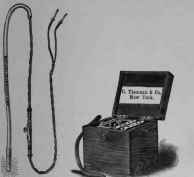
Fig. 7. - The Gastrodiaphane (Einhorn).
The aims of gastrodiaphany ore: 1. To ascertain the exact position and the size of the stomach. 2. To recognize tumors or thickenings of the front wall of the etomach by their lack of transluceucy. Of late many investigators have busied themselves with this method of examination: Heryng and Beichmann,1 Renvers,2 Pariser,3 Stewart, Ewald, Kuttner and Jacobson,4 Martius and Meltzing,5 Stockton, Frieden-wald,6 M. Manges,7 and many others, and all have come to about the same conclusion as I have. Meltzing especially has written a very extensive and elaborate paper on gastrodiaphany and has tried to determine the normal position of the stomach by this means.
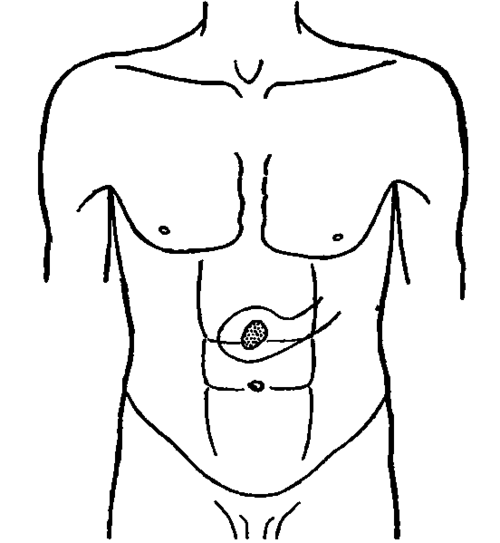
Fig. 8. - Transilluminated Zone of a Normal Stomach (M. S.). The dotted area in the centre shows the spot which was more luminous, being nearer to the lamp.
1 Heryng und Reichmann: Therap. Monatshefte, 1892.
2 Renvers: Ver. f. innere Medicin, April 4th, 1892. 3Pariser: Beril klin. Wochenschr., 1892, No. 82.
4Kuttner and Jacobsohn: Berl. klin. Wochenschr., 1898, No. 39.
5 Meltzing: Zeitschr. f. klin. Medicin, 1895.
6 J. Friedenwald: "Electric Illumination of the Stomach." Maryland Med. Journ., Jan. 20th, 1894.
7M. Manges: "The Value of the Modern Diagnostic Methods in Diseases of the Stomach." Medical Record, February 2d, 1895.
Method Of Examination
The patient, in a fasting condition, drinks one to two glassfuls of water. The apparatus, lubricated with glycerin or simply moistened in water, is then inserted into the stomach and connected with the battery. The examination is made in a perfectly dark room, either in the standing or recumbent position of the patient. The stomach transmits the electric light through the abdominal walls, and it thus becomes visible as a red zone at that place of the abdomen which corresponds to the position of the stomach. In case the gastric front wall is occupied by a tumor, the latter will not transmit the light and will be recognizable as a shady spot within the red zone of the transilluminated organ.

Fig. 9. - Transilluminated Zone of a Dilated Stomach (patient Wm. U).
The accompanying illustrations obtained from patients whose stomachs have been transilluminated by the gastrodiaphane in different conditions explain themselves.
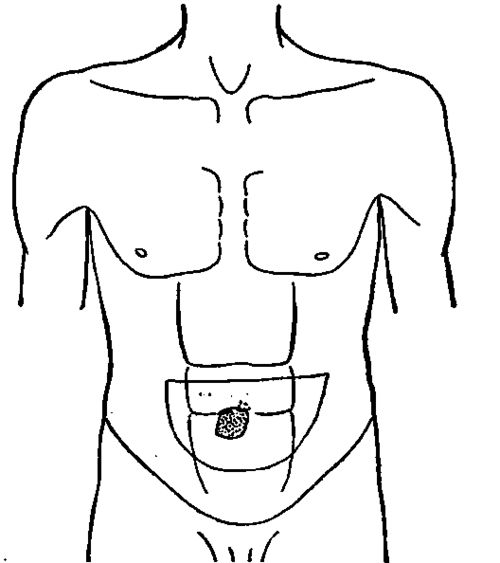
Fig. 10. - Transilluminated Zone of a Dilated Stomach (patient H. O.). .The dotted area in the centre shows the spot which was more luminous, being nearer to the lamp.
Continue to:


My Books

