


I. The Stomach Powder Blower (Einkorrt)
Description
This section is from the book "Diseases Of The Stomach", by Max Einhorn. Also available from Amazon: Diseases of the Stomach.
I. The Stomach Powder Blower (Einkorrt)
By means of the spray only soluble drugs can be applied, but not substances which are either soluble with great difficulty or not at all. In order to facilitate the introduction of the latter I1 have devised a powder blower for this purpose. The stomach powder blower1 (Fig. 47) consists of an ordinary, not too flexible rubber tube (A), twenty-eight inches and a half long, the distal end of which connects by means of a hard-rubber piece with an air-suction bulb (B), the proximate end of which is attached to a hard-rubber piece (C). The latter is hollow and pierced with several small openings at the side for the passage of air, and provided with a screw-thread for the capsule. The capsule (D) has numerous holes, and is made in three different sizes (3, 3 1/2, and 4 cm. long) (Fig. 48). It is filled with the necessary quantity of powder by means of a very small spoon (Fig. 49), and screwed on to C.
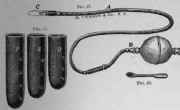
1 Max Einhurn: "A Powder Blower for the Stomach." New York Medical Journal, April 1st, 1899.
Method
Insufflation of the stomach with powder can naturally be done only when the organ is empty. It should, therefore, be performed in the fasting condition, and, in cases in which the stomach is not empty in the morning, after previous lavage. Proceed as follows: According to the quantity of medicament required, one of the capsules, D, E, or F, is filled with the powder and screwed on to the apparatus. The tube is moistened with warm water and inserted into the stomach. The bulb is then compressed three or four times in quick succession. By holding the ear over the gastric region of the patient during insufflation the entrance of air (consequently also of the powder) is distinctly heard. In cases in which there is much mucus in the pharynx and oesophagus its entrance into the holes of the capsule may be prevented by covering them with vaseline in a thin layer. The latter forms a protecting covering and prevents liquids from coming in contact with the powder. When the apparatus is in the stomach and the bulb compressed, the air opens up the vaseline layer over the holes, and the powder can now escape.
1 The stomach powder blower can be obtained at Geo. Tiemaim & Co., New York.
The following simple experiment shows that the powder does not collect merely at one spot, but rather spreads over the entire surface of the gastric mucosa:
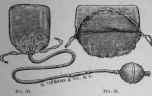
Take a rubber bag (seven inches long and six inches wide), insert the end of the stomach powder blower filled with powder, and draw the strings together (Fig. 50). Then compress the bulb two or three times and remove the insufflator from the bag. If the latter is now opened, the powder is found equally distributed upon the entire inner surface of the bag (Fig. 51). This shows that the air disseminates the powder as fine dust over all parts of the inside of the bag. In the stomach the conditions are not different from those in the bag, and the insufflation of the interior of the gastric cavity with the powder will thus be complete.
I have recently changed the powder blower for the stomach. The capsule now has three large holes and one small one near the screw-thread. Besides, there is a double bulb with a cock arrangement instead of the single bulb I formerly used. This modified powder blower (see Fig. 52) acts perfectly, allowing the entire amount of powder within the capsule to be expelled. The capacity of the big capsule is over fifteen grains - i.e., fifteen grains of powder can be thrown into the stomach at once. The indications for powdering the stomach are manifold: In ulcus ventriculi, bismuth; in gastralgia, orthoform; and in erosion, protargol or suprarenal capsule can be directly insufflated.
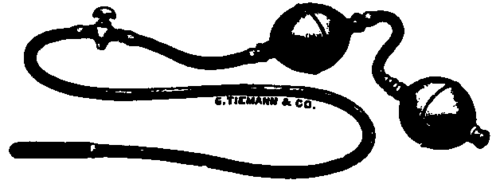
Fig. 52.
Continue to:


My Books

