


Glossary And Abbreviations
Description
This section is from the book "Chemistry Of Enzymes In Cancer", by Franz Bergel. Also available from Amazon: Chemistry Of Enzymes In Cancer.
Glossary And Abbreviations
Adenocarcinoma 7.5.5, a transplantable mammary carcinoma of the mouse. AMP, adenosine-5'-phosphate, adenylic acid.
Anabolism, synthetic or building up processes, enzymically catalysed.
Anaplasia, loss of differentiation in tumor cells.
Ascites Tumor, a tumor with a tendency to be dispersed in a fluid.
ATP, adenosine triphosphate; phosphate derivatives and especially di- and tri-phosphates of all pyrimidine-and purine-ribosides, occurring in RNA, have been discovered in biological material.
Azaserine, N2CH2CO. OCH2. CH (NH2) COOH
Carcino-Chemotherapy, cancer chemotherapy, the use of drugs against cancerous diseases and leukemias in difference to radiotherapy and surgery.
Carcinogenesis, the origin and production of malignant tumors due to endogenous and exogenous agents of a chemical or physical nature (including viruses and inert polymer films).
Carcinoma, a malignant tumor consisting mainly of epithelial cells.
Catabolism, degradative or breakdown processes, enzymically catalysed.
Coenzyme I, see DPN.
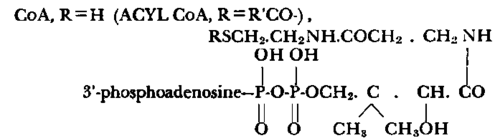
Coenzyme II, see TPN.
DAB, 4-dimethylaminoazobenzene=butter yellow.
DNA, deoxyribonucleic acid, in cell nucleus and in chromosomes.
DON, 6-diazo-5-oxo-L-norleucine.
DPN, diphosphopyridine nucleotide, coenzyme I.
DPNH, reduced DPN.
DR-, deoxyribofuranosido residue.
DRP, deoxyribofuranosido phosphate.
E, enzyme.
EFS, enzyme forming system.
FA, folic acid, pteroyl glutamic acid.
FAD, flavin adenine dinucleotide.
Glycolysis, a metabolic process, starting with glucose and terminating with lactic acid; sometimes called Meyerhof-Emb-den route, and as it is similar to alcohol production, fermentation.
Granulomas, Granulomata, tumors of granulation tissue.
Hexose Monophosphate Shunt (pentose shunt, sedoheptulose cycle), a metabolic process which leads away from glycolysis to produce pentoses, such as ribose, but can link up again with the glycolytic route.
Hypertrophy, enlargement of an organ with increase in numbers and size of its cells.
i.p., i.v., intraperitoneal, intravenous (injections).
Krebs Cycle, citric acid cycle, part of the oxidative metabolism for the production of energy, etc.
Leukemia, malignant disease of the blood forming organs with increase in leukocytes (white blood corpuscles) etc.
Lipoic Acid, 6, 8-dithio-n-octanoic acid.
Metabolism, all chemical and physico-chemical processes taking place in living material for synthesis (anabolism) and degradation (catabolism) of cellular material together with production of energy (in form of ATP).
Metastasis, with reference to cancer, a secondary growth derived from a primary tumor by implantation of neoplastic cells in a distant location.
Mouse, C3H or C+, DBA, C57, special strains of mice bred for cancer research work.
MPN, monophosphopyridine nucleotide, see nicotinamide mononucleotide.
Neoplasm, neoplastic tissue, cancerous tissue, tumor; neoplasia, formation of neoplasm.
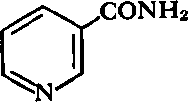
Nicotinamide or Niacinamide.
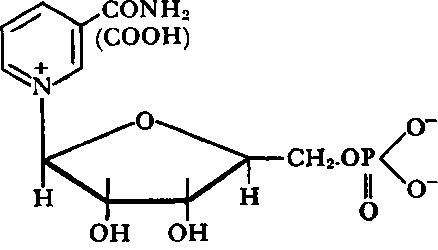
Nicotinamide Mononucleotide, MPN, (Nicotinic mononucleotide)
Nucleosides, ribo-and deoxyribon-nucleosides, compounds consisting of purines or pyrimidines, and ribose or deoxyribose.
Nucleotides, ribo- and deoxyribo-nucleotides, compounds consisting of purines or pyrimidines, ribose or deoxyribose and phosphoric acid. Adenine, guanine, cytosine, uracil in RNA; adenine, guanine, cytosine, thymine in DNA.
Oligo-, in contrast to poly-, means a polymer with a small number of units.
P, product of an enzymic reaction or phosphate. i.P, inorganic phosphoric acid or phosphate. iPP, inorganic pyrophosphate.
Pyrvanal, a combination of pyridoxal phosphate and a vanadium salt.
R-, ribofuranosido residue.
Respiration, in connection with metabolism and enzymes, a chain of transformations which through the Krebs cycle and oxidative phosphorylation leads, in presence of oxygen, to the production of water, CO2 and ATP molecules (energy carriers).
Reticulosis, proliferation of reticuloendothelial cells. RNA, ribonucleic acid in nucleus, nucleoli and cytoplasm. RP, ribofuranosido-phosphate.
S, substrate of an enzymic reaction.
Sarcoma, a malignant tumor consisting mainly of connective tissue cells.
Sarcoma 180 (Crocker) , a transplantable tumor in the mouse. THF, tetrahydrofolic acid.
TPN, triphosphopyridine nucleotide, coenzyme II. TPNH, reduced TPN.
Tumor, usually a swelling or outgrowth of malignant character of an organ or tissue; some transplantable in experimental animals, mainly rodents.
UDP, uridine diphosphate.
Walker Carcinoma 256, a transplantable tumor in the Wistar rat.
Continue to:


My Books

