


Enzymatic Phosphorylation Of Proteins
Description
This section is from the book "The Scientific Contributions Of The Ben May Laboratory For Cancer Research", by The University of Chicago. Also available from Amazon: The Scientific Contributions Of The Ben May Laboratory For Cancer Research.
Enzymatic Phosphorylation Of Proteins
With the chemical identification of the metabolically active components of the phosphoprotein fraction, it was decided to study the possible physiological significance of the rapid phosphorylation and dephosphorylation of proteins which occurs in a wide variety of tissues.
In 1949, Friedkin and Lehninger (p. 94; J. Biol. Chem., 177:775, 1949) had described the incorporation of inorganic phosphate labeled with P32 into the phosphoprotein fraction of washed rat liver particles and had shown that the reaction depended upon oxidative phosphorylation.
The ability of mitochondrial enzyme systems to phosphorylate proteins other than those present in the mitochondrion was therefore tested by the following procedure. Various purified proteins were added to a mitochondrial suspension, which was carrying out vigorous oxidative phosphorylation under conditions known to bring about the incorporation of radioactive phosphate into the phosphoprotein fraction (6). Phosphorylation of added protein over and above that of the mitochondrial proteins should lead to an increase in the total radioactivity found in the phosphoprotein fraction. A number of proteins were tested of which only one, casein, caused a large and reproducible increase in radioactivity of the phosphoprotein fraction. (Smaller increases in radioactivity of the phosphoprotein fraction were also noted with ovalbumin as the substrate.) Employing the techniques developed for the purification of phosphoserine from hy-drolyzates of the phosphoproteins of the Ehrlich ascites tumor, it was found that the radioactivity in the phosphoprotein fraction in the presence of added casein was, in fact, due to the phosphorylation of the serine residues of the casein.
To avoid the complications of the necessity for maintaining oxidative phosphorylation, experiments were then carried out with ATP labeled with P32 in the terminal phosphate. A simple and convenient assay was developed in which the phosphorylation of the casein was followed by measuring the radioactivity of the protein fraction after incubation with the radioactive ATP32.
With this technique, an enzyme which catalyzed the rapid phosphorylation of casein from ATP was discovered in mitochondria. Free phosphoserine is not an intermediate in this reaction, since the addition of unlabeled carrier phosphoserine did not dilute the amount of radioactivity transferred to the protein.
This was the first well-established demonstration of the enzymatic phosphorylation of a protein substrate by ATP. Subsequent studies by Rabino-witz and Lipmann and other workers have shown that enzymes catalyzing this reaction are widely distributed in nature and probably have an important metabolic role.
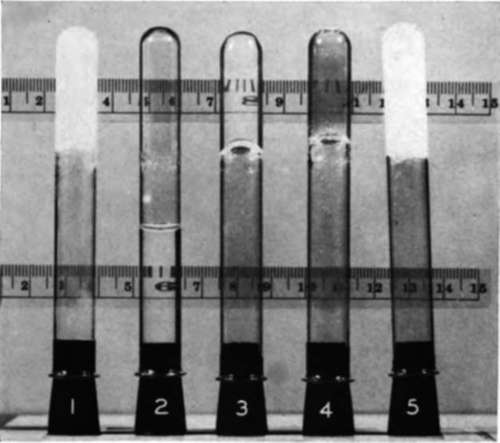
Fig. 33.-Influence of reagents on thermal coagulum of bovine plasma albumin. Each tube contains 64 mg. of bovine plasma albumin in 3 ml. of phosphate buffer, pH 7.4, with the addition of 20 µmoles of the following: Tube 1, none (control); Tube 2, sodium iodoacetate; Tube 3, iodoaceta-mide; Tube 4, p-chloromercuribcnzoate; Tube 5, cysteine hydrochloride.
Continue to:


My Books

