


Tritiation Of Steroid Estrogens
Description
This section is from the book "The Scientific Contributions Of The Ben May Laboratory For Cancer Research", by The University of Chicago. Also available from Amazon: The Scientific Contributions Of The Ben May Laboratory For Cancer Research.
Tritiation Of Steroid Estrogens
I shall say only a brief word about the preparation of tritiated estrogens. We obtained estradiol labeled in the 6,7-position by the catalytic reduction of 6-dehydroestradiol (Fig. 1). Reduction with a mixture of 10 % tritium in hydrogen gave a product with specific activity of 20mc./mg., whereas reduction with carrier-free tritium gas gave estradiol of 117-195 mc./mg. This means that one can measure 1 pug. of the substance. Thus, if the dose administered to a rat is 0.1 ug. one has the activity needed to track down 1/100,000 part of the administered steroid. We prepared 6,7-tritiated estrone by enzymatic oxidation of the tritiated estradiol using the bacterial enzyme of Hurlock and Talalay (7), and 9,11-tritiated estrone by catalytic reduction of 9 (11) -dehydroestrone.
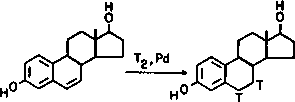
Fig. 1. Catalytic tritiation of 6-dehydroestradiol.
The apparatus developed for the tritiation of 3-5-mg. amounts of steroids is shown in Fig. 2. It is a microhydrogenation apparatus consisting of a reaction vessel, a mercury piston, and a sensitive horizontal null-point manometer designed so as to permit complete recovery of the excess gas. As tritium is absorbed by the magnetically stirred steroid solution (in ethylene glycol dimethyl ether with palladium black catalyst), the pressure in that part of the apparatus falls and the mercury droplet in the horizontal manometer moves to the left. One determines the volume of tritium absorbed by measuring the amount of mercury which must be added through a syringe operated by a screw micrometer to bring the pressure back to the original level as indicated by movement of the mercury drop back to its original position. The total gas volume of 20 ml. means that one works with about 50 curies of tritium, of which about 1 curie is incorporated into the steroid. Since 50 curies is more activity than one is allowed to bring to the University of Chicago campus, the tritiations were carried out at the Argonne National Laboratory, and we are grateful to Drs. Kenneth Wilzbach and Louis Kaplan for making their facilities available to us.
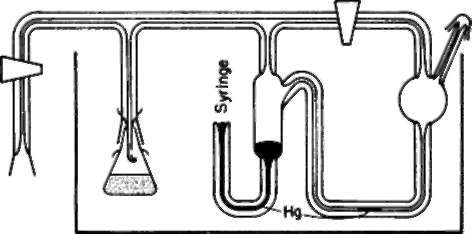
Fig. 2. Tritiation apparatus.
It is interesting that there is no adverse isotope effect in the tritiation of the steroid double bond; in fact, the reduction appears to go a little faster with tritium than with hydrogen and is complete in 12-14 minutes. Complete reduction is confirmed by paper chromatography of an aliquot of the product. The reaction mixture obtained from 10 % tritium in hydrogen contains estradiol as the only nonvolatile radioactive material, and a benzene stock solution of this substance shows no appreciable decomposition after one year's storage. With the high-level estradiol, obtained with carrier-free tritium, there are other nonvolatile radioactive substances present, and there is gradual radiochemical decomposition on storage in solution (Fig. 3). The estradiol content (Fraction IV) gradually decreases to about 50 % after one year and to 25 % after 18 months. Thus, such highly radioactive steroids are usable at least a year and a half after preparation; but, at all stages, the material taken for an animal experiment should be purified by simple paper chromatography (Bush B-3) to insure that only estradiol is being administered.
Continue to:


My Books

