


How To Mount Specimens. Continued
Description
This section is from the "Histology of Medicinal Plants" book, by William Mansfield. Also see Amazon: Histology of Medicinal Plants.
How To Mount Specimens. Continued
Cover Glasses
Great care should be used in the selection of cover glasses, however, not only as regards their shape but as to their thickness. The standard tube length of the different manufacturers makes an allowance of a definite thickness for cover glasses. It is necessary, therefore, to use cover glasses made by the manufacturer of the microscope in use.
Cover glasses are either square or round. Of each there are four different thicknesses and two different sizes. The standard thicknesses are:
The small size is designated three-fourths and the large size seven-eighths.
Cover glasses are circular (Fig. 41), square (Fig. 42), or rectangular (Fig. 43) pieces of transparent glass used in covering the specimens mounted on glass slides. A few years ago much difficulty was experienced in obtaining uniformly thick and transparent cover glasses, but no such difficulty is experienced to-day. The type of cover glass used depends largely upon the character of the specimen to be mounted. The square and rectangular glasses are selected when a series of specimens are to be mounted, but in mounting powdered drugs and histological specimens the round cover glasses are preferable because they are more sightly and more readily cleaned and rinsed.

Fig. 41. Round Cover Glass.

Fig. 42. Square Cover Glass.
Fig. 43. Rectangular Cover Glass.
Glass Slides
Glass slides (Fig. 44) are rectangular pieces of transparent glass used as a mounting surface for microscopic objects. The slides are usually three inches long by one inch wide, and they should be composed of white glass, and they should have ground and beveled edges. Slides should be of uniform thickness, and they should not become cloudy upon standing
Fig. 44. Glass Slide.
Slide And Cover-Glass Forceps
Slides and cover glasses should be grasped by their edges. To the beginner this is not easy. In order to facilitate holding slides and cover glasses during the mounting process, one may use a slide and a cover-glass forceps. The slide forceps consists of wire bent and twisted in such a way that it holds a slide firmly when attached to its two edges.
There are various forms of cover-glass holders, but only two types as far as the method of securing the cover glass is concerned. First, there are the bacteriological and the histological forceps (Fig. 45), which are self-closing. The two blades of such forceps must be forced apart by pressure in securing the cover glass. The second type of forceps is that in which the two blades are normally separated (Fig. 46), it being necessary to press the blades to either side of the cover glass in order to secure and hold it. There is a modification of this type of forceps which enables one to lock the blades by means of a sliding pin (Fig. 47), after the cover glass has been secured. It is well to accustom oneself to one type, for by so doing one may become dexterous in its use.
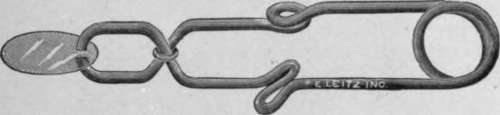
Fig. 45. Histological Forceps.

Fig. 46. Forceps.

Fig. 47. Sliding-pin Forceps.
Needles
Two dissecting needles (Fig. 48) should form a part of the histologist's mounting set. The handles may be of any material, but the needle should be of tempered steel and about two inches long.

Fig. 48. Dissecting Needle.
Scissors
Almost any sort of scissors (Fig. 49) will do for histology work, but a small scissors with fine pointed blades, are preferred.
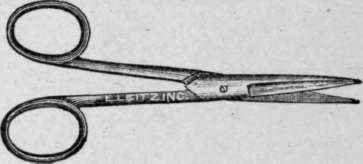
Fig. 49. Scissors.
Scissors are useful in trimming labels and in cutting strips of leaves and sections of fibrous roots that are to be embedded and cut.
Scalpels
Scalpels (Fig. 50) have steel blades and ebony handles. These vary in regard to size and quality of material. The cheaper grades are quite as satisfactory, however, as the more expensive ones, and for general use a medium-sized blade and handle will be found most useful.

Fig. 50. Scalpels.
Turntable
Much time and energy may be saved by ringing slides on a turntable (Fig. 51). There is a flat surface upon which to rest the hand holding the brush with cement, and a revolving table upon which the slide to be ringed is held by means of two clips. In ringing slides, it is only necessary to revolve the table, and at the same time to transfer the cement to the edge of the cover glass from the brush held in the hand.
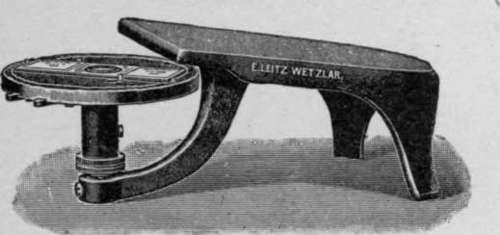
Fig. 51. Turntable.
Labeling
There are many ways of labeling slides, but the best method is to place on the label the name of the specimen, the powder number, and the box, the tray or cabinet number. For example:
Powdered Arnica Flowers No. 80 - Box A - 600.
Preservation Of Mounted Specimens
Accurately mounted, labeled, and ringed slides should be filed away for future study and reference. Such filing may be done in slide boxes, in slide trays, or in cabinets. Slide boxes are to be had of a holding capacity varying from one to one hundred slides. For general use, slide boxes (Fig. 52) holding one hundred slides will be found most useful. Some workers prefer trays (Fig. 53), because of the saving of time in selecting specimens. Trays hold twenty slides arranged in two rows. The cover of the tray is divided into two sections so that, if desired, only one row of slides is uncovered at a time. Slide cabinets (Fig. 54) are particularly desirable for storing large individual collections, particularly when the slides are used frequently for reference. Large selections of slides should be numbered and card indexed in order to facilitate rinding.
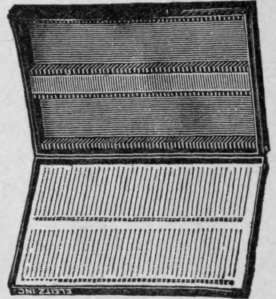
Fig. 52. Slide Box.
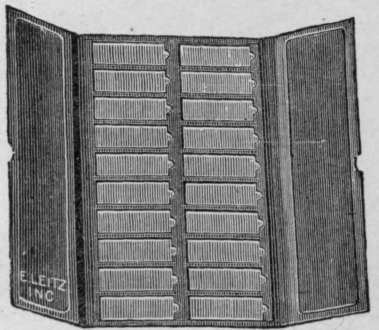
Fig. 53. Slide Tray.
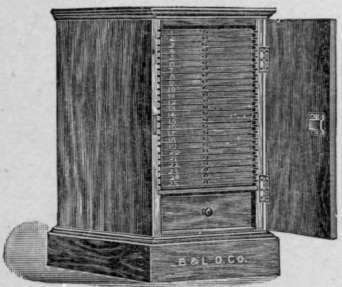
Fig. 54. Slide Cabinet.
Continue to:


My Books

