


Cell Contents. Part 5
Description
This section is from the "Histology of Medicinal Plants" book, by William Mansfield. Also see Amazon: Histology of Medicinal Plants.
Cell Contents. Part 5
Raphides
Raphides, which are usually seen in longitudinal view, resemble double-pointed needles. They are circular in crosssection, and the largest diameter is at the centre, from which they taper gradually toward either end to a sharp point.
Raphides occur in bundles, as in false unicorn root (Plate 79, Figs. 6, A, B, and C), rarely as solitary crystals.
In ipecac root the crystals are usually solitary. In sar-saparilla root, squill, etc., the raphides occur both in clusters, part of bundle, or in bundles, and as solitary crystals.
In most drugs the crystals are entire; but in squills, where the raphides are very large, they are broken. In phytolacca (Plate 79, Fig. 1) and in hydrangea the raphides are usually broken, owing to the fact that these drugs contain large quantities of fibres which break them up into fragments when the drug is milled.
There is the greatest possible variation in the size of raphides in the same and in different drugs, but the larger forms are constant in the same species.
Raphides are deposited in parenchyma cells and in special raphides sacs. These crystals are always surrounded with mucilage.

Plate 79. Raphides.
1. Phytolacca root {Phytolacca americana, L.). 2. Squills (Urginea mari-tima [L.] Baker). 3. Hydrangea root {Hydrangea arborescens, L.). 4. Con-vallaria {Convallaria majalis, L.). 5. Carthagean ipecac {Cephcelis acuminata Karst.) 6. Bundle of raphides from false unicorn root.
A. Bundle surrounded with mucilage. B. Mucilage expanded and partially dissolved. C, Bundle free of mucilage.
Rosette Crystals
Rosette crystals are compound crystals composed of an aggregation of small crystals arranged in a radiating manner around a central core. This core appears nearly black, and the whole mass is nearly spherical. The free ends of the crystals are sharp-pointed or blunt.
Characteristic rosette crystals occur in frangula bark, spikenard root, wahoo stem, root bark, rhubarb, etc. (Plate 80, Figs. 1, 2, 3, 4, 5, and 6).
These crystals are very variable in size. This variation is illustrated by the crystals of Plate 80.
Usually there is a variation in size of the crystals occurring in a given plant, but for each plant there is a more or less uniform variation. For instance, the largest rosette crystal occurring in wahoo root bark (Plate 80, Fig. 5) is smaller than the largest crystal occurring in rhubarb (Plate 80, Fig. 6), etc.

Plate 81. Inclosed Rosette Crystals.
1. Hops (Humulus lupulus, L.).
2. Bracts of cannabis indica (Cannabis sattva, variety Indica, Lamarck).
3. Medullary rays of canella alba.
4. Parenchyma cells of mandrake (Podophyllum peltatum, L.).
The prisms forming the rosette crystals, like all prisms, decompose white light, with the result that rosette crystals frequently appear variously colored. Rhubarb crystals, for instance, are blue or violet. Most of the smaller rosette crystals, however, appear grayish white with a darker-colored centre.
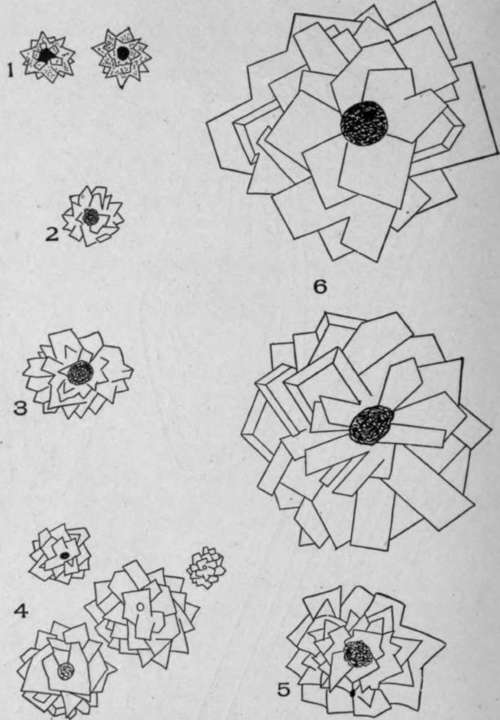
Plate 80. Rosette Crystals.
1. Frangula bark (Rhamnus frangula, L.).
2. White oak bark (Quercus alba, L.).
3. Spikenard root (Aralia racemosa, L.).
4. Wahoo stem bark (Euonymus atropurpureus, Jacq.).
5. Wahoo root bark {Euonymus atropurpureus, Jacq.).
6. Rhubarb (Rheum officinale, Baill.).
Rosette crystals occur in parenchyma cells (Plate 81, Fig. 4) and in medullary rays (Plate 81, Fig. 3).
Solitary Crystals
Solitary crystals are the most variable of all the forms of calcium oxalate. They usually occur in crystal cells associated with bast fibres and stone cells, less frequently in stone cells (Plate 33, Fig. 2). There are many different and characteristic forms of prisms. The more common are:
1. Rectangular
A. Parallelopipeds.
B. Cubes.
2. Polyhedrons
A. Irregular polyhedrons.
I. Flat bases.
(a) Non-notched.
(b) Notched. II.
Tapering bases.
B. Octohedrons.
The crystals occurring in Batavia cinnamon and henbane leaves are parallelopipeds (Plate 82, Figs. 1 and 2).
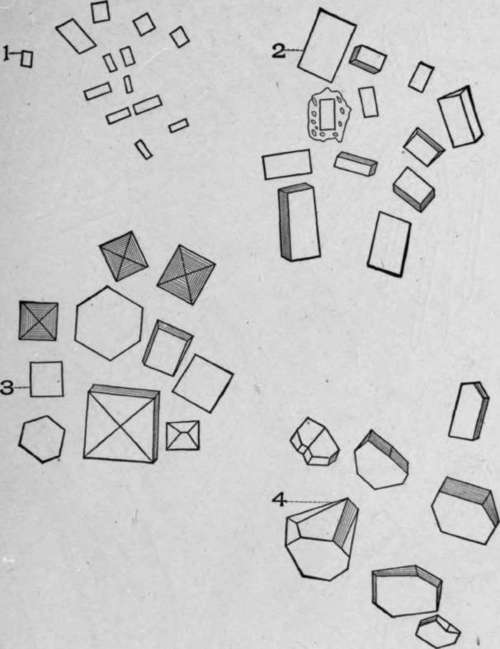
Plate 82. Solitary Crystal.
1. Batavia cinnamon (cinnamomum burmanni, Nees).
2. Henbane leaves (Hyoscyamus niger, L.).
3. Morea nutgalls.
4. Cocillana bark (Guarea rusbyi [Britton], Rusby).
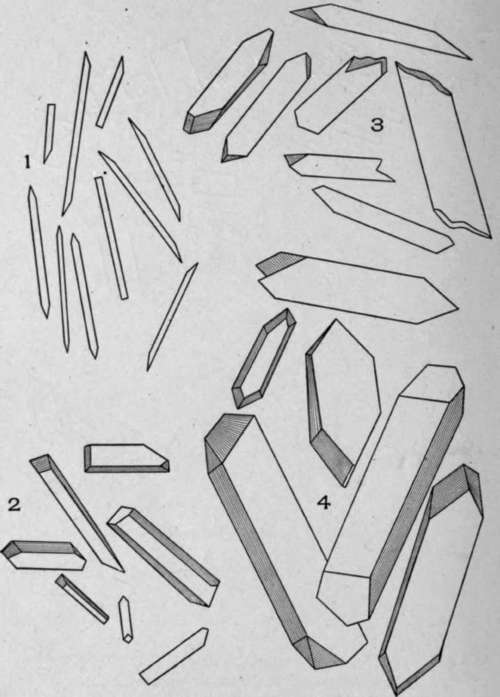
Plate 83. Solitary Crystals.
1. Cactus grandiflorus (Cerdus grandiflorus [L.], Britton and Rose).
2. Hemlock bark (Tsuga canadensis [L.], Carr.).
3. Krameria root (Krameria triandra, Ruiz and Pav.).
4. Soapbark (Quillaja saponaria, Molina).
The crystals occurring in cactus grandiflorus, hemlock bark, krameria root, and soap bark are irregular polyhedrons (Plate 83). They are longer than broad, and the ends are tapering. The crystal of cactus grandiflorus has the narrowest diameter of these four, while the crystals of soap bark have the widest diameter. In coca leaf, xanthoxylum bark, elm bark, Spanish licorice, and in white oak (Plate 84), and in cocillina bark (Plate 82, Fig. 4) the crystals are all irregular polyhedrons with flat bases. They are mostly longer than broad and they are all widest in the centre; in each a few crystals are notched, but most of the crystals are not notched.
The crystals in quassia wood, uva-ursi leaf, and most of those of quebracho and wild cherry bark (Plate 86, Figs. 1, 2, 3, and 4) are irregular polyhedrons with flat ends. They are longer than broad, widest at the centre, and non-notched.
Cubes occur in senna, cascara sagrada, frangula, white pine, tamarac (Plate 85), quassia, uva-ursi, quebracho, and in wild cherry (Plate 86).
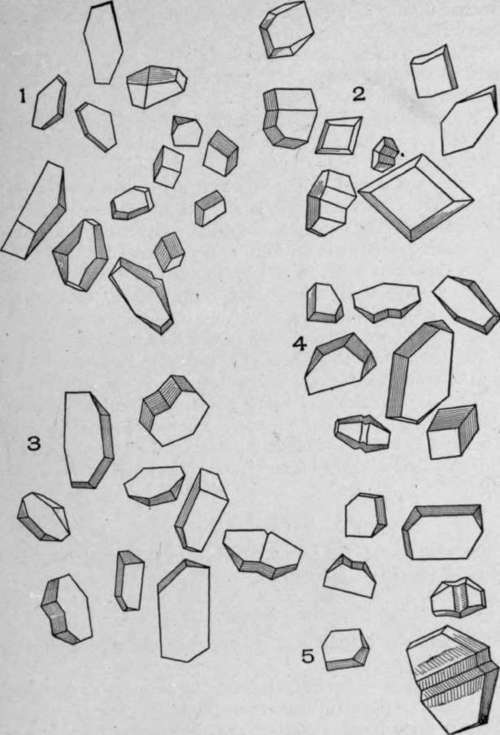
Plate 84. Solitary Crystals.
1. Coca leaf (Erythroxylon coca, Lamarck).
2. Xanthoxylum bark (Zanthoxylutn americanum, Miller).
3. Elm bark (Ulmus fulva, Michaux).
4. Spanish licorice root (Glycyrrhiza glabra, L.).
5. White oak bark (Quercus alba, L.).
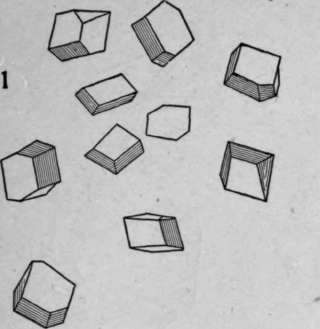


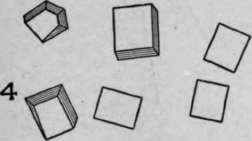
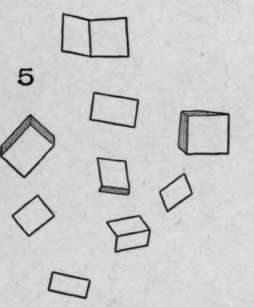
Plate 85. Solitary Crystals.
1. India senna (Cassia angustifolia, Vahl.).
2. Cascara sagrada bark (Rhamnus purshiana, D. C).
3. Frangula bark (Rhamnus frangula, L.).
4. White pine bark (Pinus strobus, L.).
5. Tamarac bark (Larix laricina [Du Roi], Koch).
The crystals of morea nutgalls (Plate 82, Fig. 3) are octo-hedrons, and they resemble the crystals of calcium oxalate found in urinary sediments.
While studying the prisms, focus first on the upper surface and then down to the under surface in order to observe the forms accurately.
There are several plants in which more than one form of crystal occur. Rosette crystals and prisms are associated, for instance, in cascara sagrada, frangula, condurango, dogwood, and pleurisy root (Plate 87, Figs. 1, 2, 3, 4, and 5).
An important factor to be kept in mind in studying crystals is the number - whether abundant, as in rhubarb, or sparingly present, as in mandrake, etc. Variation in the number of crystals is not uncommon, even in different parts of the same plants. In wahoo stem bark, for instance, there are several times as many rosette crystals as there are in the root bark.
Crystals of calcium oxalate are freely soluble in dilute hydrochloric acid without effervescence; but they are insoluble in acetic acid and in sodium and potassium hydroxide solutions. With sulphuric acid they form crystals of calcium sulphate.
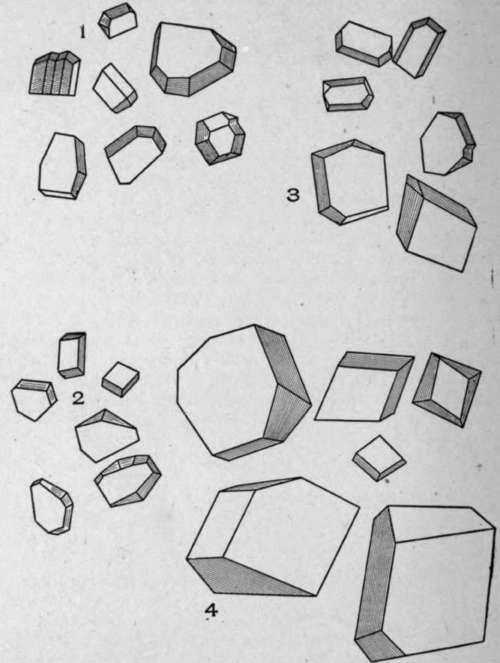
Plate 86. Solitary Crystals.
1. Quassia (Picraena excelsa [Swartz.], Lindl.).
2. Uva-ursi leaf (Arctostaphylos uva-ursi [L.], Spring.).
3. Quebracho bark (Aspidosperma quebracho-bianco, Schlechtendal).
4. Wild-cherry bark (Prunus serotina, Ehrh.).
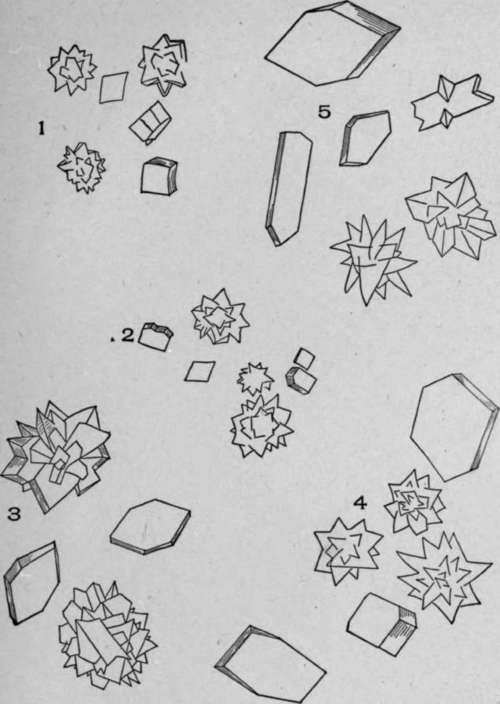
Plate 87. Rosette Crystals and Solitary Crystals Occurring in.
1. Cascara sagrada bark (Rhamnus purshiana, D.C.)
2. Frangula bark (Rhamnus frangula, L.).
3. Cundurango bark (Marsdenia cundurango, [Triana] Nichols).
4. Dogwood root bark (Cornus florida, L.).
5. Pleurisy root (Asclepias tuberosa, L.).
Cystoliths
Cystoliths consist of calcium carbonate deposited over and around a framework of cellulose.
Forms Of Cystoliths
The forms of cystoliths differ greatly in the different plants in which they occur.
In the rubber-plant leaf, the cystolith resembles a bunch of grapes and is stalked; in ruellia root (Plate 87, Fig. 1) the cystoliths vary from nearly circular to narrowly cylindrical, and no stalk is present; also the cystolith nearly fills the cell in which it occurs. In the hair of cannabis indica (Plate 88, Fig. 3), the cystolith varies in form according to the size and shape of the hair, but in all the hairs the cystolith appears to be attached to the upper curved part of the inner wall of the hair.

Plate 88. Cystoliths.
1. Ruellia root (Ruellia ciliosa, Pursh.).
2. Pellionia leaf.
3. Cannabis indica (Cannabis saliva, variety Indica, Lam.)
Cystoliths occur, then, in special cavities, in parenchyma cells (rubber-plant leaf, fig, pellionea, and mulberry), and in non-glandular hairs (cannabis indica).
In powdered ruellia root the cystoliths occur in or are separated from the parenchyma cells.
Tests For Cystoliths
When dilute hydrochloric acid or acetic acid is added to cystoliths a brisk effervescence takes place with the evolution of carbon dioxide gas.
Continue to:


My Books

