


The Epidermis And Periderm. Part 2
Description
This section is from the "Histology of Medicinal Plants" book, by William Mansfield. Also see Amazon: Histology of Medicinal Plants.
The Epidermis And Periderm. Part 2
Testa Epidermis
Testa epidermal cells form the epidermal layers of such seeds as lobelia, henbane, capsicum, paprika, larkspur, belladonna, scopola, etc.
In surface view the end walls are thick and wavy in outline; frequently the line of union - middle lamella - of two cells is indicated by a dark or light line, while in others the wall between two cells appears as a single wall. The walls are porous or non-porous, and the color of the wall varies from yellow to brown, to colorless. These cells always occur in masses, composed partially of entire and partially of broken fragments.
In lobelia seed (Plate 4, Fig. 2) the line of union of adjacent cell walls appears as a dark line. The walls are wavy in outline, of a yellowish-red color and not porous.
In henbane seed (Plate 4, Fig. 3) the line of union between the cells is scarcely visible; the walls are decidedly wavy, more so than in lobelia, and no pits are visible.
In capsicum seed (Plate 4, Fig. 1) the cells are very wavy and decidedly porous, the line of union between the cell walls being marked with irregular spaces and lines.
In belladonna seed (Plate 5, Fig. 1) the walls between two adjacent cells are non-striated and non-porous, and extremely irregular in outline.
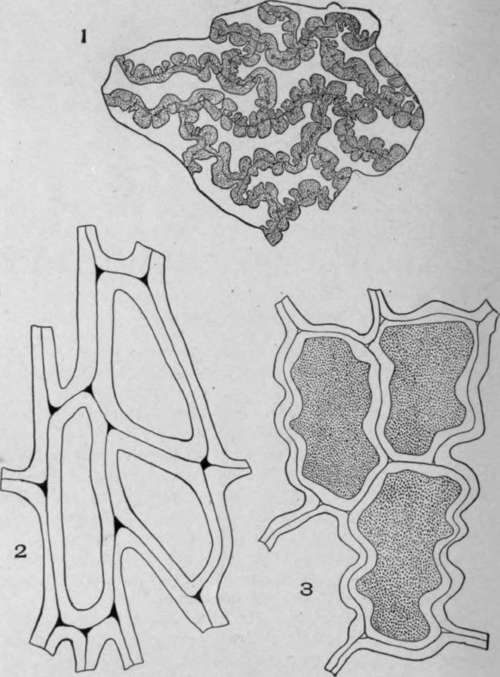
Plate 4. Testa Epidermal Cells.
1. Capsicum seed (Capsicum frutescens, L.).
2. Lobelia seed (Lobelia inflata, L.).
3. Henbane seed (Hyoscyamus niger, L.).
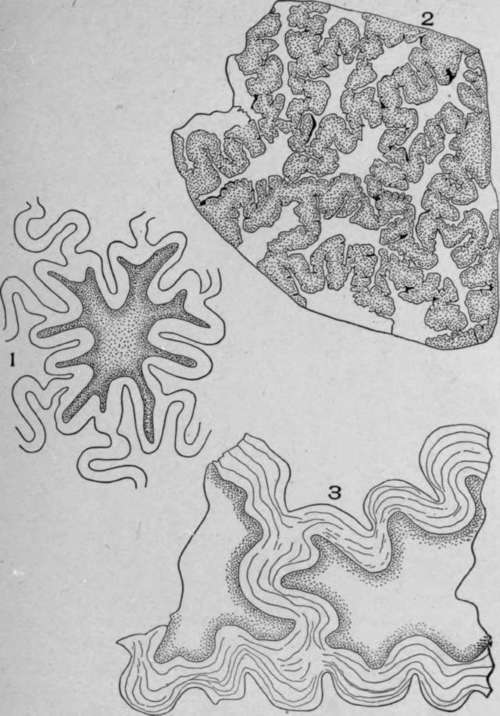
Plate 5. Testa Cells.
1. Belladonna seed (Atropa belladonna, L.).
2. Star-aniseed (Illicium verum, Hooker).
3. Stramonium seed (Datura stramonium, L.).
In star-anise seed (Plate 5, Fig. 2) the walls are irregularly thickened and wavy in outline.
In stramonium seed (Plate 5, Fig. 3) the walls are very thick, wavy in outline, and striated.
Plant Hairs (Trichomes)
In histological work plant hairs are of great importance, as they offer a ready means of distinguishing and differentiating between plants, or parts of plants, when they occur in a broken or finely powdered condition. There is no other element in powdered drugs which is of so great a diagnostic value as the plant hair. The same plant will always have the same type of hair, the only noticeable variation being in the size. In microscopical drug analysis the presence of hairs is always noted, and in many cases the purity of the powder can be ascertained from the hairs. Botanists seem to have given little attention to the study of plant hairs. This accounts for the fact that information concerning them is very meagre in botanical literature, and, as far as the author can learn, no one has attempted to classify them. In systematic work, plant hairs could be used to 'great advantage in separating genera and even species. Hairs are, of course, a factor now in systematic work. The lack of hairs is indicated by the term glabrous. Their presence is indicated by such terms as hispid, villous, etc. In certain cases the term indicates position of the hair as ciliate when the hair is marginal. When hairs influence the color of the leaf, such terms as cinerous and canescent are used. In all the cases cited no mention is made of the real nature of the hair.
In systematic work, as in pharmacognosy, we must work with dried material, and it is only those hairs which retain their form under such conditions which are of classification value.
Hairs are the most common outgrowths of the epidermal cells. They are classified as glandular or non-glandular, according to their structure and function. The glandular hairs will be considered under synthetic tissue.
Each group is again subdivided into a number of secondary groups, depending upon the number of cells present, their form, their arrangement, their size, their color, the character of their walls, whether rough or smooth, whether branched or non-branched, whether curved, twisted, straight, or twisted and straight, whether pointed, blunt, or forked.
Forms Of Hairs. Papillae
Papillae are epidermal cells which are extended outward in the form of small tubular outgrowths.
Papillae occur on the following parts of the plant: flower-petals, stigmas, styles, leaves, stems, seeds, and fruits. Papillae occur on only a few of the medicinal leaves.
The under surface of both Truxillo (Plate 6, Fig. 3) and Huanuca coca have very small papillae. The outermost wall of these papillae are much thicker than the side walls. The papillae of klip buchu (Plate 6, Fig. 4), an adulterant of true buchu, has large thick-walled papillae.
The velvety appearance of most flower-petals (Plate 6, Figs. 2 and 5) is due to the presence of papillae. The papillae of flower-petals are very variable. In calendula flowers (Plate 6, Fig. 1) they are small, yellowish in color, and the outer wall is marked with parallel striations which appear as small teeth in cross-section. The ray petal papillae of anthemis consist of rather large, broad, blunt papillae with slightly striated walls. The papillae of the ray petals of the white daisy consist of papillae which have medium sized, cone-shaped papillae with finely striated walls. The papillae of the flower stigma vary greatly in different flowers. In some cases two or more types of papillae occur, but even in these cases the papillae are characteristic of the species.
The papillae differ greatly in the case of the flowers of the compositae, where two types of flowers are normally present - namely, the ray flowers and the disk flowers.
In all cases observed the papillae of the stigma of the ray flowers are always smaller than the papillae of the stigma of the disk flowers. It would appear from extended observation that the papillae of the ray flower stigma are being gradually aborted. The papillae of the style are always different from the papillae of the stigma. The style papillae are always smaller, and they are of a different form.

Plate 6. Papillae.
1. Calendula flowers (Calendula officinalis, L.).
2. White daisy ray flower (Chrysanthemum leucanthemum, L.).
3. Coca leaf (Erythroxylon coca, Lamarck).
4. Klip buchu.
5. Anthemis ray petal (Anthemis nobilis, L.).
Continue to:


My Books

