


Chapter XVIII. Hypnotism And The Insane
Description
This section is from the book "Practical Lessons In Hypnotism", by Wm. Wesley Cook. Also available from Amazon: Practical Lessons In Hypnotism.
Chapter XVIII. Hypnotism And The Insane
Maniacs not easily hypnotized - Melancholia - Weak-minded persons not good subjects - Hypnotism the rational method of curing insanity - Concentration of thought - Insane on the subject of perpetual motion - Case of Mr. Williams - Pacifying a maniac - Insanity from bad habits cured - Religious insanity - Organic diseases must be recognized - Overcoming imaginary notions.
Persons who are violently insane cannot, as a rule, be readily hypnotized, because it is a very difficult matter to force them to concentrate their thoughts upon any one object for any length of time. But those who are suffering from melancholia or other undemonstrative forms of insanity can be much more readily managed.
Many persons have an idea that the weak minded can be easily hynotized, and that good hypnotic subjects have "a screw loose somewhere." This is far from the truth, and the facts in relation to it have been fully given in the chapter on "Qualifications of a Subject."
When it is possible to concentrate the thoughts of an insane person upon some object devised or selected for the purpose, then hypnosis may be produced and great benefit derived from suggestions. In fact, hypnotism presents the only rational method of curing the insane. Their trains of thought have, as a rule, traversed one channel in the brain so intensely that they are beyond ordinary influences to change them. Could the mind be rendered passive, then the current of thought could be shifted; and the frequent repetitions of this would prob-ablv result in cure in cases where the structures of the brain have not been destroyed.
A gentleman of great mechanical ingenuity became insane upon the subject of perpetual motion. He had employed all his spare moments for several years in trying to devise an instrument which his imagination had conceived, and finally he became unfit for business and devoted his entire time to his useless task, at times becoming quite violent at his inability to accomplish his purpose. Having no means, his family soon suffered, and were about to take steps to confine him in an asylum, when the author suggested hypnotic influence.
The ordinary methods were evidently useless, and the following plan was adopted:
He was asked to explain the general principle of his machine and was given the closest attention. In every respect he was led to believe that the greatest interest was being manifested in his work, and various suggestions were made to him from* time to time. Finally some such remarks as the following were made:
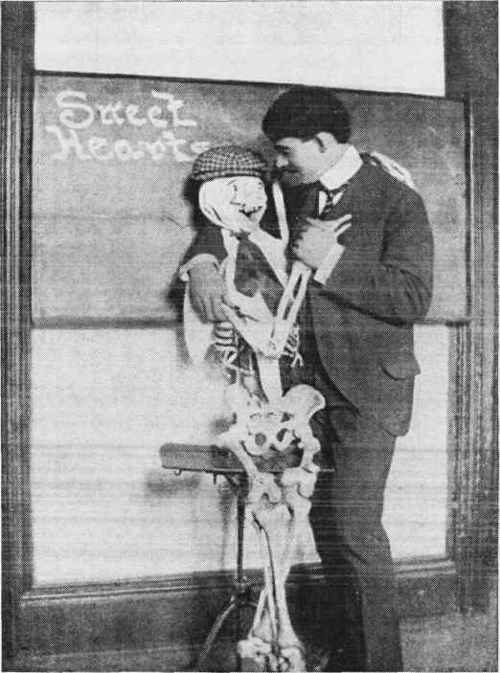
This young man believes he holds in his arms the beautiful object of his affection.
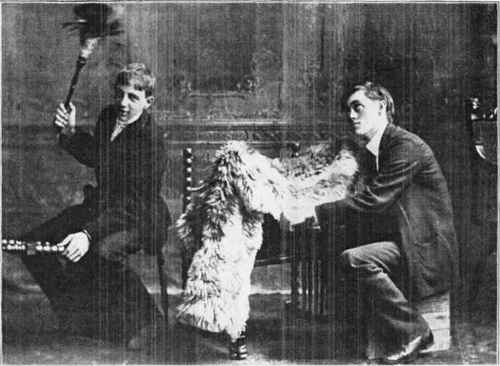
One of these subjects believes he is milking a cow, while the other thinks he is a jockey at a horse race.
"Mr. Williams, there is only one way in which you can complete your invention, and that is to put yourself in a hypnotic condition and in that way make your mind perfectly passive, so that suggestions will come to you."
He knit his brows a while, evidently in deep thought, and then exclaimed: "All right! I am ready; let us begin at once."
A bright yellow orange was selected as the object upon which he should gaze for the sake of concentration, and it served most effectually.
"Look at this orange," he was told; "it looks like the moon. It is round and yellow and bright. If you look at it steadily you will get drowsy and go to sleep. Look at it, now, and keep on looking at it. You are drowsy; you are going to sleep; you are asleep - sound, sound asleep."
He was, indeed, sound asleep, and when in the fifth degree of hypnosis (the somnambulistic state), it was suggested to him, most emphatically, that his invention was before him. He was directed to work at it, and then he was told that one thing was needed: a brass screw half an inch long to connect two wooden bars. He was made to believe that he supplied and adjusted the screw. Then he was told that the president was in front of him wishing to see the invention, which he took delight in imagining he was showing. Then the president told him he must keep the whole thing secret, that he must not work at it any more, and that it would be presented to congress for a suitable reward. After he had agreed to these propositions he was awakened with the precaution: "Don't forget; you will not talk of your invention again."
It seems remarkable, but improvement was noticed at once. He assumed an air of mystery and great secrecy, but did not mention his invention and did not even enter the room he had used for a workshop. He talked rationally, and in few days requested to be hypnotized again. His request was complied with, and it was then suggested that he would not think of his invention until congress sent him the reward. He is probably still waiting for the official notification that shall enrich him. The evidences of insanity have nearly all left him, he never talks of his invention directly, but frequently says: "Some of these days I may be able to count my millions, and I have good reasons for thinking so," or some similar hint of expected riches. He attends to business and is earning a living, although his companions regard him as somewhat high-strung and indisposed to associate with them.
A few years ago an attempt was being made to remove to an ambulance a woman who was violently insane. She resisted every effort and caused quite a struggle. One of the attendants, who was a hypnotist, succeeded in attracting her attention and then commanded her to keep silent and then to go sound asleep. She obeyed, and was placed in the ambulance without further trouble.
The milder cases of insanity, such as are formed by bad habits, are usualy curable by hypnosis and suggestion. They are more fully mentioned in the chapter on "Overcoming Habits by Hypnotism."
Religious insanity, so-called, is often most deplorable, and persons suffering from it are frequently placed in asylums without there being any necessity for doing so. In fact, "religious insanity" is seldom anything more than a concentration of the mind upon one train of thought, and may be completely overcome through hypnotism. It is really not insanity at all, and is often but a symptom of some, organic disease, most frequently indicating liver or uterine derangements. Proper treatment of these organs usually suffices to effect a cure, although hypnotic suggestion will more quickly relieve the distressing frame of mind so often mistaken for insanity.
To relieve this trouble, place the subject in the somnambulistic state and impress upon the mind that an angel is present who is making just such statements as the subject should believe. This may be repeated several times and will always have the desired effect. It is a wonderful relief for the family, as well as the patient, to have those fears and notions termed "religious insanity" expelled. As a rule, the patient realizes that they are all imaginary notions, and wishes to overcome them.
Continue to:


My Books

