


Chapter XXIII. Post-Hypnotism
Description
This section is from the book "Practical Lessons In Hypnotism", by Wm. Wesley Cook. Also available from Amazon: Practical Lessons In Hypnotism.
Chapter XXIII. Post-Hypnotism
Suggestions carried out after awakening - Somnambulistic state - Practical illustration - Awake at four o'clock in the morning - Post-hypnotic suggestions always obeyed - Honorable persons will not commit crime by post-hypnotic suggestion - . seping an appointment - Unable to eat his Sunday dinner - Cannot drink tea or coffee - Overcoming the liquor habit - Post-hypnotic suggestion a great power for good or evil - Valuable in treating nervous conditions - Changing personal likes and dislikes - As an aid for self-control - Avoiding evil companions - Hypnotism cannot change a person's moral nature - Affairs of the heart - Had her sweetheart hypnotized - A parent's use of hypnotism.
One of the most interesting and valuable of all hypnotic phenomena is that of post-hypnotic suggestion. This is the suggestion made to the hypnotized subject which he carries out at some future time designated by the operator when the suggestion is made. The time designated may be hours, days or months after the subject has been awakened, and yet the act will be performed as suggested when the time arrives.
In order to be successful in making post-hypnotic suggestions, the operator must first place the subject in profound hypnosis - the condition of somnambulism being best. When this state has been reached, passess must be made over the body and suggestion uttered in a most emphatic manner. By way of example, the following illustration will prove interesting:
A young man who had allowed himself to be hypnotized for amusement was brought into the somnambulistic state. After several ordinary experiments had been conducted, it was decided to make a post-hypnotic suggestion. Accordingly he was "mesmerized" by passes from the head to the feet and rendered profoundly hypnotized. Standing beside him, the operator said:
"Harry, to-morrow morning you will wake up at four o'clock, and you will not be able to sleep after that time, and every morning for a week you will wake up at the same time and dress yourself and stay awake till evening. Now, you will not remember that I told you this, but you will do it, without fail, for you simply can't help yourself."
Such words were repeated emphatically to him several times, and then he was awakened. The next day he surprised himself and others by awakening-just as the hands of the clock indicated the hour of four, and each morning for a week he did the same thing. The eighth morning he slept soundly until a late hour.
It makes no difference what post-hypnotic suggestion is made to the subject while in the somnambulistic state, if properly made he will obey it strictly, provided it does not call for the performance of an act repulsive to his nature. Honorable men cannot be made to commit crime by posthypnotic suggestion, much as criminals would like to declare otherwise. Nevertheless, a man willing to do a criminal act may have the act suggested to him by post-hypnotic suggestion, and he. will perform it at the time designated. It is possible that the actual perpetrator of the deed would not be responsible under such circumstances, but until the phenomena of hypnotism are more generally understood, it will be difficult to settle the legal aspects of such cases satisfactorily.
Make the post-hypnotic suggestion to a subject that one month from date he will call at your office bareheaded, and he will certainly do it at that time, although he will be at a loss to explain his action.
Suggest that a subject will be unable to eat his dinner on the following Sunday, and he will have no appetite at that time; or, suggest that he will find himself unable to enjoy tea or coffee or alcoholic liquors of any kind, and the dislike for them will follow. Of course, it will require oft-repeated post-hypnotic suggestions to accomplish the permanent dislike for liquors; but it can be done, and all bad habits can be overcome in this manner, provided the mind is not destroyed by long indulgence. More upon this subject will be found in the chapter on "Overcoming Habits by Hypnotism."
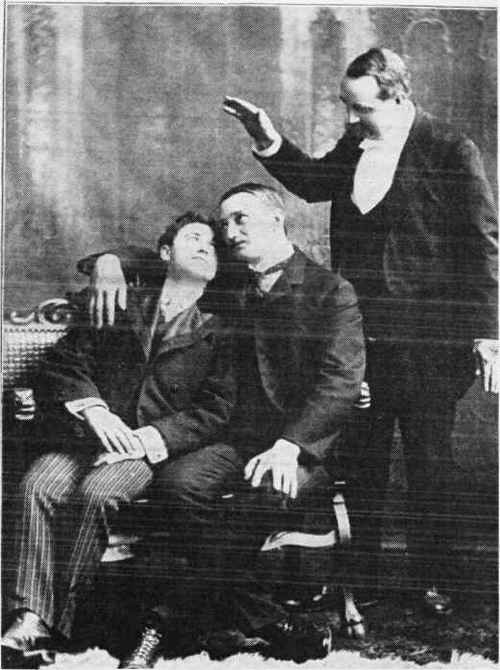
These hypnotized subjects believe themselves to be a newly-married couple sitting for a photograph.
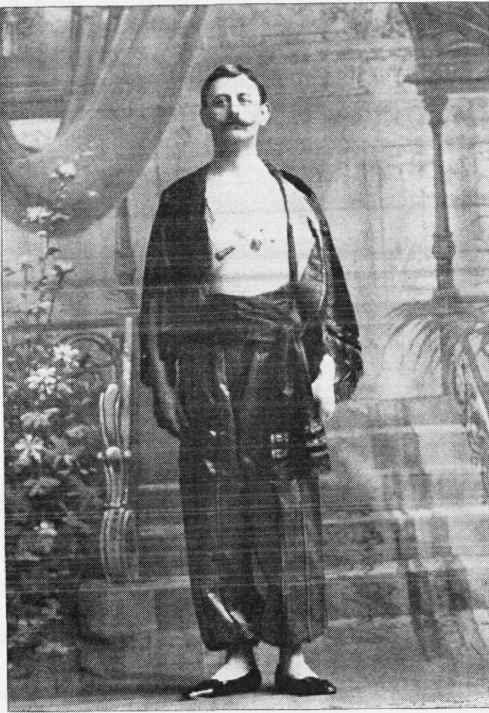
This subject feels no pain and has no loss of blood from a five inch dagger being run through the chest muscles over the region of the heart.
A great power for good or evil lies in post-hypnotic suggestion. It is the key to curing many diseases and correcting mental peculiarities. It is an invaluable aid, especially in nervous conditions, and many cases of hysteria have been permanently cured by warding off periodical attacks through post-hypnotism.
There is another phase of post-hypnotic suggestion that should be recognized, and that is its power to affect the life of individuals. Persons may be made to completely change their personal likes and dislikes of others. In some instances this is desirable, but it is not always right. A few authentic cases will illustrate the practical uses of this peculiar exercise of hypnotic influence.
A father brought his son to the office for treatment to overcome a lack of self-control. He was a young man of good education and always enjoyed every advantage of life. His family were refined and wealthy, and not only highly respectable, but sincerely religious. He himself was inclined to live a moral life, but could not withstand the temptations presented to him by his companions. These companions had been his playmates in childhood, and it was difficult, and, in fact, impossible, for him to refuse to associate with them, although they were continually leading him into trouble, or, at least, into performing acts that were at variance with his sense of proper living, and which occasioned his parents much anxiety.
He was willing and anxious to test the power of hypnotism as an aid for giving- him what he termed "strength of character." Accordingly, he was hypnotized by the usual method and placed in the somnambulistic state. He was then told that it would be impossible for him to be induced to accompany his friends to any questionable places, and that whenever they met him he would treat them civilly, but would no longer make companions of them. Over and over again these suggestions were emphatically repeated to him before he was awakened, and this was repeated daily for twelve days, during which time he had no communication with any of his companions, as his father had brought him quite a distance to secure the benefits of this hypnotic treatment.
Upon his return home the post-hypnotic suggestions were strictly carried out. He met his former companions and treated them with civility, but he absolutely refused to enter into any of their plans for having a "good time." They soon took offense at his coolness toward them, and ceased to associate with him. He considered the hypnotic treatment had given him strength of character, for he had no recollection of the post-hypnotic suggestions. But hypnotic treatment did not give him strength of character. It cannot change a person's nature. The post-hypnotic suggestions were carried out because they were not at variance with his sense of right and wrong. In fact, they were more easily carried out because they were what he most desired to do.
A couple of cases of "affairs of the heart," which read almost like fairy stories, with a wizard to "throw a spell" over the lovers, are here given as actual occurrences, which may be repeated whenever necessity dictates:
It is said that the course of true love never does run smooth, and this was the case with Miss Edith. She was engaged to marry a young man who had succeeded in securing her utmost devotion. Being of a decidedly jealous nature, she became miserable in mind when she realized that he was on many occasions very attentive to her own cousin. It seemed to her that the cousin would surely win him from her, and she devised all manner of means to keep her cousin out of his thoughts, but without avail. Finally, after witnessing, with her lover, an exhibition of hypnotism, she privately called en the hypnotist and consulted him in regard to the matter, and was encouraged to challenge her lover to be hypnotized. He accepted the challenge and was completely hypnotized, and while under the influence the suggestion was made to him that he would at a certain time call upon the young lady rival and upbraid her for some oversight in a manner that would give offense. The posthypnotic suggestion acted like a charm, and there was no longer any cause for jealousy.
An incident is related where a father was very much worried about his daughter's evident love for a worthless suitor. Being a young and romantic girl, and a great reader of novels, the father could not believe the love to be more than of a sentimental nature. Persuasion and commands being of no avail, he consulted an expert hypnotist and arranged for a private exhibition in his own home. He persuaded the daughter to be hypnotized, and while in the somnambulistic state post-suggestions were made to her calculated to disrupt the affectionate relationship distasteful to her parents. The plan worked well. The girl became interested in hypnotism and frequently subjected herself to its influence, and each time she was hypnotized posthypnotic suggestions were made to her, which led to abhorrence of the worthless suitor.
The above case probably would not have been so successful from the parents' standpoint, if, instead of sentimentalism, earnest and steadfast love had existed; for it is almost impossible to uproot deep affection through hypnotic influence.
Continue to:


My Books

