


Natural Analogies Of Hypnosis. Part 8
Description
This section is from the book "Treatment By Hypnotism And Suggestion Or Psycho-Therapeutics", by Charles Lloyd Tuckey. Also available from Amazon: Treatment By Hypnotism And Suggestion, Or Psycho-Therapeutics.
Natural Analogies Of Hypnosis. Part 8
He sums up the condition seen in the three stages as hyperexcitability of the nervous centres, which shows itself in different ways, according to the nature, intensity, and duration of the stimulus applied. Hypnotism, in fact, increases the reflex excitability of the nervous centres, which is always abnormally present in hysterical persons, and in these cases it practically induces an attack of la grande hysterie, complicated with hypnotic phenomena. Tamburini, therefore, considers Charcot's stages as not characteristic of hypnotism, but as merely illustrating the only essential features of the condition, viz., increased susceptibility to suggestion and increased reflex excitability. The stages of hypnosis he considers as only a form of classification, such as we might adopt in speaking of the relative profundity of natural sleep.
* Riv. Speriment., vol. xvi.
It follows, from what he has written, that Tamburini refuses to regard hypnotism as pathological or a neurosis, but he considers it a psychical state, which may be induced in healthy persons, and which is as varied in its manifestations as are the temperaments and constitutions of the subjects.
Braid found increased action of the heart with acceleration of the pulse, and he therefore warned experimenters to be careful with subjects in whom heart trouble was suspected. Tamburini and Seppilli, in their experiments on hysterical subjects hypnotized by the method of fixation, got similar results, which they have very carefully recorded. They found that in the stages of lethargy (Charcot) the tracing tends to rise progressively, whereas in catalepsy the reverse is the case. This shows that in the former state the vessels undergo dilatation, with consequent increased volume of the pulse, whereas in catalepsy they progressively contract. In somnambulism the condition approaches closely that observed in lethargy. The volume of the pulse augmented in the passage from the waking to the hypnotic state, and the changes indicated by the sphygmograph in the transition from one state to another, were instantaneous.
In the profounder states of hypnosis I have found nearly constantly present a tonic contraction of the capillaries and smaller arteries, so that wounds bleed less freely than in the waking state, and it is often possible - as is sometimes shown in platform experiments - to make a considerable puncture without drawing blood. This condition of contraction is also present in hysterical anaesthesia.
The phenomena observed in the respiratory sphere are exactly what we should expect. Tamburini and Seppilli find that when hypnosis is induced by fixation of the eyes disturbance of rhythm commences at once; and as long as the subject's attention is fixed it is quick and shallow, or it may even intermit or cease entirely for as long as a minute. But invasion of sleep is always marked by a profound inspiration. During lethargy the breathing is deep, becomes slower and slower, and tends to be accompanied by stertor. When catalepsy is induced by opening the eyes, there is an immediate arrest of respiratory movement - at whatever stage it has reached - and this suspension may last a minute or longer. The breathing then becomes of peculiar character and rhythm, inspiration being slow, and expiration still slower. In somnambulism the character of the respiration partakes more of the character of that seen in lethargy, but is somewhat more irregular. During natural sleep, as in the waking state, there exists a rhythm between the movement of the chest and abdomen in respiration, but Gilles de la Tourette states that in hypnosis this rhythm is altered, and that the movements are no longer associated, and may even become antagonistic (Dict, des Sciences Med., ' Hypnotisme'). In reading Gilles de la Tourette's writings on hypnotism we must remember that he refers to experiments on the most hysterical subjects, and it is well to bear in mind Preyer's warning against confusing post hoc with propter hoc symptoms.
Preyer remarks that the disturbance in the circulation and respiration noticed by some observers does not depend upon the hypnotic state, but is the result of the nervous stimuli used - whether visual, tactile, or auditory; and in support of this contention he maintains that persons in the waking state exposed to similar sensory stimulation will exhibit the same phenomena. They are, in fact, the result of inhibition of the respiratory centre, producing shallow and rapid breathing; and of the regulating circulatory centres, causing increased rapidity of the hearts action, with heightened arterial tension from vaso-motor paralysis. Forel, contrasting the flexible catalepsy seen in some forms of insanity with hypnotic catalepsy, attributes the latter to temporary cortical hyperaemia and the former to pathological oedema.
When hypnosis has been induced by simple verbal suggestion without any special sensory excitation, no such alteration of the pulse and respiratory rhythm is observable; and it is also seen, after the patient has rested a few minutes in a state of hypnotic lethargy induced by fixation, that the breathing and pulse assume the character found in ordinary sleep. Tamburini, therefore, considers that the respiratory and circulatory symptoms observable in Charcot's stages of hypnotism are simply manifestations of the conditions characteristic of this state - general increased muscular tonicity with ischaemia.
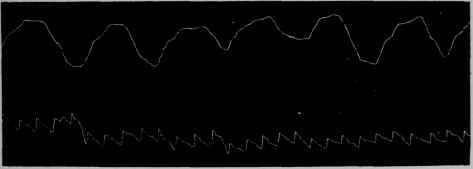
Fig. 1.
It would thus appear that the principal Italian investigators are fairly in accord as to the phenomena of hypnosis, only that Morselli denies the possibility of Charcot's stages occurring spontaneously, while Tamburini asserts that he has seen them so occur in exceptional cases. I have not yet come across a case in which Charcot's stages have been producible, but I believe that such cases exist. Morselli's experiments are so full and graphic that I reproduce them as being thoroughly illustrative of the effect suggestion in the hypnotic state has upon the heart and respiration. My own experiments, as far as they have gone, are thoroughly corroborative of them.
Continue to:


My Books

