


Natural Analogies Of Hypnosis. Part 9
Description
This section is from the book "Treatment By Hypnotism And Suggestion Or Psycho-Therapeutics", by Charles Lloyd Tuckey. Also available from Amazon: Treatment By Hypnotism And Suggestion, Or Psycho-Therapeutics.
Natural Analogies Of Hypnosis. Part 9
The subject of these experiments was a healthy young girl presenting no signs of hysteria, unacted upon by magnets, and not susceptible to Charcot's stages. She was always hypnotized by Professor Morselli or Dr. Tanzi by suggestion alone. From the first she fell into a state of profound trance, and was extremely susceptible to suggestion. The respiration was measured with Marey's pneumograph, and the pulse with Mosso's aerosphyg-mograph.
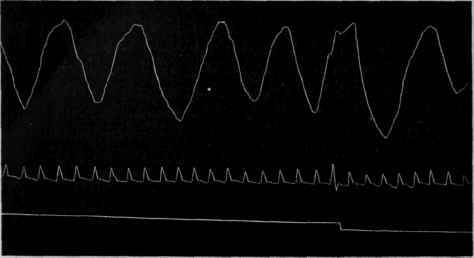
Fig. 2.
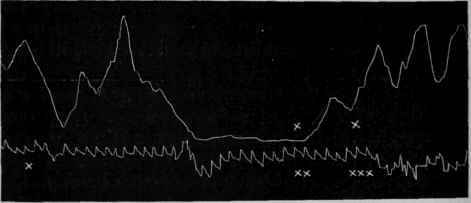
Fig. 3.
Fig. 1 shows the tracings taken when the subject was awake and in her normal state. They show how the ordinary ' life of relation,' thoughts, ideas, and impressions, influence the rhythm and regularity of the functions.
Fig. 2 shows the tracings taken when the patient is lying tranquil and in a state of deep trance, unacted upon by the environment, and in a state of complete psychical repose.
In .Fig. 3 the subject is told that she is to lift an imaginary weight. At X she raises it, and at x x she is told to put it down. The effect in the tracing is the same as if a real weight were being borne. There is the muscular contraction and preparation for the effort, followed by relaxation. This supports the theory that the idea is attended by motor accompaniments.
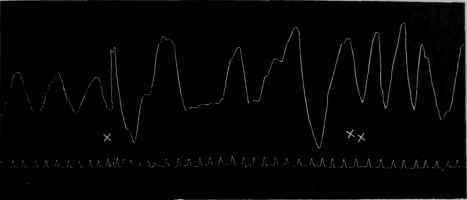
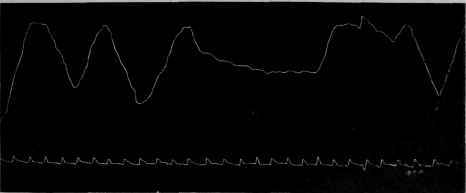
Fig. 5.
Fig. 4 represents the tracings taken when an attack of hiccough was induced by suggestion.
Fig. 5 represents the tracings taken when suggestions had been made leading up to a state of stupor, which the experimenters found a close reproduction of those observed in the idiopathic condition.
It is plain that the only characteristic symptoms of hypnosis in this case were slight increase in volume of the pulse and marked equalization of the respiratory curves. In fact, they are just what we should expect to find in a condition of absolute psychological repose. On the other hand, Charcot, Gilles de la Tourette, Tamburini, and others, as we have seen, describe marked changes in the phenomena of the circulatory and respiratory functions in the different stages of le grande hypnotisme.
Morselli found that by suggesting the symptoms he almost invariably and immediately produced the respiratory curves and pulse tracings belonging to that condition, and he was even able to obtain the characteristic tracings of melancholia, mania, and other mental disorders.*
Preyer says that the rapidity of the pulse increases in some persons and diminishes in others, and directs that great care be taken to avoid error in gauging the blood-pressure. He finds that the pulse-rate frequently falls at first, but on the induction of catalepsy it becomes greatly quickened, and the radial artery is so compressed by muscular constriction that the pulse in it can hardly be felt. He also notices that the capillaries of the face are often very full during hypnosis, though sometimes there is pallor, or alternate pallor and flushing; but he thinks we should be wrong to infer from this that either anaemia or hyperaemia of the brain is necessarily present. Preyer finds that persons who have naturally very dry skins readily perspire in the hypnotic state, and that the head is especially affected in this way. I have very frequently been able to induce perspiration by suggestion in persons who were in only the lighter grades of hypnosis.
Preyer found that after long hypnotic trance the chlorides and phosphates were greatly diminished; but the subject experimented on was markedly hysterical.
* 'Contributo sperimentale alla Fisiopsicologia dell' Ipnotismo.' Morsellii e Tanzi. Milan, 1889.
It is but natural, however, to suppose that prolonged inactivity of the muscles and of psychical functions would be accompanied by greatly diminished waste and metabolism of tissue. Liebeault considers that hypnotic lethargy is a state similar to that assumed by hibernating animals, and he conceives it possible that organic life might be preserved for a very long period if the subject were kept warm and absolutely removed from sensory stimuli. He supposes that respiration would fall to eight, the pulse to thirty, and the excretion of urinary products to something very small. In the case referred to by Dr. Voisin the patient was fed as usual, and, as has been seen, her excretions differed but little from the normal waking standard.
Continue to:


My Books

