


Butea Frondosa, Roxb. Sans
Description
This section is from the book "The Materia Medica Of The Hindus", by Udoy Chand Dutt. Also available from Amazon: The Materia Medica Of The Hindus.
Butea Frondosa, Roxb. Sans

Palάsa.

Kinsuka. Vern, Dhak. Hind.
Dr. Hooker states "that when in full flower the Dhάk tree is a gorgeous sight; the masses of flowers resembling sheets of flame, their bright orange red petals contrasting brilliantly against the jet black velvety calyx." These beautiful flowers were used as ear-ornaments by the ancient Hindu women and much admired by the poets. The seeds of Butea frondosa are said to be laxative and anthelmintic and are used, both alone and in combination with other medicines, for expelling intestinal worms. Thus the fresh juice of the seeds, or the seeds beaten to a paste are given with honey.2 Sarangadhara gives the following recipe for worms.
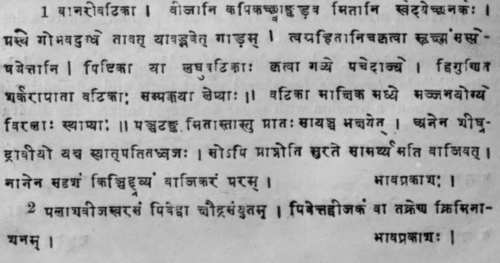
Take of the seeds of Butea frondosa, root of Ipomoea Turpethum (trivrit), seeds of Hyoscyamus niger (parasika yamani), kamala powder, baberang seeds and treacle, equal parts, boat them together into a paste with water and administer with butter-milk.1
The gum of Butea frondosa, now used as a substitute for kino, was employed by the ancient Hindus, externally only, as for example in the following. Take of red sandal wood one part, rock salt two parts, chebulic myrobalans three parts, and the gum of Butea frondosa four parts, powder and mix. This powder is recommended to be applied to pterygium and opacities on the cornea.2
The alkaline ashes of this plant are used in the preparation of caustic pastes, and diuretic medicines, along with others of their class.
Continue to:


My Books

